Loading…


Loading…
Loading…
Loading…
Eduqas GCSE Religious Studies · C120
Eduqas C120 Check the specification (PDF) (opens in a new tab)
Your body changes as you grow, and your thoughts and feelings change too. Hindu teachings about atman distinguish these changes from the enduring self. Atman is the eternal, non-material self: it is not the body, nor is it the mind. In this understanding, a person is fundamentally the self living within a body, rather than a body that happens to possess a soul.
The Bhagavad Gita presents Krishna teaching Arjuna. In 2.12, Krishna declares: “Never was there a time when I did not exist, nor you … nor in the future shall any of us cease to be.” This supports belief that the self exists beyond the beginning and end of its present bodily life. In 2.17, “That which pervades the entire body is indestructible.” Consciousness throughout the body is understood as a sign of the soul's presence, although the soul itself is not material.
A useful comparison is a driver and a vehicle. The driver uses the vehicle but is not the vehicle; similarly, atman inhabits the body without being identical to it. Describing atman as trapped in matter means that the eternal self is bound to temporary bodily existence. Identification with the body and attachment to its pleasures can keep a person preoccupied with changing happiness and distress, rather than recognising their spiritual nature.
Hindus share many beliefs about the eternal self, but disagree about its relationship with Brahman, ultimate spiritual reality.
Advaita Vedanta is non-dual: atman and Brahman are ultimately identical. The sense that the self exists independently of Brahman is a mistaken understanding. Liberation involves recognising this underlying identity, not turning a previously material self into something spiritual. A drop of water merging into the ocean helps represent the disappearance of a separate sense of identity.
Dvaita Vedanta is dualist: the individual self and God remain eternally distinct. The self is spiritual, but that does not make it identical with God. Liberation therefore does not erase the self's individuality. Unity with God means loving service and unity of purpose, rather than being the same being. A green bird entering a green tree provides a contrasting picture: the bird may appear to merge with its surroundings, but remains distinct.
These views lead to different accounts of liberation. For Advaita, the central distinction is between mistaken separateness and realised identity; for Dvaita, it is between material bondage and a liberated relationship with God.
Because atman is eternal, death is understood as the end of a particular body, not the destruction of the self. Reincarnation is the same self entering another body. Samsara is the continuing cycle of birth, death and rebirth.
Bhagavad Gita 2.22 compares changing bodies with replacing worn-out clothes. Clothing changes while the wearer remains; similarly, the body changes while the self continues. 2.13 connects this with familiar changes within one lifetime: the embodied soul passes through childhood, youth and old age, and then passes into another body at death.
Karma means action and reaction, or action and its consequences. A person's actions influence their future circumstances and rebirth. The clothes comparison can be extended: what someone wears depends on both what they want and what they can afford; the next body is understood to reflect both desires and karma. Karma is therefore not simply luck, and rebirth is not necessarily into another human body.
The mind also matters. Bhagavad Gita 8.6 teaches that the state remembered at death influences the state attained afterwards. Within this account, the self travels with a subtle body, consisting largely of the mind, while leaving the physical body behind. This does not make the mind identical with atman: it is another material covering of the self.
Bhagavad Gita 15.9 describes the living being receiving a particular set of senses, grouped around the mind, in a new body. The new body therefore shapes how the continuing self experiences the world. These passages explain rebirth; they do not mean that every death brings liberation.
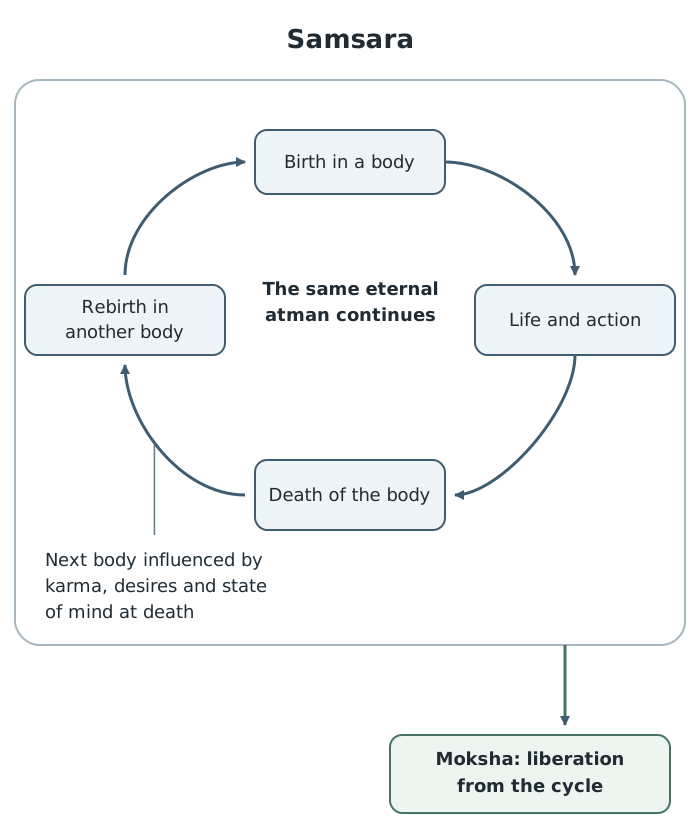
The self continues through changing bodies in samsara. Moksha means freedom from the cycle, rather than another rebirth within it.
Most Hindu traditions regard moksha, liberation from samsara, as the ultimate goal of life. Samsara involves repeated birth, disease, old age and death. Even a pleasant lifetime is temporary, so a favourable rebirth is not the same as lasting freedom.
Spiritual discipline aims to overcome the attachments that bind the self to material existence. Self-knowledge, meditation and selfless duty can help a person recognise their spiritual nature. In traditions emphasising a personal God, surrender, loving service and God's grace are important; liberation is not necessarily understood as something achieved by effort alone.
Bhagavad Gita 2.15 describes a person who remains steady in happiness and distress as “eligible for liberation”. This steadiness shows freedom from being controlled by temporary bodily experiences. It does not mean ignoring other people's suffering.
Both Advaita and Dvaita understand moksha as freedom from material bondage, but their explanations differ: Advaita stresses realising identity with Brahman, while Dvaita maintains an eternal individual self in a liberated relationship with God.
Get unlimited access to all revision notes, key terms, and exam tips.
Get unlimited access to all revision notes, key terms, and exam tips.
Distinguish reincarnation, which is rebirth into another body, from samsara, which is the continuing cycle of birth and death.
Do not say that all Hindus believe atman and Brahman are identical. Explain the difference between Advaita Vedanta and Dvaita Vedanta.
Link scriptural references to the belief they support: for example, Bhagavad Gita 2.17 supports the indestructibility of the self.
Moksha is liberation from rebirth, not simply a better next life. Bhagavad Gita 2.15 describes someone as eligible for liberation, rather than guaranteeing it through calmness alone.
Atman
The eternal, non-material self, distinct from the changing body and mind.
Brahman
The ultimate spiritual reality. Hindu traditions differ over whether the individual self is identical with or eternally distinct from Brahman.
Advaita Vedanta
A non-dual Hindu philosophy teaching that atman and Brahman are ultimately identical.
Dvaita Vedanta
A dualist Hindu philosophy teaching that the individual self and God remain eternally distinct.
Karma
Action and its consequences: actions influence a person's future experiences and rebirth.
Samsara
The continuing cycle of birth, death and rebirth.
Reincarnation
The rebirth of the same eternal self into another body after death.
Moksha
Liberation from samsara, the cycle of birth, death and rebirth.
Put your knowledge into practice — try past paper questions for Religious Studies
Atman
The eternal, non-material self, distinct from the changing body and mind.
Brahman
The ultimate spiritual reality. Hindu traditions differ over whether the individual self is identical with or eternally distinct from Brahman.
Advaita Vedanta
A non-dual Hindu philosophy teaching that atman and Brahman are ultimately identical.
Dvaita Vedanta
A dualist Hindu philosophy teaching that the individual self and God remain eternally distinct.
Karma
Action and its consequences: actions influence a person's future experiences and rebirth.
Samsara
The continuing cycle of birth, death and rebirth.
Reincarnation
The rebirth of the same eternal self into another body after death.
Moksha
Liberation from samsara, the cycle of birth, death and rebirth.