

Loading…
Loading…
Loading…
Eduqas GCSE History · C100
Eduqas C100 Check the specification (PDF) (opens in a new tab)
For much of the medieval period, a holiday meant a holy day, rather than a journey away from home. Religious observances provided occasions when communities could gather and take a break from their ordinary routines. Holy days began with long, solemn ceremonies, so worship and leisure were closely connected.
The calendar of celebrations also reflected the agricultural year. Older pagan festivals had marked seasonal events such as planting and harvest; medieval celebrations combined Christian religious observance with traditions rooted in this farming calendar. This mattered because most people’s working lives depended on agriculture, not on a fixed allowance of annual leave.
The monk Bede, writing The Reckoning of Time in 725, recorded Anglo-Saxon festivals. These included Mother’s Night, a winter celebration marking the beginning of the Anglo-Saxon year, and an April festival associated with Eostre, spring and new life. September, or Holy Month, celebrated the harvest. November, or Blood Month, involved animal sacrifices as offerings to pagan gods and provided food for winter. These celebrations connected belief, the seasons and the practical needs of farming communities.
The grandest medieval celebrations stretched from Christmas Eve to Twelfth Day, 6 January. The lord of the manor gave servants gifts of food, drink and clothing. Houses were decorated with holly and ivy, Yule logs were burned, and gifts were exchanged on New Year’s Day. Celebrations offered both enjoyment and a way of maintaining relationships between households, servants and their lord.
After Epiphany, Plough Monday marked the return to cultivation. Villagers held plough races, while youths went from house to house asking for money, food and drink. Refusal could result in the ground outside a house being ploughed up. Work and leisure were therefore not entirely separate: even festivities could mark the beginning of agricultural tasks.
At Easter, villagers gave eggs to the lord, who provided a dinner in return. People decorated their homes with wild flowers in the hope of a fertile and prosperous season. Like Christmas, Easter combined religious celebration, gift-giving and communal eating.
The fortnight-long Christmas break continued into Tudor times. Most work stopped, although animals still needed tending. Spinning stopped too, and flowers were placed around spinning wheels. People used the break to visit friends. Holidays were mainly communal occasions at home, rather than annual trips to a distant destination.
In the seventeenth century, Puritans in Parliament sought to suppress Christmas celebrations and other saints’ days and holy days. They objected to excessive drinking and lack of restraint. They also regarded Christmas, or ‘Christ’s Mass’, as a survival of Roman Catholic worship without a biblical basis. These were Puritan objections, not beliefs shared by everyone.
This shows how political and religious authority could restrict leisure as well as encourage it. Customs that some people valued as opportunities for celebration were condemned by others as improper worship or behaviour.
Charitable giving was another part of the Christmas season. Wealthier households distributed boxes of money to servants, and churches opened collection boxes for the needy on the day after Christmas. Such practices became associated with Boxing Day.
A pilgrimage was a journey to a sacred place. Pilgrims travelled to demonstrate devotion, seek supernatural help or perform penance for sin. Unlike a modern seaside holiday, its central purpose was religious, although it also took travellers away from their usual surroundings.
Important destinations included Walsingham, Lindisfarne and Canterbury. At Canterbury, pilgrims visited the tomb of Saint Thomas Becket. Geoffrey Chaucer’s Canterbury Tales, written at the end of the fourteenth century, portrays pilgrims travelling there and telling stories. It illustrates how a religious journey could also involve companionship and worldly interests, although it is a literary work rather than a record of every pilgrim’s experience.
A pilgrimage abroad could take up to a year. Guidebooks offered advice, while souvenirs and art objects bought by travellers helped spread artistic styles between countries. Religious travel therefore supported businesses and cultural exchange long before modern mass tourism.
Religion could encourage travel, but religious change could also restrict it. Henry VIII’s closure of the monasteries devastated the pilgrimage industry. This weakened an important reason for travel in the early modern period.
Wealth remained a major dividing line. Rich people could afford journeys, whereas most poor people remained closely tied to their villages. For poorer people, travelling was more likely to be a necessity, such as searching for work, than a leisure choice. The existence of travellers does not mean that holidays away from home were available to everyone.
Between 1660 and 1820, the Grand Tour was regarded as a way to complete a wealthy gentleman’s education. It was particularly associated with young men who had already attended school and university and studied Greek and Latin.
Tourists left England for continental Europe to visit Renaissance towns and cities and sites associated with ancient Greek and Roman civilisation. Seeing art, architecture and historic places was intended to deepen the education they had received at home. The Tour therefore combined travel with cultural learning and social status.
A tutor or supervisor, nicknamed a ‘bear leader’, usually accompanied the young traveller. Often a schoolmaster or aspiring academic, he managed finances and tried to keep his charge out of trouble. Some tourists returned with paintings and sculptures for their homes; others devoted time to drinking, gambling and sexual relationships. Educational aims did not always determine how the journey was actually spent.
The production of guidebooks helped develop services for tourists. However, the Grand Tour remained an elite experience: it required money, considerable time and freedom from everyday work. Its tradition continued until the growth of large-scale rail and sea travel from the mid-nineteenth century changed the possibilities for tourism.
Before the railways, stagecoaches connected major towns. Improvements in roads made these journeys quicker and more comfortable, but leisure travel was still particularly associated with the wealthy.
In the eighteenth century, rich visitors went to Bath, Malvern and Harrogate to ‘take the waters’. They believed that the mineral waters had healing powers. Visitors supported lodging houses, coffee houses and shops, helping these spa towns prosper.
Towards the end of the eighteenth century, wealthy visitors increasingly went to the coast because they believed bathing in seawater had medicinal benefits. Brighton and Eastbourne flourished. Seaside tourism therefore existed before the railways: rail transport expanded its accessibility rather than creating it from nothing.
Railway expansion after the 1840s transformed the speed of travel and opened journeys to more ordinary people. A shorter journey made a day trip practical and left more of a longer visit available for leisure rather than travelling.
The change can be seen in journeys from London. Travelling to Edinburgh took 43 hours by coach in 1836, compared with 12 hours by train in 1850. The journey to Bournemouth took 18 hours by coach in 1836, compared with five hours by train in 1870. These were substantial reductions, not simply small improvements in comfort.
As more visitors arrived, resorts needed accommodation, shops and attractions. Tourism helped seaside towns grow and supported employment there. Bournemouth’s railway arrived in 1870; its population increased from 13,160 in 1871 to 18,725 in 1881.
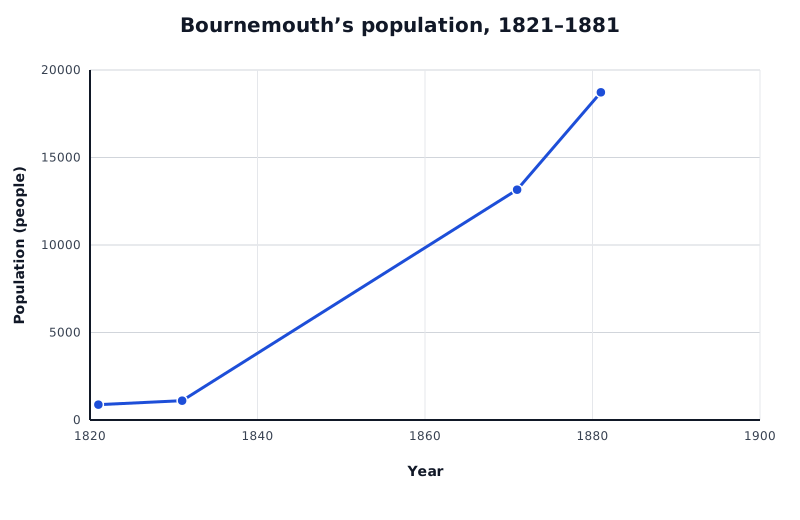
Bournemouth grew before and after the railway arrived in 1870. These population figures show growth, but do not isolate the railway’s contribution.
Data for Bournemouth’s population, 1821–1881
| Series | Year | Population (people) |
|---|---|---|
| Bournemouth population | 1821 | 877 |
| Bournemouth population | 1831 | 1104 |
| Bournemouth population | 1871 | 13160 |
| Bournemouth population | 1881 | 18725 |
The graph also shows that Bournemouth had grown considerably before 1870. Railway access helped its development, but the population figures alone cannot establish that railways caused all of its growth.
Southport, about 20 miles north of Liverpool, gained a rail connection in 1848. Its population rose from 5,000 in 1851 to 48,000 in 1901, illustrating the scale of growth that could accompany improved access to the coast. Blackpool became a leading working-class resort, especially important for its visitors and attractions.
By 1911, seaside visits were no longer confined to a wealthy minority: figures recorded for England showed 55% of people visiting seaside resorts on day trips and 20% taking longer holidays requiring accommodation. The important change was both in how people travelled and in who could participate.
Transport alone could not create a holiday. People also needed time away from work. Industrialisation reduced the seasonal breaks associated with farming, and most workers had Sundays off together with Good Friday and Christmas Day. Regular industrial work could therefore restrict leisure even as new transport made travel easier.
Sir John Lubbock, MP for Maidstone and a former banker, introduced the measure that became the Bank Holiday Act of 1871. He wanted to ease pressure on workers by establishing additional holidays. In England and Wales, the Act designated Easter Monday, Whit Monday, the first Monday in August and Boxing Day. Good Friday and Christmas Day were already recognised holidays.
The name ‘bank holiday’ reflected the closure of banks, which interrupted business and gave the holidays greater recognition. Shared days off created opportunities for excursions and leisure activities, complementing the growing railway network.
The distinction between time off and paid time off is important. A recognised holiday did not, by itself, solve the problem of losing earnings or finding money for travel and accommodation. To explain the widening availability of holidays, transport, leisure time and affordability must be considered together.
For a low-paid worker, an unpaid break could mean losing money needed for food and rent. Holiday pay allowed workers to take leave without sacrificing their usual earnings. It did not make travel free, but removed an important financial obstacle to taking a holiday.
As real wages rose in the later nineteenth century, friendly societies and holiday clubs helped workers save towards trips. In northern England, wakes weeks developed from religious celebrations into secular breaks when factories, mills and collieries closed for maintenance. These holidays were initially unpaid. Lancashire towns took different weeks between June and September, providing resorts such as Blackpool and Southport with a summer season of visitors.
Paid holidays developed partly through agreements between employers and workers. The Trades Union Congress (TUC) began campaigning for paid holidays for all workers in 1911, and some businesses extended paid leave after the First World War. In the parliamentary debate of July 1938, the government reported that about three million manual workers already received paid holidays through collective agreements, alongside others receiving them through different arrangements. Paid leave therefore existed before the 1938 legislation, but access was uneven.
The Holidays with Pay Act of 1938 enabled particular wage-regulating authorities to provide paid holidays. These included trade boards, agricultural wages committees and the Road Haulage Central Wages Board. The measure potentially affected just over two million workers. It also allowed the Minister of Labour to assist voluntary paid-holiday schemes.
This was an important step towards wider access, not an immediate universal entitlement. In the debate, Lord Templemore presented it as progress towards paid holidays for all workers. The Earl of Listowel welcomed the reform but criticised its limited coverage, including the omission of special provision for domestic servants. He argued that millions would still lack a right to paid leave.
By the 1950s, many workers received two weeks of paid holiday through collective bargaining. In 1998, the Labour government implemented the Working Time Regulations, establishing an entitlement to four weeks of paid annual leave for workers. Paid leave increasingly made longer holidays possible, although families still needed money for travel and accommodation.
The significance of holiday pay was therefore both economic and social: more workers could consider a holiday without losing wages, but opportunities still depended on their employment arrangements and ability to pay for the trip itself.
Camping became popular in the late nineteenth century. After the First World War, basic ‘pioneer camps’ offered accommodation with a hands-on approach. During the inter-war years, camping appealed to a growing interest in healthy outdoor living. Gradually, chalets and communal buildings for meals and entertainment replaced tents at some sites, creating the holiday camp.
Billy Butlin opened his first camp at Skegness in 1936. Butlin’s promoted the idea of ‘a week’s holiday for a week’s pay’, linking organised holidays to the widening availability of paid leave. A summer week was advertised at £2 12s 6d for an adult and £1 6s 3d for a child. A stated price helped families judge the cost, although affordability still depended on their earnings and circumstances.
The attraction was the combination of services on one site. Butlin’s offered family chalets, swimming pools, funfairs, shows, ballroom dancing, childcare and sporting activities, as well as shops and hairdressing facilities. Redcoats organised entertainment and competitions, including talent contests and ‘Knobbly Knees’ competitions.
This differed from a holiday based mainly on finding lodgings and arranging activities independently. Families could stay together while choosing from organised entertainment for different ages. Communal facilities also offered activities when the weather made outdoor recreation less appealing. Holiday camps helped turn a break away into an organised family leisure experience.
Butlin’s expanded to nine locations by the mid-1960s, including Minehead, Filey and Bognor Regis. Camps therefore became a major part of the mid-twentieth-century family holiday, rather than remaining a single pioneering experiment.
After the Second World War, seaside resorts, boarding houses, holiday camps and caravan parks attracted growing numbers of visitors. Beaches cleared of wartime landmines became available again. This expansion helped develop mass tourism: holidays serving large numbers of people rather than a small wealthy elite.
Nevertheless, an annual holiday away was not yet a regular part of every family’s life. Many poorer people could afford only day trips, which avoided the expense of overnight accommodation. Destinations included the seaside, historic places and local beauty spots. Fruit picking in the countryside also offered a change from the routine of work. These shorter outings widened leisure opportunities even for people unable to afford a week at a resort or camp.
Growing car ownership gave families more freedom to choose destinations and travel times. Britain had 2.3 million cars in 1950, rising to 5.5 million by 1960. Cars made countryside outings easier and encouraged caravanning, because families could tow their accommodation and move between places rather than rely on resort lodgings.
During the 1960s, caravan parks improved their facilities with toilets, showers and clubhouses. Caravanning thus combined independent travel with more comfortable accommodation. Its growth was not uninterrupted: in the 1970s, VAT on touring caravans and motorhomes, together with the 1973 oil crisis, contributed to falling sales by making this form of holiday more expensive.
A national park is a designated area of countryside managed to conserve its landscape and support public enjoyment. Its importance to holiday patterns was that recreation could centre on the countryside itself, not just seaside entertainment.
During the 1930s, conservationists pressed the government for measures to improve countryside access. After the Second World War, the Labour government prepared national parks legislation as part of its post-war recovery programme. In 1951, the Peak District became Britain’s first national park.
Other parks established during the 1950s included the Lake District, Snowdonia, Dartmoor, Pembrokeshire Coast, North York Moors, Yorkshire Dales, Exmoor, Northumberland and Brecon Beacons. These areas supported rural tourism through activities such as hiking, pony-trekking and canoeing.
National parks widened the choice of places for both longer holidays and day trips. Rising car ownership helped families reach countryside destinations, while opportunities for outdoor recreation gave them reasons to visit. Visitors also supported local businesses. Government action and changing transport therefore worked together to expand leisure beyond traditional seaside resorts.
The changes associated with holiday patterns after 1970 had begun during the 1960s. Air travel became more affordable, and holidays to the Mediterranean grew in popularity. From the mid-1960s, stretches of southern Europe developed accommodation and services for mass tourism.
Travel agents sold package holidays, combining flights and accommodation in one price. Instead of organising each part separately, a family could buy a complete arrangement. This made overseas holidays easier to organise, while cheaper flights brought them within reach of more households.
Speed mattered too. Jets travelling at around 550 miles per hour could reach some destinations in about two hours. A foreign holiday no longer necessarily required a long journey that consumed much of the available leave. Affordable air travel, convenient packages and more paid holiday time together challenged the traditional week or fortnight at a British seaside resort.
Freddie Laker’s Skytrain offered low-cost flights to the USA, helping challenge expensive air fares. Laker Airways collapsed in 1982, so its commercial success was limited, but it helped demonstrate the possibilities of lower-cost flying. Overseas travel was no longer solely the preserve of the wealthy Grand Tourist.
Competition from foreign package holidays put pressure on British seaside resorts by the end of the twentieth century. Skegness struggled to maintain visitor levels, while Blackpool remained popular but faced a decline in the traditional longer-stay seaside holiday. A resort could still attract visitors while losing overnight bookings and the income associated with them.
Blackpool shows how several changes worked together. Rising car ownership and caravanning gave families alternatives to staying in seaside guest houses. The M55 motorway made it easier to visit Blackpool and return home the same day, reducing the need for overnight accommodation. Self-catering holidays, in which visitors arranged their own meals, also competed with the traditional bed-and-breakfast holiday.
Holiday camps created further competition for the town’s lodging and entertainment businesses. Butlin’s in 1955 and Pontin’s in 1961 offered accommodation and organised activities together. Theme parks provided other attractive destinations, while budget flights and foreign package holidays competed for families’ main summer holiday.
Blackpool’s image also mattered. Some people perceived it as ‘tacky’, or associated it with noisy stag and hen parties rather than a family holiday. Some attractions became faded and dated, and insufficient municipal and commercial investment made it harder to compete with newer facilities. These were perceptions and weaknesses affecting its appeal, not proof that everyone disliked the resort.
British tourism did not simply surrender to overseas competition. Some resorts developed indoor leisure complexes with beaches, slides, wave machines and warm temperatures. These facilities reduced dependence on good weather and offered families more activities within one destination.
Theme parks such as Thorpe Park in Surrey, Alton Towers in Staffordshire and Flamingo Land in Yorkshire expanded the choice of domestic leisure trips. Although they competed with traditional resorts, they also show how British tourism adapted to changing demand.
Countryside recreation continued to grow through country parks and nature trails established by local authorities. Center Parcs offered a more upmarket version of the holiday camp, combining accommodation with indoor and outdoor activities in woodland surroundings. British holidays therefore diversified: the alternatives were not simply a traditional seaside stay or a flight abroad.
Across these developments, the meaning of a holiday widened. Medieval holy days mainly offered communal celebration within a religious and agricultural calendar. The Grand Tour made extended cultural travel a mark of elite education. Railways brought seaside trips within reach of more ordinary people, while bank holidays and paid leave increased the opportunity to go.
In the mid-twentieth century, camps, cars and national parks widened the choice of holidays and outings, although poorer families often remained limited to day trips. Later, package holidays and affordable air travel increased overseas competition, while British tourism responded with new facilities and different kinds of destination.
No single development was sufficient on its own. Transport made destinations accessible; time off made a visit possible; income and holiday pay helped make it affordable; resorts and camps supplied places to stay and things to do. Changes in these same factors could also weaken established resorts. Their combined effect explains both the growth of holiday participation and the changing fortunes of particular destinations.
Explain how a development changed holidays: faster transport made short trips practical, while more time off made longer stays possible.
Distinguish a recognised bank holiday from paid annual leave. Time away from work and money to afford a holiday are separate factors.
Use dated examples to support comparisons, such as the Grand Tour of 1660–1820 and railway expansion after the 1840s.
Do not assume that resort population growth was caused entirely by the railways: Bournemouth was already growing before its railway arrived in 1870.
Do not claim that the Holidays with Pay Act of 1938 immediately guaranteed paid holidays to all workers. It enabled particular wage-regulating authorities to provide them.
Attribute opposition to Christmas celebrations to Puritans in Parliament, rather than claiming that Oliver Cromwell personally banned Christmas.
For resort decline, connect each cause to its effect: the M55 made day trips easier, reducing the need to pay for overnight accommodation. Declining overnight stays did not mean that all visitors stopped coming.
It can see this note and what your specification asks for.
Answers are free with an account.
1 free note left this week
Get more free notesYour answer sets when this note comes back for review, or marks it complete.
Was this note helpful?
Log in to tell us whether it helped, or to report a problem.
Last updated
Holy day
A day set aside for religious observance, which could also provide a break from ordinary work and an opportunity for celebration.
Feast day
A religious festival celebrated by a community, often combining worship with festivities.
Pilgrimage
A journey to a place considered sacred, made for religious reasons.
Puritan
A Protestant who sought further reform of religious worship and objected to practices considered unbiblical or associated with Roman Catholicism.
Grand Tour
An extended journey around continental Europe undertaken mainly by wealthy young men to complete their education, especially between 1660 and 1820.
Spa town
A town visited for its mineral springs, whose waters were believed to have healing properties.
Seaside resort
A coastal town developed to provide accommodation, entertainment and other services for visitors.
Bank holiday
A legally designated holiday on which banks close. Recognition as a bank holiday is distinct from a worker’s entitlement to paid leave.
Holiday pay
Payment received during time off work for a holiday, allowing workers to take leave without losing their usual earnings.
Collective agreement
An agreement negotiated between employers and representatives of workers, such as trade unions, about pay or working conditions.
Holiday camp
A holiday centre providing accommodation, meals and organised entertainment or activities on one site.
National park
A designated area of countryside managed to conserve its landscape and support public enjoyment and recreation.
Day trip
A leisure visit that involves travelling away from home and returning on the same day, without an overnight stay.
Mass tourism
Tourism involving large numbers of holidaymakers, supported by transport, accommodation and attractions serving a broad market.
Package holiday
A holiday sold for a combined price covering travel and accommodation, rather than requiring the customer to arrange each separately.
Self-catering holiday
A holiday in accommodation where visitors arrange their own meals rather than having meals provided.
Put your knowledge into practice — try past paper questions for History
Holy day
A day set aside for religious observance, which could also provide a break from ordinary work and an opportunity for celebration.
Feast day
A religious festival celebrated by a community, often combining worship with festivities.
Pilgrimage
A journey to a place considered sacred, made for religious reasons.
Puritan
A Protestant who sought further reform of religious worship and objected to practices considered unbiblical or associated with Roman Catholicism.
Grand Tour
An extended journey around continental Europe undertaken mainly by wealthy young men to complete their education, especially between 1660 and 1820.
Spa town
A town visited for its mineral springs, whose waters were believed to have healing properties.
Seaside resort
A coastal town developed to provide accommodation, entertainment and other services for visitors.
Bank holiday
A legally designated holiday on which banks close. Recognition as a bank holiday is distinct from a worker’s entitlement to paid leave.
Holiday pay
Payment received during time off work for a holiday, allowing workers to take leave without losing their usual earnings.
Collective agreement
An agreement negotiated between employers and representatives of workers, such as trade unions, about pay or working conditions.
Holiday camp
A holiday centre providing accommodation, meals and organised entertainment or activities on one site.
National park
A designated area of countryside managed to conserve its landscape and support public enjoyment and recreation.
Day trip
A leisure visit that involves travelling away from home and returning on the same day, without an overnight stay.
Mass tourism
Tourism involving large numbers of holidaymakers, supported by transport, accommodation and attractions serving a broad market.
Package holiday
A holiday sold for a combined price covering travel and accommodation, rather than requiring the customer to arrange each separately.
Self-catering holiday
A holiday in accommodation where visitors arrange their own meals rather than having meals provided.