

Loading…
Loading…
Loading…
Eduqas GCSE History · C100
Eduqas C100 Check the specification (PDF) (opens in a new tab)
Britain emerged from the Second World War facing damaged cities, housing shortages and financial difficulties. Rationing continued after victory: peace did not immediately bring prosperity. Many people nevertheless expected the government to build a fairer society after the sacrifices of war.
Clement Attlee’s Labour Party won a landslide victory in July 1945. Its programme drew on William Beveridge’s report of 1942, which identified five ‘giants’: want meant poverty; disease, ill health; ignorance, inadequate education; squalor, poor living conditions; and idleness, unemployment. Beveridge proposed a welfare state providing protection ‘from the cradle to the grave’.
Labour extended this protection through measures such as the National Insurance Act of 1946, which provided a system of contributions and benefits. Its wider programme connected health, education and economic reconstruction: healthier, better-educated people would have greater opportunities, while jobs and public services would make families more secure.
Before the NHS, access to medical care depended partly on what people could afford. The new service aimed to remove this financial barrier, making treatment available to everyone rather than only to those able to pay.
Aneurin Bevan, Labour’s Minister of Health, took responsibility for creating the NHS. He faced opposition from doctors and others in the medical profession who wanted to retain private practice. Establishing a national service therefore involved overcoming resistance as well as passing legislation. The National Health Service Act was passed in 1946, and the NHS began operating on 5 July 1948.
At its launch, the service provided access to doctors, hospitals, dentists, opticians, ambulances, midwives and health visitors free of charge. A family could seek medical help without having to meet a treatment bill; maternity services and hospital care became available regardless of income.
Demand revealed how much need had previously gone unmet. More than five million pairs of spectacles were issued in the first year. This was a practical improvement: people who had struggled with poor eyesight could obtain help with reading, work and everyday tasks. Access to treatment widened, while infectious diseases such as tuberculosis declined. These health improvements also reflected wider changes in living conditions, so they should not be attributed to the NHS alone.
Universal provision was expensive. The NHS cost more than £500 million in its first year, and the initial £2 million allocation for spectacles was spent within weeks. In 1951, Labour introduced charges for dentures and spectacles to contain costs. Bevan resigned in opposition. This exposed a lasting tension: the NHS greatly widened access, but governments had to decide how to fund growing demand.
Nationalisation transferred industries from private owners to the state. Wartime government control had already shown that major industries could be organised nationally. Labour wanted to modernise essential industries, increase efficiency and improve services and working conditions rather than leave decisions entirely to private profit.
Coal and electricity were nationalised in 1947; railways and gas followed in 1948. Legislation to nationalise iron and steel followed in 1949. Former owners received compensation totalling about £2,700 million: nationalisation was not simply the seizure of their property without payment.
Supporters argued that essential services should serve the whole country. State ownership could support provision in less profitable areas, such as bringing electricity to more rural communities. Many workers also welcomed the prospect of employers placing greater emphasis on their welfare. Coal workers gained paid holidays and sickness pay, and coal output increased.
However, better conditions and public ownership did not automatically make every industry efficient. Critics argued that nationalisation was expensive and could protect declining industries. Conservatives objected to the concentration of control in central government, particularly over iron and steel. Its effects therefore need to be judged separately: it changed ownership and improved some workers’ lives, but its wider economic benefits remained contested.
The 1944 Education Act, passed before Labour took office, introduced free secondary education. Post-war governments put its reforms into practice. Education was organised into primary, secondary and further stages, and in 1947 the school-leaving age rose to fifteen, keeping children in education for longer.
At about eleven, pupils took the eleven-plus, which selected them for different secondary schools. Grammar schools concentrated on academic education; secondary modern schools provided a broader, less academic education; technical schools were intended to offer technical training. The principle was that school placement should depend on assessed ability rather than parents’ ability to pay.
This widened access, but the system did not offer equal opportunities. Grammar schools had better resources and stronger routes to university. Very few technical schools opened, so the promised three-way system was limited in practice. Many people regarded the eleven-plus as unfair because a test taken so young could strongly influence a child’s future.
The reforms therefore achieved two different things: secondary schooling became free and lasted longer, but selection continued to separate children into schools with unequal prospects.
Labour’s reforms did not immediately end austerity. It narrowly won the 1950 election, then lost to Winston Churchill’s Conservatives in October 1951. Rising costs, continuing rationing and divisions within Labour helped weaken its position. The Conservatives nevertheless largely retained the welfare state, so the change of government did not mean abandoning the NHS.
During the 1950s, expanding overseas trade and demand for British products supported employment. By 1952, manufacturing employed about 40% of the workforce. With jobs readily available, workers could move between employers, and businesses competed to attract staff with higher wages. Shorter working hours also gave people more leisure time.
As rationing ended during the early 1950s, households had greater freedom to buy goods. Conservative tax reductions, including income tax cuts under Chancellor R. A. Butler, allowed workers to keep more of their earnings. Government policy thus helped increase spending power, but prosperity also depended on employment, trade and production—not tax cuts alone.
The government relaxed hire-purchase controls in 1954. Families could obtain expensive goods and repay their cost gradually. By 1956, half of televisions were bought on hire purchase. This made goods accessible without years of saving, although it also committed households to future repayments.
Rising incomes and easier credit encouraged families to buy televisions, refrigerators, washing machines and cars. Goods once regarded as luxuries increasingly became ordinary expectations. The following figures show the scale of change:
| Year | Total private cars | TV licences issued | Private houses built |
|---|---|---|---|
| 1950 | 2,258,000 | 344,000 | 30,240 |
| 1955 | 3,526,000 | 4,504,000 | 116,093 |
| 1960 | 5,526,000 | 10,470,000 | 171,405 |
These columns measure different things: cars are a total stock, licences indicate television use, and houses built measure construction during the year. Together, their growth demonstrates increasing access to transport, home entertainment and private housing.
Consumer spending could reinforce prosperity. More purchases increased businesses’ sales, supporting jobs and wages. Businesses could also invest in new products and advertising, encouraging further purchases.
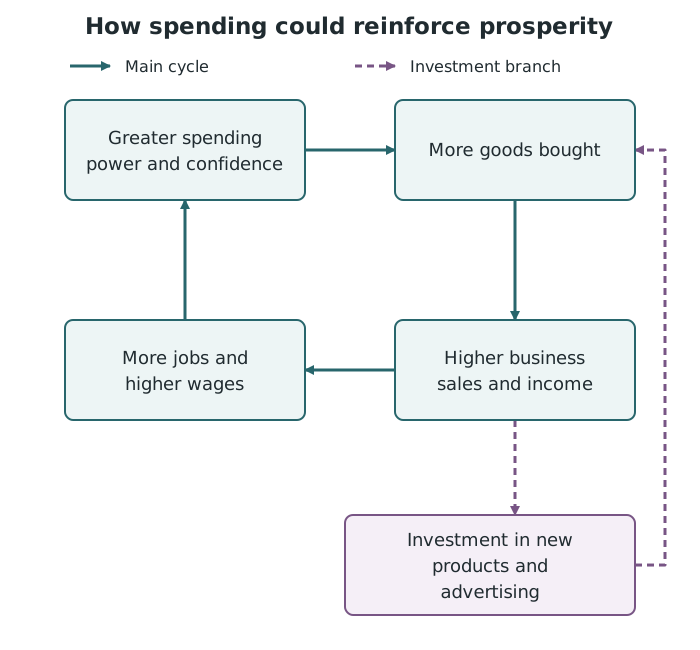
Spending, business activity and employment could reinforce one another during the growth of consumerism.
Advertising helped turn greater spending power into demand. Spending on advertising was four times greater in 1960 than in 1947. ‘Keeping up with the Joneses’ described the pressure to own what neighbours owned. Consumers also sought independent advice: Which?, founded in 1957, assessed advertising claims and value for money.
In a speech at Bedford on 20 July 1957, Conservative Prime Minister Harold Macmillan declared that ‘most of our people have never had it so good’. The qualification ‘most’ matters: he claimed widespread prosperity, not that hardship had disappeared. The Conservatives promoted this record in the 1959 election with the slogan ‘Life’s better with the Conservatives’.
By 1960, government policies had made healthcare and secondary education more accessible, changed ownership of essential industries and helped households spend more. Yet benefits were uneven: school selection restricted opportunities, some families remained poor, and public services required substantial funding. The strongest judgement is that Britain experienced major improvements in security and living standards, without achieving complete equality.
Greater security, wider access to services and higher living standards—but educational inequality, continuing hardship and financial costs remained.
Link a policy to a change in people’s lives: naming the NHS is not enough without explaining how it widened access to treatment.
Distinguish intentions from results. Nationalisation aimed to improve efficiency; improved working conditions do not by themselves prove that every industry became more efficient.
Keep evidence within 1945–60. Later growth in consumer ownership belongs to a different part of the story.
Distinguish an Act from implementation: the NHS Act was passed in 1946, but the service opened in 1948.
For a balanced judgement, weigh wider access and rising living standards against costs, educational inequality and continuing hardship.
It can see this note and what your specification asks for.
Answers are free with an account.
1 free note left this week
Get more free notesYour answer sets when this note comes back for review, or marks it complete.
Was this note helpful?
Log in to tell us whether it helped, or to report a problem.
Last updated
Welfare state
A system in which government takes responsibility for protecting people’s welfare through services and financial support, including healthcare, education and benefits.
Beveridge Report
William Beveridge’s 1942 report proposing measures to tackle want, disease, ignorance, squalor and idleness in Britain.
National Health Service
The publicly funded health service launched on 5 July 1948 to make medical care available to everyone, regardless of ability to pay.
Nationalisation
The transfer of an industry or business from private ownership to state ownership.
Eleven-plus
The examination taken at about age eleven to select pupils for different types of secondary school.
Austerity
Economic conditions marked by shortages, restricted consumption and efforts to limit spending, experienced in Britain after the Second World War.
Affluence
Having enough income and material wealth to enjoy a higher standard of living, including spending beyond basic necessities.
Full employment
A situation in which almost everyone seeking work can find a job; it does not mean that nobody is unemployed.
Hire purchase
An arrangement allowing a customer to obtain goods and pay for them in instalments rather than paying the whole price immediately.
Consumerism
An increasing emphasis on buying consumer goods, including non-essential goods, as part of everyday life.
Put your knowledge into practice — try past paper questions for History
Welfare state
A system in which government takes responsibility for protecting people’s welfare through services and financial support, including healthcare, education and benefits.
Beveridge Report
William Beveridge’s 1942 report proposing measures to tackle want, disease, ignorance, squalor and idleness in Britain.
National Health Service
The publicly funded health service launched on 5 July 1948 to make medical care available to everyone, regardless of ability to pay.
Nationalisation
The transfer of an industry or business from private ownership to state ownership.
Eleven-plus
The examination taken at about age eleven to select pupils for different types of secondary school.
Austerity
Economic conditions marked by shortages, restricted consumption and efforts to limit spending, experienced in Britain after the Second World War.
Affluence
Having enough income and material wealth to enjoy a higher standard of living, including spending beyond basic necessities.
Full employment
A situation in which almost everyone seeking work can find a job; it does not mean that nobody is unemployed.
Hire purchase
An arrangement allowing a customer to obtain goods and pay for them in instalments rather than paying the whole price immediately.
Consumerism
An increasing emphasis on buying consumer goods, including non-essential goods, as part of everyday life.