

Loading…
Loading…
Loading…
Eduqas GCSE Geography B · C112
Eduqas C112 · 1.3.3 Causes and Consequences of Uneven Development Check the specification (PDF) (opens in a new tab)
Globalisation makes countries increasingly connected through trade, investment, technology and the movement of people. Development involves improvements in economic prosperity and people's quality of life. Uneven development occurs when those improvements are distributed unequally, both between countries and within them.
A connection to the world economy creates an opportunity, not a guaranteed benefit. A business can serve overseas customers only if it has suitable workers, communications and transport. Places already possessing these advantages often attract further investment, while less connected places struggle to catch up.
The UK is a high-income economy, while India is studied as a newly industrialised country, or NIC. Malawi, a low-income country in south-eastern Africa, provides a contrasting example. These countries also contain substantial internal differences: a national economy can grow while some regions and communities gain little.
Foreign direct investment, or FDI, occurs when a business invests in operations in another country. Building a factory creates direct employment; buying materials and services from nearby businesses can create additional jobs. Workers then spend some of their earnings locally. This multiplier effect spreads part of the benefit beyond the original business.
However, investors choose locations selectively. Reliable transport, skilled workers, dependable electricity and political stability make operations easier and less risky. Investment can therefore reinforce existing advantages: better-connected places attract businesses, gain income and improve infrastructure, making them even more attractive.
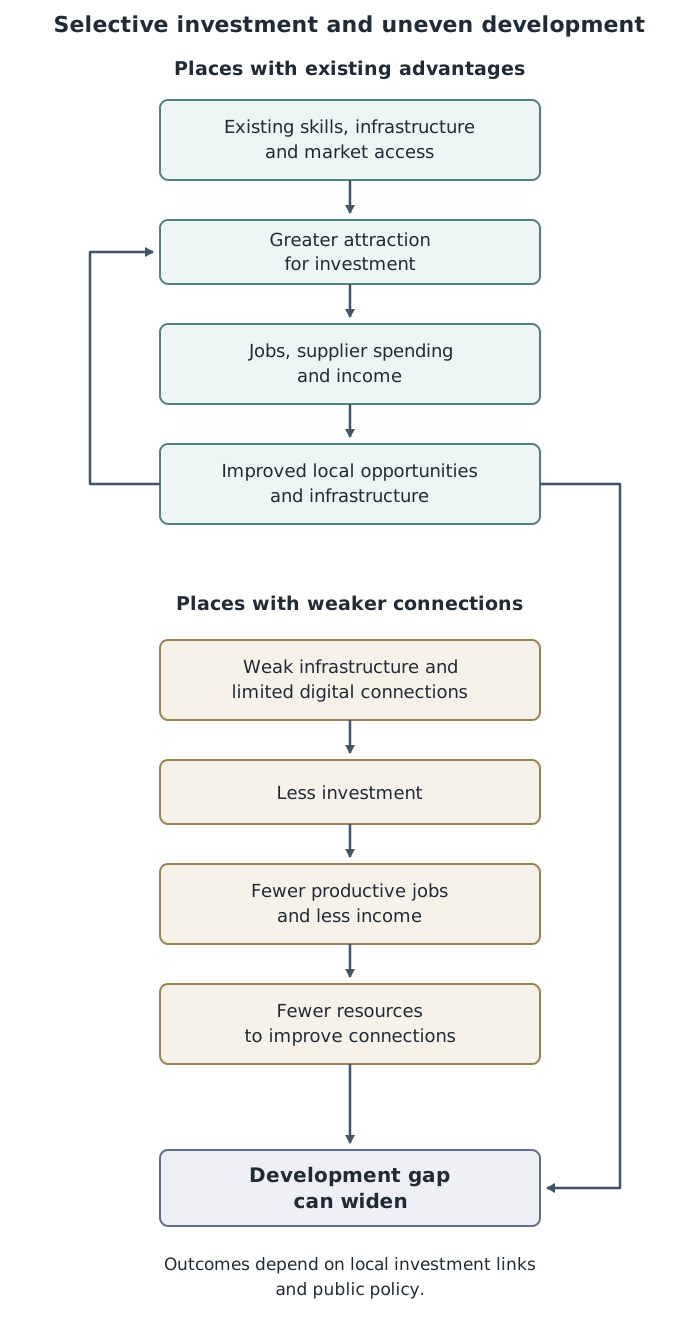
Investment can reinforce existing advantages, widening the gap with places that receive less investment.
In the UK, international firms such as Toyota and Google operate in an economy with skilled workers and established infrastructure. London and the South East attract substantial international business and high-value services. Their concentration of investment and higher-paid work contributes to differences with places such as Teesside and Hull, although investment also reaches areas outside the South East.
In India, global investment and demand for technology services have benefited cities such as Bengaluru, also known as Bangalore, and Mumbai. Urban businesses can connect to international customers and employ skilled workers. Poorer rural areas, including parts of Bihar, have fewer of these opportunities. Growth in successful cities does not automatically raise incomes equally across India.
In Malawi, landlocked geography and inadequate infrastructure make access to international markets more difficult. Its export economy depends heavily on tobacco, with limited diversification into other products. Corruption, cumbersome tax administration and unpredictable regulations increase uncertainty for businesses and discourage investment. Compared with the UK's established international business connections and India's growing service industries, Malawi faces greater barriers to gaining productive jobs and income from globalisation.
Unevenness also exists within Malawi. Agriculture supports many vulnerable rural households, but commercial farmers are only a small minority. Policies focused on food self-sufficiency have not created enough opportunities for broader employment and rural economic transformation. Established businesses can benefit from arrangements that restrict competition, while smaller firms face barriers to entering markets and growing. Global connections therefore do not give all farmers and businesses equal opportunities.
Digital communications allow businesses to coordinate overseas operations and sell services internationally. The UK's developed communications networks support this activity. India's IT and service centres, including Hyderabad and Pune, also benefit. Yet poorly connected rural areas of India cannot access the same opportunities as easily. This digital divide affects business activity as well as access to information and learning.
Migration can both reduce and deepen inequality. Migrants may earn more abroad and send remittances home, helping families pay for schooling, healthcare or housing. Overseas earnings benefit Indian regions such as Kerala. However, households without a migrant abroad may receive no direct benefit, and dependence on overseas earnings leaves families exposed to changes in foreign employment.
The UK gains when skilled international migrants fill shortages in sectors such as healthcare and engineering. The country of origin may lose scarce skills through brain drain, weakening services and making development harder. The same movement can therefore benefit one place while imposing costs on another.
Political connections matter too. Wealthier countries generally have greater resources to influence international economic decisions. Countries dependent on overseas aid or loans may have less freedom over how they fund development. In Malawi, heavy reliance on donor funding limits policy autonomy. Weak institutions and corruption can also divert resources away from infrastructure, healthcare and education, reducing the country's ability to benefit from investment. Globalisation's benefits depend partly on bargaining power and effective government, not simply on whether a country participates.
A multinational company, or MNC, owns or controls operations in more than one country. Its location choices usually combine several aims: increasing sales, reducing costs, obtaining resources and accessing skills. Different parts of the same company may therefore operate in countries at different levels of development.
The UK offers access to wealthy customers and specialist skills. Its consumer purchasing power makes it an attractive market. Universities, skilled workers and research centres, including those around Cambridge, support innovation and product development. London provides access to finance, while established transport and communications networks help firms coordinate international operations. Toyota's presence illustrates overseas investment in UK manufacturing; Google illustrates investment in technology and services.
These advantages have costs for the company. UK wages and land can be expensive, and complying with employment and environmental regulations adds to operating costs. A firm may accept these costs because skilled workers, reliable infrastructure or access to customers offer greater benefits.
India offers a large market, lower costs in many activities and substantial technical skills. Its growing consumer market attracts firms seeking additional sales. Its large, educated, English-speaking workforce supports IT and other business services, while lower labour costs can reduce manufacturing expenses. Samsung is an example of a foreign MNC operating in India. Government incentives, including tax concessions and special economic zones, can also make investment attractive.
India is not uniformly low-cost or easy to operate in. Poor transport or unreliable power in some regions can interrupt production. Congestion raises transport costs, while administrative delays create uncertainty. The cheapest workforce does not necessarily produce the cheapest overall operation.
For an MNC, international expansion can increase sales, spread activities across markets and provide access to skills or resources unavailable at home. Against this, managing distant operations is complex, and infrastructure problems or changing regulations can reduce the expected gains.
The host country is the country receiving the multinational's investment. Its interests are not identical to those of the company.
Jobs, local purchasing, worker training and infrastructure improvements can raise incomes and productivity. Tax payments can help fund public services. Local suppliers may gain contracts and learn new methods. These benefits can occur in both the UK and India, although their size depends on how closely the operation connects with the local economy.
Some benefits may leak away. Profit repatriation sends earnings back to the MNC's home country rather than retaining them in the host economy. Tax avoidance can reduce government revenue, while tax concessions limit the revenue received initially. Local firms may struggle to compete with a large multinational.
Employment can also be insecure. A company able to move production internationally may leave when another location becomes more profitable. The host community then loses jobs and spending. Low wages may still provide income, but employment alone does not guarantee a good standard of living.
Training can improve workers' skills and future employment prospects. Higher household income may improve access to education and healthcare, and new employment opportunities can widen participation in paid work. However, repetitive jobs may offer little progression, and weak workplace protections can expose employees to unsafe conditions.
Where investment concentrates in cities, people migrate towards employment. In Indian cities such as Delhi and Bengaluru, this can increase pressure on housing, transport and services. Those unable to obtain secure work may gain much less than skilled employees. In the UK, concentrations of opportunity in London and the South East also contribute to housing pressure.
Environmentally, MNCs may introduce cleaner machinery and more efficient production methods. These are potential benefits, not automatic outcomes. Factories, transport and resource extraction can also increase emissions, waste and water demand. Land clearance can destroy habitats, while pollution or excessive water use can harm nearby communities. Effective regulation and enforcement help determine which outcome dominates.
Uneven opportunities encourage migration, leaving some places short of skills while putting pressure on services elsewhere. Income differences affect access to education and healthcare. Exclusion from economic growth can also create social tensions and political dissatisfaction.
Malawi shows why economic growth alone is insufficient. Its per-person economic output increased by more than 50% over the 30 years discussed in the World Bank's 2023 assessment, but growth had not been sufficiently inclusive to significantly reduce poverty. Barriers facing farmers and smaller businesses help explain why gains do not spread evenly. Corruption and ineffective public spending further weaken improvements in essential services.
Environmental risks can deepen these differences. Malawi's vulnerable agricultural households are particularly exposed to floods and droughts, which damage livelihoods, housing and living conditions. Dependence on a climate-sensitive sector makes it harder for these households to achieve secure improvements in welfare. In industrialising areas of India, growth can raise incomes while exposing nearby communities to pollution. Poorer households often have fewer resources to protect themselves or move away.
Globalisation can narrow some gaps when investment creates productive jobs and remittances improve household welfare. It can widen others when investment repeatedly favours well-connected cities, profits leave the host economy or environmental costs fall on poorer communities.
A justified conclusion therefore asks who benefits, where, and for how long. MNC investment is more likely to support broad development when it provides decent work, builds local skills, purchases from local suppliers, pays taxes and meets environmental standards. In countries such as Malawi, improving infrastructure and governance can help more businesses and rural households participate. Rising national output alone does not demonstrate that development has become more equal.
Distinguish between uneven development between countries and uneven development within a country. Use named places to explain both scales.
Develop a causal chain: a location advantage attracts investment, which creates jobs and income, which can widen the gap with places receiving less investment.
Keep benefits to the MNC separate from consequences for the host country. Lower labour costs benefit the company; the effect on workers depends on wages and working conditions.
For an evaluation, compare benefits and costs, identify who gains or loses, and explain the conditions on which your judgement depends.
Do not assume that every multinational operating in India is foreign-owned. Tata Motors and Infosys are Indian multinationals.
It can see this note and what your specification asks for.
Answers are free with an account.
1 free note left this week
Get more free notesYour answer sets when this note comes back for review, or marks it complete.
Was this note helpful?
Log in to tell us whether it helped, or to report a problem.
Last updated
Globalisation
The increasing connections and interdependence between countries through flows of goods, services, money, people and information.
Uneven development
Differences in economic prosperity and quality of life between countries, regions or groups of people.
Multinational company (MNC)
A company that owns or controls business operations in more than one country.
Host country
A country in which a foreign multinational establishes business operations.
Foreign direct investment (FDI)
Investment by a business in operations or assets in another country, such as building a factory.
Newly industrialised country (NIC)
An economy experiencing substantial growth in manufacturing and related industries, increasing its role in the world economy.
Low-income country (LIC)
A country with a low average income per person, classified using gross national income per person.
Digital divide
Unequal access to digital technology, reliable internet connections and the skills needed to use them.
Remittance
Money sent by a migrant to people in their country of origin.
Brain drain
The loss of skilled workers from a country or region when they move elsewhere.
Multiplier effect
Further economic activity created when an initial investment generates spending, income and additional jobs.
Profit repatriation
The transfer of profits from an overseas operation back to the company's home country.
Put your knowledge into practice — try past paper questions for Geography B
Globalisation
The increasing connections and interdependence between countries through flows of goods, services, money, people and information.
Uneven development
Differences in economic prosperity and quality of life between countries, regions or groups of people.
Multinational company (MNC)
A company that owns or controls business operations in more than one country.
Host country
A country in which a foreign multinational establishes business operations.
Foreign direct investment (FDI)
Investment by a business in operations or assets in another country, such as building a factory.
Newly industrialised country (NIC)
An economy experiencing substantial growth in manufacturing and related industries, increasing its role in the world economy.
Low-income country (LIC)
A country with a low average income per person, classified using gross national income per person.
Digital divide
Unequal access to digital technology, reliable internet connections and the skills needed to use them.
Remittance
Money sent by a migrant to people in their country of origin.
Brain drain
The loss of skilled workers from a country or region when they move elsewhere.
Multiplier effect
Further economic activity created when an initial investment generates spending, income and additional jobs.
Profit repatriation
The transfer of profits from an overseas operation back to the company's home country.
| Location | Advantages for the MNC | Disadvantages for the MNC |
|---|---|---|
| UK | Wealthy market, specialist skills, finance, reliable infrastructure | High labour and land costs; regulatory compliance costs |
| India | Large growing market, lower costs in many activities, skilled English-speaking workforce, investment incentives | Uneven power and transport provision; congestion; administrative delays |
Examples: Toyota and Google in the UK; Samsung in India.
Uneven development creates income and service gaps, migration pressures and unequal exposure to environmental harm. Malawi's vulnerable farming households are particularly exposed to floods and droughts.
Gains depend on local links, wages, taxation, regulation and whether benefits spread beyond the main investment centres. National growth does not necessarily mean reduced inequality.