

Loading…
Loading…
Loading…
Eduqas GCSE Geography A · C111
Eduqas C111 · 8.2.1 Management and Restoration of Ecosystems Check the specification (PDF) (opens in a new tab)
A habitat is the place where an organism lives. It must provide suitable conditions, food and shelter. Human activities can damage these conditions: ponds may be filled in for agriculture, water can become polluted, and river engineering can separate waterways from surrounding wetlands.
Habitat restoration repairs this damage. It is more than making a place look greener. A restored habitat needs the water, vegetation and connections that allow wildlife to survive and reproduce. Its success can therefore be judged by improvements in habitat conditions and biodiversity — the variety of living organisms present.
Restoration also needs to address the original cause of damage. Improving a pond will have limited value if pollution continues to enter it. Repairing one wetland may not be enough if animals cannot reach it from neighbouring waterways.
Wetlands are areas where water covers the ground or keeps the soil saturated, either permanently or seasonally. They include ponds, marshes and wet grasslands. Their water levels and connections to other habitats help determine which species can live there.
Industrialisation has created barriers in rivers, reduced water quality and altered water levels. These changes can cause both habitat loss and fragmentation, where habitats become smaller and separated. A surviving pond might appear healthy but still be difficult for wildlife to reach.
The European eel shows why connections matter. Eels use freshwater wetlands during much of their lives but must return to the Sargasso Sea to breed. Human-made barriers can obstruct these journeys. Eels are also food for otters, herons and bitterns, so helping one species can benefit others through the food web.
River restoration can return a straightened channel towards a more natural form, with meanders and wetland areas. Allowing water to spread into suitable parts of the floodplain creates habitat and slows its movement downstream. This can combine wildlife conservation with reduced downstream flood risk.
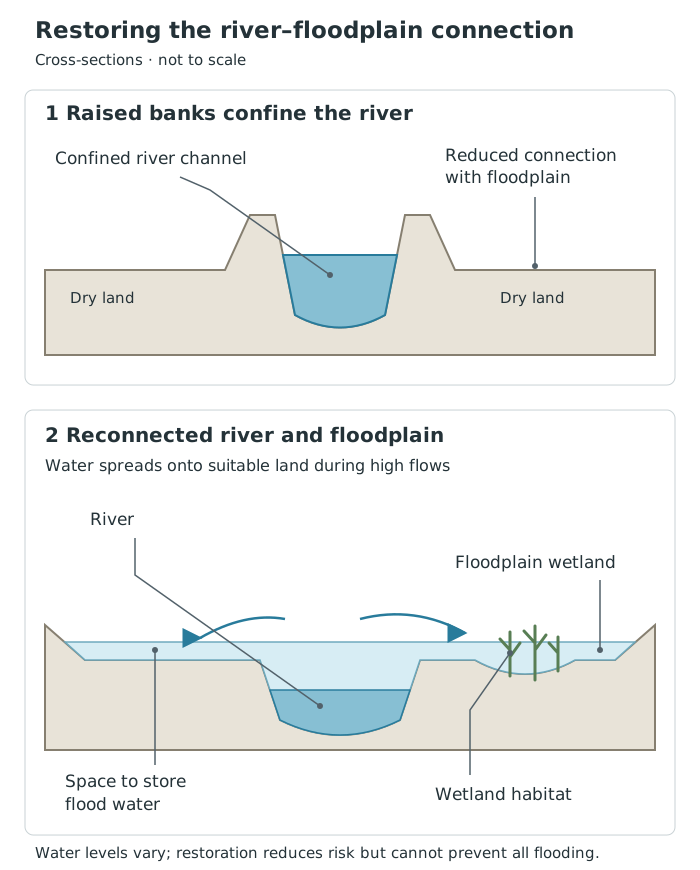
Reconnecting a river with suitable floodplain land can restore wetland habitat and provide space for flood water.
The important connection is between the river and the land beside it. A floodplain that can hold water provides different conditions from a river confined within an engineered channel. Protecting undeveloped floodplains from building can help retain these habitats and leave space for natural flooding.
There are trade-offs. Constructing new channels can be expensive, and some land must be allowed to flood. This may conflict with farming or development. Restoration is therefore more suitable where there is room for water to spread without putting homes and businesses at unacceptable risk. It cannot guarantee that flooding will never occur.
Ponds can be lost by being filled in, but they can also deteriorate through neglect. Accumulated material and dense overhanging vegetation may leave little open water and block sunlight.
A pond-restoration example described by the Wildfowl & Wetlands Trust involved farmer Adam Henson’s neglected farm pond. Work included digging out accumulated leaves and clay and opening the pond to sunlight. The intended result was a water-filled habitat supporting aquatic invertebrates. Emerging insects would then provide food for birds and bats feeding their young.
This shows how restoring a small habitat can benefit wildlife beyond its boundaries. However, repairing an individual pond is only part of the solution: a healthy wetland landscape needs a network of ponds and waterways, rather than a few isolated sites.
At WWT Slimbridge in Gloucestershire, beside the Severn Estuary, restoration focuses on making wetlands bigger, better and more connected. A reserve warden reported that the team had restored and created two miles of ditches in six months. Streams and ditches act as wildlife corridors, helping animals move through the wider landscape.
These connections can benefit eels and other fish, as well as water voles and otters. Otters need both feeding areas and sheltered places; well-maintained reedbeds provide secluded habitat with fish, while artificial holts can provide shelter.
The eel project also identified a specific obstacle at a 400-metre Victorian tunnel leading into the reserve. At very low tides, young eels faced a vertical climb of two metres to enter it. The proposed solution was an eel pass, effectively a ladder that would help the small eels climb past the obstruction.
Monitoring helps distinguish promising management from proven success. Researchers tagged eels to investigate their movements, and seven tagged mature females were recorded leaving the reserve. This demonstrated that those individuals could leave, but did not establish that the problem of too few young eels arriving had been solved.
Different damage requires different responses. Channel restoration repairs river processes; pond restoration improves local habitat; corridors and eel passes address obstacles to movement. Combining suitable methods can achieve more than treating each habitat separately.
The strongest approach balances ecological gains with costs and effects on land users. Restoring rivers can provide habitat and flood-water storage, but requires space and investment. Reconnecting wetlands helps wildlife move, but cannot compensate for continuing poor water quality. A justified judgement is therefore that restoration works best when it tackles the cause of damage, improves the wider habitat network and uses monitoring to check whether wildlife actually benefits.
Success depends on removing the cause of damage, connecting habitats, balancing land-use conflicts and monitoring ecological results.
Link each strategy to the damage it repairs: for example, reconnecting waterways helps overcome habitat fragmentation.
When evaluating, weigh ecological benefits against costs and competing land uses, then explain the conditions needed for success.
Distinguish an intended benefit from a demonstrated result. Installing a passage for fish does not by itself prove that their population has recovered.
Use specific details from Slimbridge to support explanations, rather than simply naming the reserve.
It can see this note and what your specification asks for.
Answers are free with an account.
1 free note left this week
Get more free notesYour answer sets when this note comes back for review, or marks it complete.
Was this note helpful?
Log in to tell us whether it helped, or to report a problem.
Last updated
Habitat
The place where an organism lives, providing the conditions and resources it needs to survive.
Biodiversity
The variety of living organisms in an area.
Wetland
An area where water covers the ground or keeps the soil saturated, permanently or seasonally.
Habitat restoration
Repairing a damaged habitat by improving its conditions and restoring the natural processes that support wildlife.
Habitat fragmentation
The breaking up of a habitat into smaller, separated areas, making movement between them more difficult.
Wildlife corridor
A strip or connected network of habitat that allows wildlife to move between otherwise separated areas.
Floodplain
The low-lying land beside a river that may be covered by water when the river floods.
Put your knowledge into practice — try past paper questions for Geography A
Habitat
The place where an organism lives, providing the conditions and resources it needs to survive.
Biodiversity
The variety of living organisms in an area.
Wetland
An area where water covers the ground or keeps the soil saturated, permanently or seasonally.
Habitat restoration
Repairing a damaged habitat by improving its conditions and restoring the natural processes that support wildlife.
Habitat fragmentation
The breaking up of a habitat into smaller, separated areas, making movement between them more difficult.
Wildlife corridor
A strip or connected network of habitat that allows wildlife to move between otherwise separated areas.
Floodplain
The low-lying land beside a river that may be covered by water when the river floods.