

Loading…
Loading…
Loading…
Eduqas GCSE Geography A · C111
Eduqas C111 · 5.2.1 Weather Hazards: Causes and Responses Check the specification (PDF) (opens in a new tab)
High-pressure systems usually bring settled weather because air descends. As it sinks, it warms, making cloud formation less likely. Clear skies allow strong sunshine to heat the ground during summer. If the system stays in place, it can also block cooler, wetter weather from moving into the area.
A few sunny days are not necessarily hazardous. The danger develops when unusually hot or dry conditions persist. A heatwave is a period of unusually hot weather for the place and time of year. A drought is an extended period of below-average rainfall. A normally wet region can therefore experience drought: it does not have to become a desert.
Heatwaves and droughts can reinforce each other. A prolonged lack of rain reduces water supplies, while high temperatures increase evaporation, causing water to be lost more quickly. Continued water abstraction from rivers, lakes and underground aquifers can deepen shortages. However, heatwaves and droughts are distinct: extreme heat can develop quickly, whereas drought usually builds over a longer period.
Heatwaves are not confined to the tropics or deserts. They can affect temperate regions when persistent high pressure produces temperatures far above local norms. Examples include western North America, central-eastern China and the UK. The 2021 western North American heatwave affected British Columbia in Canada and the Pacific Northwest of the United States. Central-eastern China experienced a damaging heatwave in July 2017, while the UK experienced exceptional summer heat in 2018.
Drought risk is widespread but uneven. Important affected regions include Australia, the Middle East, central and southern Africa, parts of North America and eastern South America. Many vulnerable areas lie around desert margins, where rainfall is already limited or unreliable. Drought can also affect regions that depend on seasonal rainfall: failure of India's monsoon rains, for example, can leave a serious water shortage.
High pressure is one cause, not the only cause. Changes in atmospheric circulation can divert rain-bearing weather away from a region. El Niño, a periodic change in Pacific Ocean conditions and atmospheric circulation, can reduce rainfall in Australia and Indonesia.
To describe this distribution geographically, identify broad regions and then give named examples. Compare the patterns: drought is especially threatening where water supplies are already limited, whereas heatwaves can affect normally mild places that are poorly prepared for exceptional heat.
Frequency describes how often a hazard occurs. Magnitude describes its size or severity. For heatwaves, severity can involve the temperatures reached and how long the heat lasts. For drought, duration and the extent of the rainfall shortage are important.
Since 1950, warm days and nights have become more common globally, and some regions have experienced more heatwaves. Human-induced warming has made hot extremes more likely. For example, analysis of the July 2017 central-eastern China heatwave found that an event like it was about 20 times more likely in the climate affected by human greenhouse gas emissions than in a world without those emissions. As average global temperatures rise, more hot extremes are expected in most places.
Changes also concern magnitude, not just frequency. The UK is experiencing higher maximum temperatures and longer warm spells: heat can reach greater extremes and persist for longer. This is evidence of a longer-term change in the severity of hot weather, rather than simply an increase in how often it occurs. The summer of 2018 was the joint warmest on record for the UK as a whole and the hottest recorded for England. Human-induced climate change made those record-breaking UK summer temperatures about 30 times more likely than they would have been naturally.
Drought trends are less uniform. The Met Office's 2019 review reported that, since 1950, drought frequency and intensity had likely increased in the Mediterranean and West Africa, but likely decreased in central North America and north-west Australia. This contrast matters: a global warming trend does not produce an identical rainfall response everywhere.
Drought is also harder to assess because rainfall varies naturally, records can be incomplete, and water shortages depend partly on water use. Some regions are expected to become drier and potentially experience more droughts. In the UK, projections of drier summers, particularly in southern areas, could increase drought risk.
Climate change can alter the likelihood and severity of a hazard without being its only cause. Persistent pressure systems and natural variability still help determine where and when individual events develop.
From late June to early July 2021, a record-breaking heatwave affected western Canada and the Pacific Northwest of the United States. In Lytton, British Columbia, the temperature reached 49.6°C, setting a Canadian national record. Many places exceeded their previous maximum-temperature records, some by more than 5°C.
A powerful, persistent high-pressure system settled over the region. Descending air warmed and dried, producing stable conditions and clear skies. The system blocked cooler, wetter Pacific air from entering, allowing heat to build beneath it. This combination is often called a heat dome. Human-induced climate change worsened the extreme heat by raising the background temperature from which the event developed.
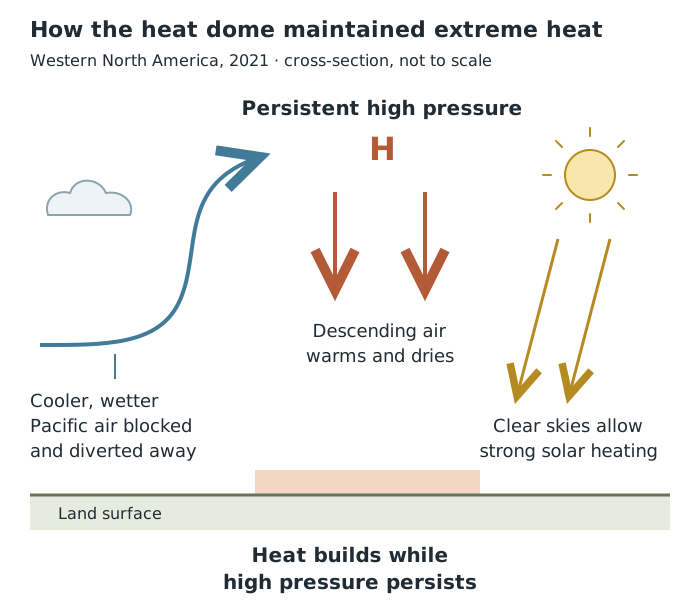
Persistent high pressure allowed heat to build by warming descending air, maintaining clear skies and blocking cooler Pacific air.
The important connection is persistence: the same conditions continued rather than being replaced by cooler weather. This allowed temperatures to reach levels that people, ecosystems and infrastructure were not prepared to withstand.
People: extreme heat caused hundreds of deaths across the affected region and put hospitals and emergency services under severe pressure. Older people and those with existing health conditions were particularly vulnerable, especially where they lacked air conditioning. Some COVID-19 vaccination centres had to close or relocate temporarily. A wildfire destroyed much of Lytton, displacing hundreds of residents.
Environment: intense heat and dry conditions contributed to widespread wildfires. These burned vegetation and damaged ecosystems. The heat and lack of water also harmed crops and livestock.
Economy: crop failures and livestock deaths caused losses for farmers. Wildfires destroyed property, while extreme heat damaged infrastructure, including roads. Demand for cooling strained electricity systems, and some power systems failed. These effects show how one weather hazard can disrupt food production, transport, energy supplies and housing at the same time.
The consequences were unequal. Someone with a cool home and access to help could reduce their exposure more easily than an isolated person without air conditioning. The severity of a disaster therefore depends on both the physical event and people's vulnerability.
Public health campaigns warned people about the heat and advised them to stay cool and drink water. Temporary cooling centres in public buildings provided cooler spaces for people without air conditioning. These measures addressed the immediate risk of heat illness, although their usefulness depended on people receiving the warnings and being able to reach a centre.
Transport services reduced train speeds to lower the danger associated with heat-affected rails. This improved safety but also disrupted journeys. Firefighting equipment was shared between the United States and Canada to tackle widespread wildfires. British Columbia declared a state of emergency to help coordinate the wildfire response.
These responses tackled different consequences rather than removing the high-pressure system itself. Cooling centres and warnings protected health; slower trains reduced transport risks; emergency coordination and shared equipment supported firefighting. A justified assessment should recognise their value while noting that the scale of deaths, infrastructure damage and destruction in Lytton shows that the harm was not fully prevented.
Locate your case study precisely and use its date and named places, rather than referring only to ‘a heatwave’.
Distinguish frequency from magnitude: more events does not necessarily mean stronger events.
Link each consequence to a cause, and each response to the problem it addresses. Include consequences for people, the environment and the economy.
Do not claim that drought is increasing everywhere. Regional trends differ, and natural rainfall variability also matters.
A heatwave is unusually hot weather; a drought is a prolonged rainfall shortage. They can occur together, but they are not the same hazard.
It can see this note and what your specification asks for.
Answers are free with an account.
1 free note left this week
Get more free notesYour answer sets when this note comes back for review, or marks it complete.
Was this note helpful?
Log in to tell us whether it helped, or to report a problem.
Last updated
High-pressure system
An area where atmospheric pressure is higher than in surrounding areas, usually associated with descending air and relatively settled weather.
Heatwave
A period of unusually hot weather compared with the normal conditions for that place and time of year.
Drought
An extended period of below-average rainfall that can reduce available water and harm people, vegetation and animals.
Heat dome
A persistent high-pressure system in which descending air warms and cooler air is prevented from moving into an area, allowing extreme heat to build.
Frequency
How often a particular event occurs within a given period.
Magnitude
The size or severity of an event, such as the temperatures reached during a heatwave or the duration and intensity of a drought.
Water security
Reliable access to enough suitable water to meet people's needs.
Put your knowledge into practice — try past paper questions for Geography A
High-pressure system
An area where atmospheric pressure is higher than in surrounding areas, usually associated with descending air and relatively settled weather.
Heatwave
A period of unusually hot weather compared with the normal conditions for that place and time of year.
Drought
An extended period of below-average rainfall that can reduce available water and harm people, vegetation and animals.
Heat dome
A persistent high-pressure system in which descending air warms and cooler air is prevented from moving into an area, allowing extreme heat to build.
Frequency
How often a particular event occurs within a given period.
Magnitude
The size or severity of an event, such as the temperatures reached during a heatwave or the duration and intensity of a drought.
Water security
Reliable access to enough suitable water to meet people's needs.
Responses reduced exposure and supported emergency services, but did not prevent widespread harm. Risk depended on both extreme temperatures and vulnerability, including age, health and access to cooling.