

Loading…
Loading…
Loading…
Eduqas GCSE Geography A · C111
Eduqas C111 · 6.2.1 Uneven Global Development Check the specification (PDF) (opens in a new tab)
Tourism involves travelling away from home for leisure and staying for at least one night. When tourists cross national borders, their journeys connect the economies of their home countries and their destinations. Airlines, tour operators, hotels and booking systems can operate across many countries: tourism is therefore part of a globalised economy.
A holiday creates several flows. Visitors move to a destination, information passes through booking systems, and money flows to airlines, accommodation providers, guides and shops. However, the country visited does not necessarily keep all the money spent on the holiday. Understanding where that money goes helps explain tourism’s effects on uneven development: differences in income, opportunities and living conditions between places and groups of people.
The Gambia and India provide contrasting studies. The Gambia is included in Eduqas’s list of low-income countries (LICs), while India is listed as a newly industrialised country (NIC). An NIC is a middle-income country with relatively rapid economic growth, including growth in manufacturing, cities and international trade. These classifications provide the context for studying tourism; they do not mean that everyone within either country has the same living conditions.
Tourism grows when more people have both the money and the time to travel. Rising household incomes leave more money available for holidays after essential expenses. Paid holidays and retirement give people time to travel; pensions can allow retired people to take holidays outside the main working population’s holiday periods.
Transport technology has made destinations easier and cheaper to reach. Larger aircraft spread operating costs across more passengers, while budget airlines such as easyJet have widened access to air travel. Lower fares make overseas holidays affordable to more people.
Changing communications are especially important. Internet booking lets customers compare and reserve holidays without visiting a travel agent. Computer reservation systems, such as Amadeus and Galileo, connect travel businesses and allow tour operators to organise journeys on a worldwide scale. A hotel can therefore reach customers far beyond its own country.
Political changes can also make travel easier. Relaxed border controls reduce barriers to movement, and a shared currency removes the need to exchange money between participating countries. The opening of eastern Europe after the end of the Iron Curtain helped destinations such as Prague and Budapest attract international visitors. These changes work together: an appealing destination needs to be accessible, affordable and easy to book.
Growing tourism increases demand for services such as accommodation, transport, entertainment and guiding. These create direct employment. Hotels also purchase food, furniture and other supplies, supporting employment in businesses that serve the tourism industry.
The benefits can spread through a multiplier effect. For example, a hotel buys vegetables from a local farmer, who then spends some of that income in local shops. Hotel workers also spend their wages locally. The original tourist spending supports further economic activity rather than benefiting only the hotel.
International visitors bring foreign currency into a destination. Foreign hotel companies may also invest in hotels and airport facilities, providing construction work and longer-term service jobs. These connections explain why tourism’s growing economic contribution extends beyond the people employed directly in resorts.
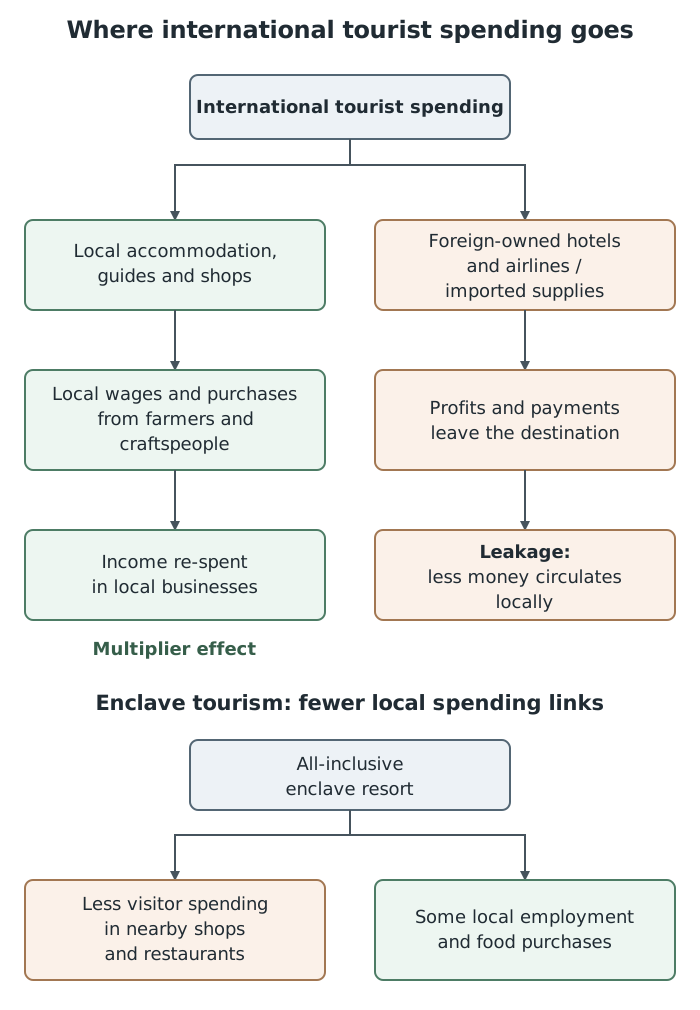
Local purchasing and re-spending spread tourism’s benefits; leakage reduces the money remaining in the destination economy.
The important distinction is between money that continues circulating locally and money that leaves. A busy resort can generate large revenues while providing only limited benefits to nearby communities if ownership, employment and purchasing favour outsiders.
In enclave tourism, visitors stay in a largely self-contained resort, often paying one price for accommodation, food, drinks and entertainment. Because these needs are met inside the resort, visitors have less reason to spend money in nearby shops and restaurants.
If foreign multinational companies own the hotels or airlines, some profits return to their home countries. This is leakage. Purchases of imported food and other supplies also take money out of the destination economy. Leakage weakens the local multiplier effect and can concentrate benefits among large companies rather than local businesses.
Nevertheless, enclave tourism is not entirely without local benefits. Resorts can employ local workers and buy local food. Foreign investment can also finance expensive hotels that a poorer destination could not easily build itself.
Tourism creates opportunities in the informal economy, too. A street seller may earn money from selling handmade souvenirs without running a formally registered business. Such work gives people access to tourist income and requires less capital than building a hotel. However, earnings can be irregular, employment protection limited and income dependent on visitor numbers. Informal work is not the same as criminal activity.
The Gambia is in West Africa. Its beaches and climate attract international visitors, and its coastal belt has developed enclave tourism. Tourism is a substantial source of income and employment: the World Bank’s 2025 diagnostic reports estimated contributions of 14.3% of GDP and about 13.5% of employment. GDP measures the value of economic output, so these figures show tourism’s importance both to production and to livelihoods.
International arrivals reached 206,836 in 2023, 13% above 2022, although still below pre-pandemic levels. This recovery increases demand for accommodation, transport, food and guiding. Foreign-owned hotels provide jobs, while souvenir sales give local people opportunities to earn income.
However, benefits are unevenly distributed. Tourism remains concentrated on the coast near Banjul, so inland communities have fewer opportunities to share its gains. All-inclusive holidays restrict spending outside resorts, and payments to foreign hotel and airline owners leak out of the destination economy. Although some businesses buy local food, the World Bank found that most tourism consumption was imported rather than locally grown. This limits the opportunities for Gambian farmers and suppliers. The dominant role of international tour operators also limits the growth and influence of local operators.
Tourism can create a market for cultural skills and encourage exchanges between visitors and residents. Local guides and craft sellers can earn income while sharing their own knowledge and traditions. However, interactions are not always equal or respectful. The Gambia’s 2002 Responsible Tourism Policy identified sex tourism, visitor harassment and environmental degradation as problems to tackle. It also called for respect for local social, cultural and religious rights. These concerns show why increasing visitor numbers alone is not a sufficient measure of successful development.
The policy sought to promote local guides, cultural attractions and community participation. These were aims for improving tourism, not proof that its social problems had been solved. Involving residents in decisions matters because they should help determine how their culture is presented and how visitors interact with their communities.
Tourism also needs roads, energy, water supplies and waste services. The World Bank reports government investment in roads, ports and energy projects intended to improve the sector’s operation. Such infrastructure can support businesses and residents as well as visitors, but tourism investment does not automatically provide adequate environmental services. More than US$45 million in foreign investment entered the tourism sector after 2015, yet only a small fraction went towards managing its environmental impact.
Limited formal waste collection and fragmented waste management make it harder to deal with rubbish, including plastics. Accommodation also adds demand for water. The country’s drinking-water supply is mainly drawn from groundwater, which is at risk of contamination and over-extraction. These weaknesses affect residents’ access to a healthy environment as well as the quality of the tourist destination. The proposed integrated waste facility in Kanifing is a response to these problems, not an already demonstrated solution.
Footsteps, near Gunjur, shows a different approach. This ecotourism business links tourism more closely to the local community. In the documented example, all 22 staff came from Gunjur and were paid throughout the year, rather than only during the tourist season. Training and career development were provided, alongside medical and dental care. These arrangements improve the quality and security of employment, not just the number of jobs.
Local craftspeople made furniture for the business. Women demonstrated tie-dye and batik, and the on-site craft shop promoted local products to guests. This creates a market for cultural skills as well as income. The example records that 20% of craft-shop profits went to the local community.
Its environmental practices include solar electricity, solar-heated shower water, composting toilets and filtered water from baths and sinks reused to grow fruit and vegetables. These reduce demand for fuel and fresh water and make use of waste. Locally sourced building materials and food grown on site strengthen local supply links. Water from tubewells is stored in tanks, illustrating the practical water infrastructure needed to support accommodation.
The contrast matters: tourism can bring investment through large resorts, but local recruitment, local purchasing and year-round employment help more of its benefits reach residents. Footsteps demonstrates these possibilities at business scale; it does not mean that environmental and social problems across The Gambia have disappeared.
Kodagu district in Karnataka provides an example of how tourism in India can bring development while increasing inequalities within a destination.
Employment and income: tourism supports lodges, small hotels, shops, local transport and sales of products such as honey and herbal goods. Some farmers earn additional income by providing accommodation and selling food to visitors. This diversifies their income beyond agriculture.
However, research in Kodagu found that only about 30–40% of tourist service facilities both employed local people and purchased products from local farms. Other facilities favoured non-local workers and outside suppliers. Much of the tourism income was concentrated among non-local owners of larger restaurants, lodges and resorts. Local people could therefore live close to a growing tourism industry without receiving an equal share of its gains.
Jobs were often seasonal and poorly paid. Tourism also drew workers away from farming, creating agricultural labour shortages and increasing labour costs. This shows how growth in one sector can make conditions harder for another.
Environment: tourism can provide finance for ecosystem conservation and natural-resource management. Yet Kodagu also experienced pollution, solid-waste problems, deforestation, soil erosion and loss of biodiversity associated with tourism. Environmental damage affects residents as well as visitors: polluted water, air and soil can increase health risks and treatment costs.
Culture: demand for local traditions and handicrafts can encourage their preservation and strengthen community pride. Cultural exchange can also develop communication and business skills. On the other hand, the study identified erosion of traditional values and conflicts between tourism and local cultural or religious heritage. Preserving a culture is different from changing it to suit visitors’ expectations.
Infrastructure and living costs: tourism was associated with improvements in roads, schools, libraries, healthcare institutions and internet facilities. These can benefit residents as well as visitors. But increased traffic brought congestion, while demand for land and holiday homes raised housing costs. Higher prices for essentials placed particular pressure on poorer households. Better facilities can therefore coexist with worsening affordability.
Tourism growth can increase the share of employment in the tertiary sector, including hospitality, transport and retail. People may move from agricultural work into these services. That can widen opportunities, but Kodagu shows that it can also leave farms short of workers.
Overdependence develops when a community relies heavily on tourism for jobs and income. Seasonal visitor demand then produces seasonal earnings. If visitor numbers fall, the effects can spread beyond hotels to guides, farmers, craft sellers and shops through the same connections that previously spread benefits. The Gambia’s arrivals remaining below pre-pandemic levels in 2023 demonstrate that visitor demand cannot be assumed to grow continuously.
A justified judgement should therefore consider more than the number of tourists or hotels. Ask whether jobs are secure, whether businesses recruit and buy locally, whether profits remain in the destination, and whether residents retain access to affordable housing and a healthy environment.
Tourism can reduce uneven development by bringing income, employment and infrastructure to poorer places. It can also deepen inequality when outsiders capture profits while residents face seasonal work, higher living costs and environmental damage. In both The Gambia and Kodagu, the strongest benefits arise when local communities participate in tourism and retain a substantial share of its gains. Economic diversification and environmental protection make those benefits more likely to last.
Explain a chain of effects: tourist spending → local employment or purchases → higher local income. Simply saying that tourism makes a country richer is not enough.
For enclave tourism, explain how an all-inclusive resort limits spending outside the resort, while still providing some local jobs and demand for supplies.
In an evaluation, consider who benefits, who loses and whether benefits last. A balanced judgement need not give both sides equal weight.
Use place-specific evidence for both the LIC and NIC. Do not assume that a rise in tourism income benefits every region or household equally.
Distinguish policy aims from achieved improvements: a plan to reduce tourism’s environmental damage does not prove that the damage has been reduced.
It can see this note and what your specification asks for.
Answers are free with an account.
1 free note left this week
Get more free notesYour answer sets when this note comes back for review, or marks it complete.
Was this note helpful?
Log in to tell us whether it helped, or to report a problem.
Last updated
Tourism
Travel away from home for leisure, involving at least one overnight stay.
International tourism
Tourism in which people travel from one country to another.
Globalisation
Increasing connections and interdependence between countries through flows of people, money, goods and information.
Low-income country
A country with a low average income per person. The Eduqas specification uses the World Bank’s 2013 definition: GNI per capita of US$1,045 or less.
Newly industrialised country
A middle-income country experiencing faster economic growth than other developing countries, characterised by rapid manufacturing and urban growth, strong international trading relationships and foreign-owned multinational companies.
Multiplier effect
The additional economic activity created when money first spent by tourists is re-spent within the local economy.
Enclave tourism
Tourism concentrated in a largely self-contained resort, often offering accommodation, food and entertainment through an all-inclusive package.
Leakage
Money generated by tourism that leaves the destination economy, for example through profits paid to foreign owners or purchases of imported goods.
Informal economy
Work and businesses operating outside formal registration and regulation, often without secure contracts or employment protection.
Tertiary sector
The part of the economy providing services, such as hotel accommodation, guiding, transport and retail.
Ecotourism
Tourism that minimises environmental damage and brings benefits to the destination and its local community.
Put your knowledge into practice — try past paper questions for Geography A
Tourism
Travel away from home for leisure, involving at least one overnight stay.
International tourism
Tourism in which people travel from one country to another.
Globalisation
Increasing connections and interdependence between countries through flows of people, money, goods and information.
Low-income country
A country with a low average income per person. The Eduqas specification uses the World Bank’s 2013 definition: GNI per capita of US$1,045 or less.
Newly industrialised country
A middle-income country experiencing faster economic growth than other developing countries, characterised by rapid manufacturing and urban growth, strong international trading relationships and foreign-owned multinational companies.
Multiplier effect
The additional economic activity created when money first spent by tourists is re-spent within the local economy.
Enclave tourism
Tourism concentrated in a largely self-contained resort, often offering accommodation, food and entertainment through an all-inclusive package.
Leakage
Money generated by tourism that leaves the destination economy, for example through profits paid to foreign owners or purchases of imported goods.
Informal economy
Work and businesses operating outside formal registration and regulation, often without secure contracts or employment protection.
Tertiary sector
The part of the economy providing services, such as hotel accommodation, guiding, transport and retail.
Ecotourism
Tourism that minimises environmental damage and brings benefits to the destination and its local community.
Tourism reduces inequality most effectively when secure jobs, local ownership and purchasing spread benefits, while environmental protection and economic diversification limit costs and dependence.