

Loading…
Loading…
Loading…
Eduqas GCSE Geography A · C111
Eduqas C111 · 6.2.1 Uneven Global Development Check the specification (PDF) (opens in a new tab)
A multinational company (MNC) owns or controls operations in more than one country. Its headquarters, factories, research centres and customer-service offices need not all be in the same place. Unilever, which sells food and hygiene products internationally, is one example.
Globalisation is the increasing connection and interdependence of countries. Improved transport, including container shipping, makes moving large quantities of goods between countries easier and cheaper. Internet and telephone communications allow managers to coordinate overseas operations and service workers to support customers thousands of kilometres away.
Industry has therefore become less tied to a single country. Manufacturing can move to lower-cost locations, while design, research and management remain where specialist skills are available. Services can also move: some UK companies outsource customer support to call centres in India.
This connects industry to uneven development: differences in wealth, opportunities and living standards between places. Companies use these differences to reduce costs or increase sales. Their investments can then either narrow or deepen the inequalities they originally took advantage of.
Different locations offer different advantages. An MNC can combine these rather than choosing one country for every activity.
Low wages alone do not guarantee a good location. Unreliable electricity, poor transport or congestion can delay production and increase costs. Companies weigh the overall advantages against these difficulties.
The UK offers wealthy consumers, skilled workers, research expertise and reliable transport and communications. London provides access to finance, while centres such as Cambridge offer opportunities for research and innovation. These advantages help explain why MNCs invest in skilled services and higher-value production, despite relatively high labour and land costs.
India, a newly industrialised country (NIC), offers lower labour costs and a large, growing consumer market. It also has an educated, English-speaking workforce with expertise in information technology and software. This makes it attractive for both manufacturing and skilled services: it is not simply a source of cheap, unskilled labour.
For customer support, English-language skills allow Indian workers to communicate with UK customers, while lower operating costs benefit the company. Digital communications make providing that service from another country possible. However, infrastructure problems in some regions can reduce the savings.
An overseas factory or office brings foreign direct investment into its host country. It creates direct employment and may buy supplies or services from local businesses, creating indirect employment. Training can improve workers' skills, while new machinery and methods can raise productivity.
Workers spend some of their wages locally. Shops and other businesses gain customers and may employ more people. This is a multiplier effect: the benefits extend beyond the original workplace. Company taxes can also help fund infrastructure and public services, although the benefit depends on how much tax is actually paid.
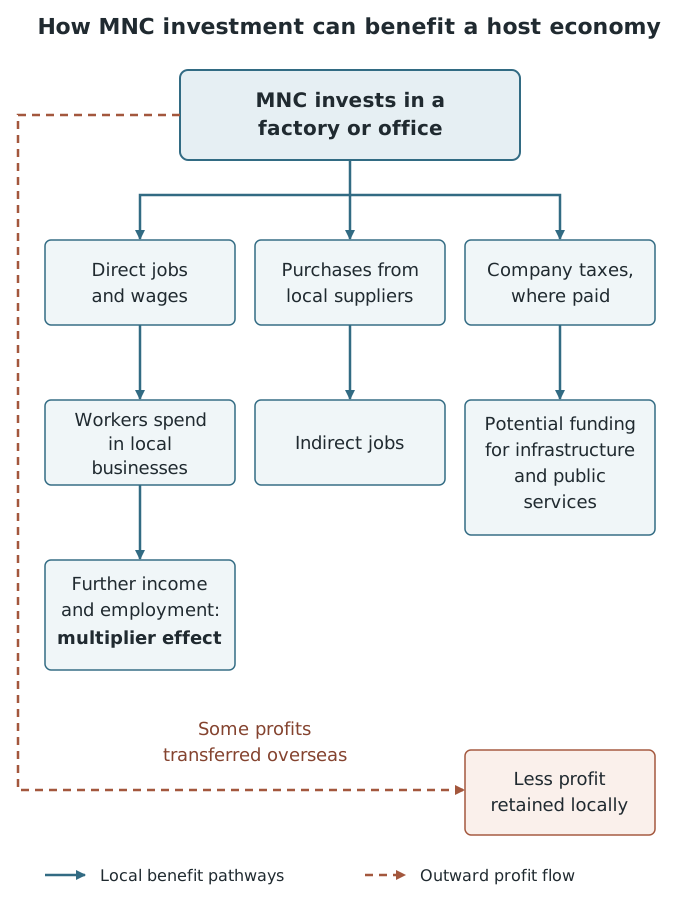
Investment can generate further local spending and jobs, but some profits may leave the host economy.
In India, Hindustan Unilever employed about 18,000 people in 2018. This provides a concrete example of employment associated with an MNC. Training by multinational businesses can also enable more skilled, higher-value work to take place in India rather than only in developed countries.
In the UK, overseas-owned businesses such as Nissan and Tata Motors support manufacturing employment. Foreign investment can bring technology and help sustain higher-value production. The manufacture of offshore wind turbine blades on the East Yorkshire coast illustrates the UK's shift towards specialised manufacturing requiring skilled workers.
Jobs do not automatically produce secure, well-paid work. Some MNC operations offer repetitive work, low wages or poor conditions. Where companies can relocate to cheaper countries, workers face job insecurity and may have limited bargaining power.
In India, large multinational businesses such as Unilever can make it difficult for smaller local firms to compete. Some profits also leave the country as payments to overseas owners or shareholders. Profit repatriation means that not all the wealth generated stays in the host economy. Tax incentives may attract investment but reduce the revenue available for public services.
Industrial expansion can increase pollution, waste, energy use and pressure on resources such as water. Cleaner technology can reduce these impacts, but environmental benefits depend on company practices and effective regulation.
The UK also experiences losses. Moving manufacturing or customer-support work overseas can close workplaces and reduce employment. Falling household incomes then affect nearby businesses. Meanwhile, people with qualifications suited to research, IT or finance may gain better-paid opportunities. Globalisation can therefore widen the gap between skilled, highly paid workers and workers whose jobs are easier to move abroad.
MNCs can reduce development gaps by bringing investment, employment, skills and technology to countries such as India. However, gains may be concentrated among particular workers, businesses and urban areas, while profits flow overseas and other communities receive little benefit.
The strongest judgement is therefore conditional. MNC investment is more likely to support lasting development when jobs are secure, workers receive training, local suppliers benefit, taxes are paid and environmental standards are enforced. A company becoming more profitable is not, by itself, evidence that development has become more equal.
Match each location advantage to its purpose:
UK: wealthy market, skills, finance and reliable infrastructure; higher costs.
India, an NIC: lower costs, growing market and skilled English-speaking workforce; infrastructure difficulties in some regions.
Benefits: investment → direct jobs and local supplier jobs → wages and further spending → multiplier effect. Training, technology and tax revenue can support development.
Costs: low pay or insecure work, local competition, profit repatriation, reduced tax receipts and environmental damage.
For a location question, link a country's characteristics to a benefit for the company: lower wages reduce production costs; a large market offers more potential sales.
Distinguish advantages for the MNC from advantages for the host country. Higher company profits do not automatically mean better local living standards.
Support explanations of impacts with named examples from the UK and India. Give the date when using an employment figure.
In an evaluation, compare benefits and costs, identify who gains or loses, and explain the conditions on which your judgement depends.
It can see this note and what your specification asks for.
Answers are free with an account.
1 free note left this week
Get more free notesYour answer sets when this note comes back for review, or marks it complete.
Was this note helpful?
Log in to tell us whether it helped, or to report a problem.
Last updated
Globalisation
The increasing connections and interdependence between countries through flows of goods, services, money, people and information.
Multinational company (MNC)
A business that owns or controls operations in more than one country, also called a transnational corporation (TNC).
Host country
A country in which an overseas company establishes operations, such as a factory or office.
Uneven development
Differences in wealth, opportunities and living standards between places or groups of people.
Newly industrialised country (NIC)
A country undergoing substantial industrial growth and economic change, although incomes and living standards remain uneven.
Foreign direct investment (FDI)
Investment by a business in operations in another country, such as establishing or expanding a factory.
Outsourcing
Paying another business to carry out an activity previously performed within a company. The activity may be outsourced within the same country or overseas.
Multiplier effect
The additional economic activity created when an initial investment or increase in income generates further spending and employment.
Profit repatriation
The transfer of profits earned overseas back to the company's home country.
Put your knowledge into practice — try past paper questions for Geography A
Globalisation
The increasing connections and interdependence between countries through flows of goods, services, money, people and information.
Multinational company (MNC)
A business that owns or controls operations in more than one country, also called a transnational corporation (TNC).
Host country
A country in which an overseas company establishes operations, such as a factory or office.
Uneven development
Differences in wealth, opportunities and living standards between places or groups of people.
Newly industrialised country (NIC)
A country undergoing substantial industrial growth and economic change, although incomes and living standards remain uneven.
Foreign direct investment (FDI)
Investment by a business in operations in another country, such as establishing or expanding a factory.
Outsourcing
Paying another business to carry out an activity previously performed within a company. The activity may be outsourced within the same country or overseas.
Multiplier effect
The additional economic activity created when an initial investment or increase in income generates further spending and employment.
Profit repatriation
The transfer of profits earned overseas back to the company's home country.
MNCs can narrow gaps between countries but widen inequalities within them. Lasting benefits depend on job quality, training, local links, taxation and environmental protection.