

Loading…
Loading…
Loading…
Eduqas GCSE Geography A · C111
Eduqas C111 · 1.3.1 Check the specification (PDF) (opens in a new tab)
A is the area of land drained by a river and its tributaries towards a common outlet, such as the river mouth. A tributary is a smaller stream or river that joins a larger one. Rain falling on different parts of a basin can therefore eventually reach the same river.
A drainage basin is an open system within the wider water cycle: water enters from outside it and can leave it. Its main input is precipitation — rain, snow, sleet or hail. Within the basin, water is held in stores and moves between them by transfers, also called flows. Water leaves as an output, either through the river’s outlet or as water vapour returning to the atmosphere.
These categories describe what water is doing. Water held in a pond is a store; water moving across the ground towards that pond is a flow.
Water does not all reach a river immediately after rain falls. It can be held temporarily in several places:
Stores delay the movement of water through a basin. They are not permanent containers: water can enter and leave them as conditions change.
When water reaches the ground, it can follow different routes. Infiltration is its downward movement from the surface into the soil. This adds water to the soil moisture store.
Once in the soil, water may move sideways downslope towards a river. This is throughflow. Alternatively, it may move down into the pores and cracks of the rock beneath the soil by percolation, adding to the groundwater store. Groundwater flow then carries water slowly through permeable rock towards the river.
Water can also travel across the ground surface as overland flow, or surface runoff. When soil is saturated, there is no available space for more water, so additional rain is more likely to flow over the surface into a channel. Intense rainfall can also supply water faster than it can infiltrate.
These routes are alternatives, not a sequence that every drop must follow. Some water travels over the surface, some moves through soil, and some reaches the deeper groundwater store.
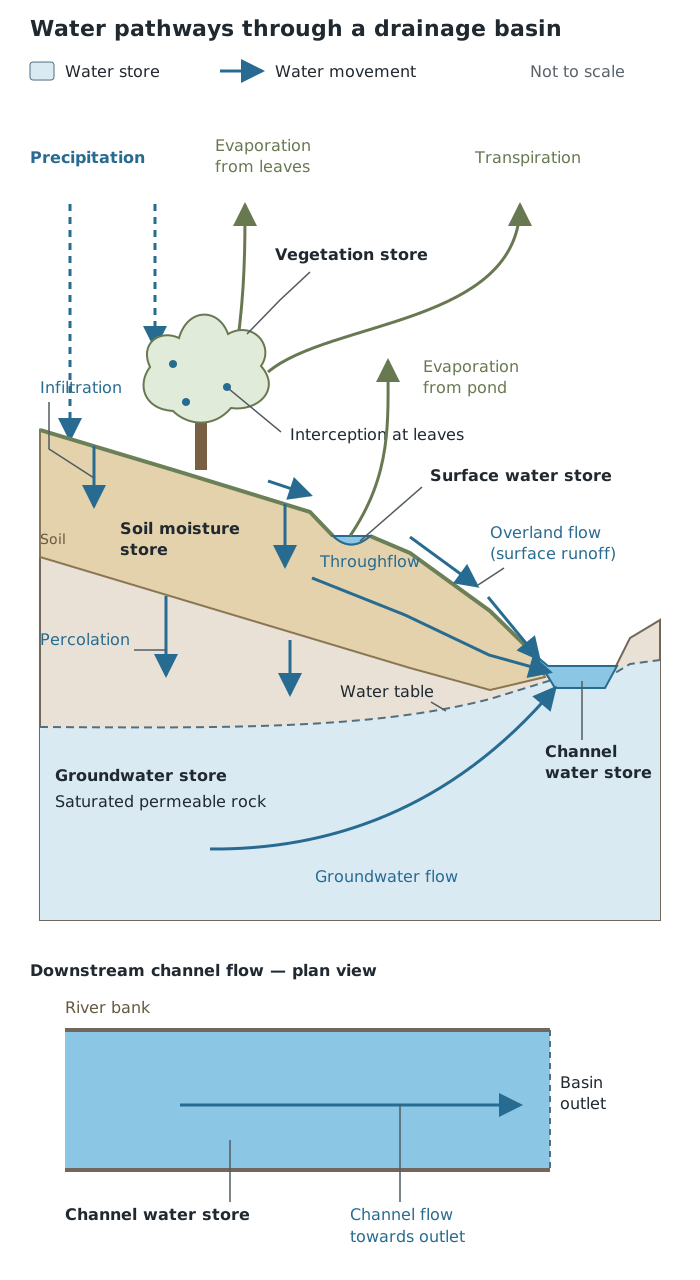
Water can reach a river across the surface, through soil or through rock. Stores hold water temporarily, while arrows show transfers and outputs. The inset shows downstream flow along the river channel.
Consider rain falling on a wooded hillside in a UK drainage basin. Some rain is intercepted by leaves and branches, so it does not reach the soil immediately. Some of this water evaporates; other water later drips or runs down onto the ground. Interception therefore delays and can reduce the amount of water reaching the surface.
If the soil has available pore space, water reaching it can infiltrate. This increases the soil moisture store, from which water can move by throughflow or percolation. Vegetation can also encourage infiltration, allowing more water to enter the soil rather than flow across its surface.
During prolonged rainfall, the soil moisture store may fill. As saturation develops, less additional water can infiltrate and more travels by overland flow. The balance between stores and flows has changed: a filled soil store encourages a surface route to the river.
Overland flow generally delivers water to channels more quickly than the slow route through groundwater. The route taken therefore affects both how much water reaches the river and when it arrives.
Water reaching a river moves downstream by channel flow and eventually leaves the drainage basin through its outlet. River discharge describes the volume of water passing a point in the river per unit of time.
Water also returns to the atmosphere. Evaporation changes liquid water from surfaces such as lakes, wet soil and leaves into water vapour. Plants absorb water through their roots and release water vapour through transpiration. Together, these losses are called evapotranspiration.
A basin therefore links several routes: precipitation replenishes stores, transfers redistribute water, and outputs remove it. Changing one part of the system, such as how full the soil store is, changes the routes available elsewhere.
Interception delays water reaching the ground; some intercepted water evaporates.
Available soil pore space allows infiltration → replenishes soil moisture → supplies throughflow and percolation.
Prolonged rainfall → soil store fills → saturation → less further infiltration → more overland flow.
Stores delay water movement. Overland flow generally reaches channels faster than groundwater flow.
Distinguish a store, where water is held, from a flow, which moves water between stores.
Keep the directions clear: infiltration is down into soil; throughflow is sideways through soil; percolation is down into rock.
For an explanation, link processes in a causal chain: prolonged rainfall fills the soil moisture store, saturation reduces further infiltration, and more water moves by overland flow.
Interception delays water reaching the ground; it does not permanently prevent all rainfall from reaching it.
It can see this note and what your specification asks for.
Answers are free with an account.
1 free note left this week
Get more free notesYour answer sets when this note comes back for review, or marks it complete.
Was this note helpful?
Log in to tell us whether it helped, or to report a problem.
Last updated
Drainage basin
The area of land drained by a river and its tributaries towards a common outlet, such as the river mouth.
Open system
A system with inputs and outputs that cross its boundary. A drainage basin receives precipitation and loses water through its outlet and to the atmosphere.
Precipitation
Water entering a drainage basin as rain, snow, sleet or hail.
Store
A place where water is held temporarily, such as vegetation, soil, a lake or underground rock.
Transfer
A process that moves water from one store or part of a drainage basin to another.
Interception
The catching and temporary holding of precipitation by vegetation, such as leaves and branches.
Infiltration
The downward movement of water from the ground surface into the soil.
Throughflow
The sideways movement of water through soil towards a river channel or another surface water body.
Overland flow
Water flowing across the ground surface towards a river channel; also called surface runoff.
Percolation
The downward movement of water through pores and cracks into rock beneath the soil.
Groundwater flow
The slow movement of water through permeable rock towards a river or another water body.
Water table
The upper surface of the groundwater store.
Saturation
The condition in which the available pore spaces in soil are filled with water.
Evapotranspiration
The combined loss of water to the atmosphere through evaporation and transpiration from plants.
Put your knowledge into practice — try past paper questions for Geography A
Drainage basin
The area of land drained by a river and its tributaries towards a common outlet, such as the river mouth.
Open system
A system with inputs and outputs that cross its boundary. A drainage basin receives precipitation and loses water through its outlet and to the atmosphere.
Precipitation
Water entering a drainage basin as rain, snow, sleet or hail.
Store
A place where water is held temporarily, such as vegetation, soil, a lake or underground rock.
Transfer
A process that moves water from one store or part of a drainage basin to another.
Interception
The catching and temporary holding of precipitation by vegetation, such as leaves and branches.
Infiltration
The downward movement of water from the ground surface into the soil.
Throughflow
The sideways movement of water through soil towards a river channel or another surface water body.
Overland flow
Water flowing across the ground surface towards a river channel; also called surface runoff.
Percolation
The downward movement of water through pores and cracks into rock beneath the soil.
Groundwater flow
The slow movement of water through permeable rock towards a river or another water body.
Water table
The upper surface of the groundwater store.
Saturation
The condition in which the available pore spaces in soil are filled with water.
Evapotranspiration
The combined loss of water to the atmosphere through evaporation and transpiration from plants.