

Loading…
Loading…
Loading…
Eduqas GCSE Film Studies · C670
Eduqas C670 Check the specification (PDF) (opens in a new tab)
Cinematography is the creation of a film’s photographic images through choices about the camera and lighting. This lesson focuses on camera distance, angle and movement: how much we see, where we see it from and how our viewpoint moves.
A shot is a continuous image presented without an intervening edit. Within one shot, the camera might remain still or move from a wide view towards a face. These choices help portray characters and settings, direct our attention and shape our response as spectators — individual members of the audience.
Shot size describes how much of the subject and its surroundings appears within the image. For a person, body landmarks provide useful guides, rather than rigid measurements.
| Shot size | What it typically shows | What this can contribute |
|---|---|---|
| Extreme close-up | A small detail filling the frame, such as an eye or a hand gripping an object | Makes the detail difficult to ignore; can heighten emotion or signal its importance |
| Close-up | A face, usually from approximately the shoulders upwards, or an object in detail | Makes expressions readable, encouraging intimacy, sympathy or scrutiny |
| Medium shot | A person from approximately the waist upwards | Combines facial expression with gesture and body language |
| Long shot |
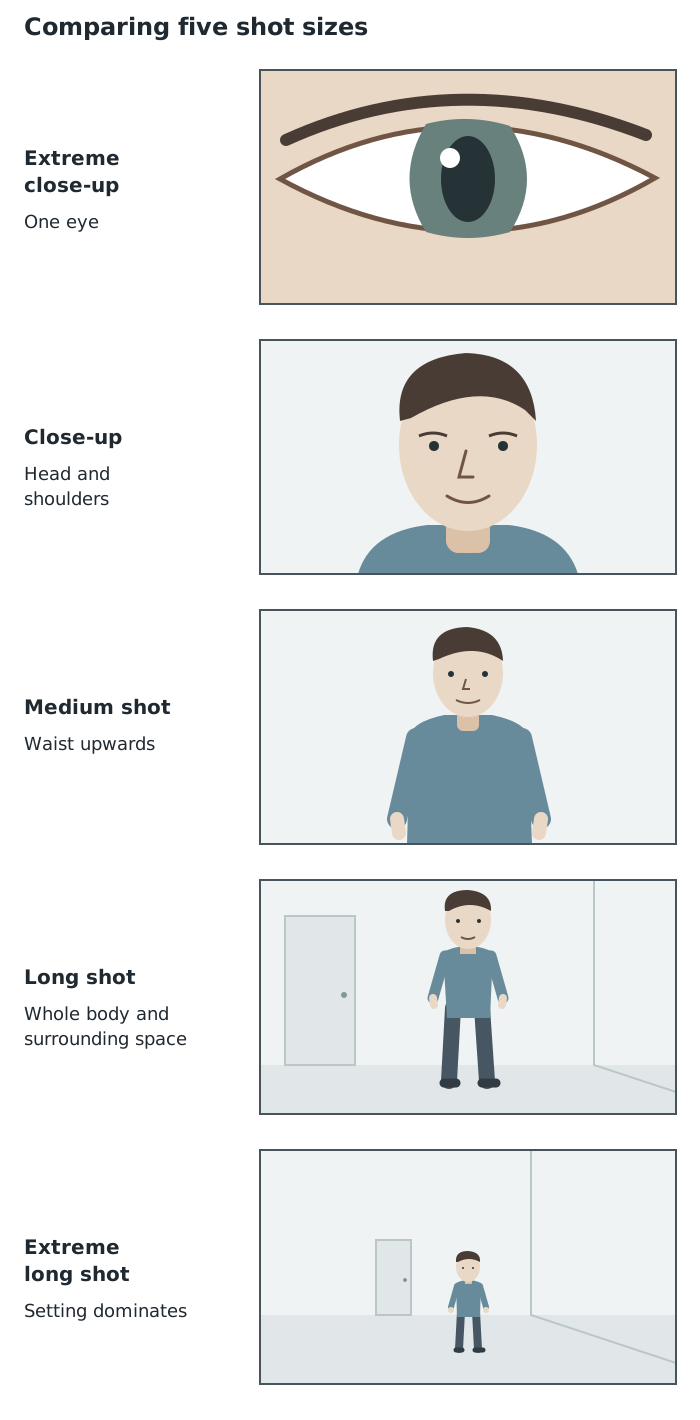
Closer views reveal detail; wider views show more of the relationship between a person and their surroundings.
Imagine a person standing alone in a large room. A long shot can show their posture and the empty space around them. A close-up can instead concentrate our attention on their expression. Neither shot automatically means loneliness: the person might be frightened, relieved or enjoying solitude. The visible details and story give the technique its particular meaning.
Wider shots are especially useful for introducing locations. An establishing shot describes this function, rather than a separate fixed shot size. In Rabbit-Proof Fence, the wide, sweeping landscape shots of the Australian bush make the setting prominent, giving spectators a sense of its scale.
Camera angle describes the viewpoint from which the subject is filmed. A high-angle shot is filmed from above eye level, looking down on a subject. It can make a character seem smaller or more vulnerable, or simply help us understand where they are within a space. Vulnerability is not an automatic meaning: the character’s actions and the film’s style shape how we interpret the viewpoint.
A low-angle shot is filmed from below eye level, looking upwards. It can make a character appear larger, powerful or threatening. Whether we admire or fear that power depends on the scene.
A canted angle has a sloping horizon because the camera is rolled sideways. Eduqas includes 60° angle shots (off-centre shots) in its terminology. This pronounced lack of level can suggest imbalance, transition or instability: the image itself seems out of balance. Its particular meaning depends on what is happening in the scene.
An aerial shot views a location from high above the ground. It can reveal the layout of a place or the scale of an event. People may appear tiny within their surroundings, encouraging us to consider the setting rather than an individual expression. Unlike the term high angle, which describes looking down on a subject, aerial emphasises the elevated viewpoint over a location.
Shot size and angle work together. A low-angle close-up can make a face imposing, while a high-angle long shot can emphasise a person’s exposure within a large space.
The first distinction is whether the camera turns from a fixed position or travels to a new position.
A pan turns the camera horizontally, like turning your head left or right. It can follow action or reveal a setting gradually. A tilt turns the camera vertically, like looking upwards or downwards. Tilting upwards along a building can reveal its height; tilting downwards can lead our attention towards a significant detail. A tilt movement is different from a canted angle: one changes the direction of the view over time, while the other makes the horizon slope.
In a tracking shot, the camera itself moves forwards, backwards or sideways. Moving alongside a character can keep us involved in their journey. Tracking in towards a face can build intensity by bringing us progressively closer to a reaction. Tracking out can reveal surroundings that change our understanding of the character’s situation.
A dolly is a wheeled camera platform used to produce movement, sometimes along rails. A dolly shot is therefore a way of creating a travelling shot, not the opposite of tracking. Moving the camera physically changes its position relative to the subject and background.
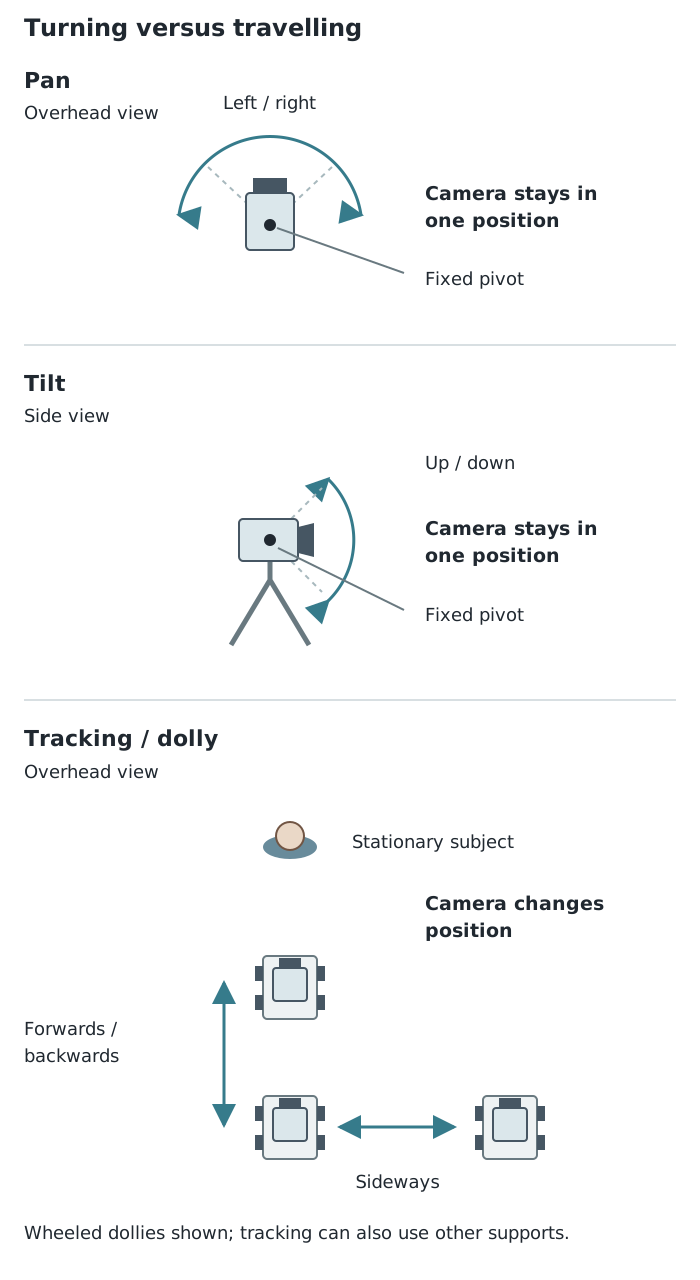
A pan or tilt turns the camera; a tracking shot moves it to a different position.
With a hand-held camera, the operator holds and carries the camera. Their movement may produce visible shake. This can make action feel immediate, unsettled or documentary-like, placing us close to a character’s experience. Hand-held footage contributes to the nostalgic style of Richard Ayoade’s Submarine, showing that it is not used only for danger or frantic action.
A Steadicam is a stabilising system attached to the operator. Its balanced support reduces the effect of their body movements, producing smoother footage than ordinary hand-held filming. It allows the camera to follow a character through a space while keeping the image relatively steady. Spectators can feel as though they are moving with the character without being distracted by pronounced shake.
In George Tillman Jr.’s The Hate U Give (2018), Starr Carter moves between her home community, Garden Heights, and her school, Williamson Prep. Camera choices help us understand her relationships and experience of these places.
During the introduction to Starr’s home and school life, many shots inside the house are medium-close-ups or close-ups. These show friendly smiles and affectionate looks between family members. The camera’s closeness makes those expressions readable, encouraging us to experience the household as loving and welcoming.
Starr’s parents are frequently shown together in two-shots — shots containing two people. Sharing the image reinforces their connection. Outside, wider shots establish the locations and their atmosphere, shifting attention from individual expressions towards the community. Across the film, camera movement follows Starr and the action, keeping her experience central to our attention.
These choices also work with other elements of film form. The home’s warm light reinforces the welcoming impression created by the close views of smiling faces. Camera technique does not create meaning in isolation from what is shown or heard.
Analysis connects a visible choice to meaning and spectator response. Begin with the technique, identify what it allows us to see, then explain why that matters in this moment.
For example: ‘In the introduction to Starr’s family in The Hate U Give, close-ups make the family members’ smiles and affectionate looks clearly visible. This presents their relationships as loving and encourages spectators to feel welcomed into Starr’s home.’
This goes beyond naming a close-up: it explains the evidence within the image and how the camera helps us interpret it. When studying movement, follow the shot from beginning to end, noticing what is revealed or concealed as the viewpoint changes. A single still can show shot size or angle, but it cannot establish how the camera moves.
Technique → precise visible evidence → portrayal of character or setting → spectator response.
In The Hate U Give, close views reveal affectionate family expressions, two-shots connect Starr’s parents, and wider exterior shots establish her community. Interpret techniques in context, not as fixed codes.
Name the technique, describe a precise moment, then explain what it suggests about a character or setting and how it may affect the spectator.
Shot size, angle and movement describe different features: a shot can be a low-angle close-up that tracks towards a character.
Distinguish a pan or tilt, where the camera turns from a fixed position, from tracking, where the camera changes position.
Do not give techniques fixed meanings. Support your interpretation with the action, expression and circumstances of the scene.
Only name a particular camera support, such as a dolly or Steadicam, when you have evidence for it. Smooth movement alone does not prove which equipment was used.
It can see this note and what your specification asks for.
Answers are free with an account.
1 free note left this week
Get more free notesYour answer sets when this note comes back for review, or marks it complete.
Was this note helpful?
Log in to tell us whether it helped, or to report a problem.
Last updated
Cinematography
The creation of a film’s photographic images through choices about camera distance, angle, movement, lighting and the appearance of the footage.
Shot
One continuous image recording, presented without an intervening edit.
Extreme close-up
A shot in which a small detail, such as an eye or an object, fills the frame.
Close-up
A shot that shows a face or object in detail; a person is typically shown from approximately the shoulders upwards.
Medium shot
A shot that typically shows a person from approximately the waist upwards, combining facial expression with body language.
Long shot
A shot that shows a person’s whole body and some surrounding setting.
Extreme long shot
A very wide view in which the setting dominates and any people appear small.
High-angle shot
A shot filmed from above eye level, looking down on the subject.
Low-angle shot
A shot filmed from below eye level, looking up at the subject.
Canted angle
A shot with a sloping rather than level horizon, created by rolling the camera sideways; also called an off-centre or Dutch-angle shot.
Aerial shot
A shot filmed from high above the ground, often providing a broad view of a location.
Pan
A horizontal camera turn to the left or right from a fixed position.
Tilt
A vertical camera turn upwards or downwards from a fixed position.
Tracking shot
A shot in which the camera changes position, moving forwards, backwards or sideways.
Dolly
A wheeled platform supporting a camera, used to create camera movement.
Hand-held shot
A shot filmed with the camera held by an operator, which may show visible shake.
Steadicam
A camera stabilising system worn by an operator that reduces the effect of their body movements, allowing smooth moving shots.
Spectator
An individual member of a film’s audience.
Put your knowledge into practice — try past paper questions for Film Studies
Cinematography
The creation of a film’s photographic images through choices about camera distance, angle, movement, lighting and the appearance of the footage.
Shot
One continuous image recording, presented without an intervening edit.
Extreme close-up
A shot in which a small detail, such as an eye or an object, fills the frame.
Close-up
A shot that shows a face or object in detail; a person is typically shown from approximately the shoulders upwards.
Medium shot
A shot that typically shows a person from approximately the waist upwards, combining facial expression with body language.
Long shot
A shot that shows a person’s whole body and some surrounding setting.
Extreme long shot
A very wide view in which the setting dominates and any people appear small.
High-angle shot
A shot filmed from above eye level, looking down on the subject.
Low-angle shot
A shot filmed from below eye level, looking up at the subject.
Canted angle
A shot with a sloping rather than level horizon, created by rolling the camera sideways; also called an off-centre or Dutch-angle shot.
Aerial shot
A shot filmed from high above the ground, often providing a broad view of a location.
Pan
A horizontal camera turn to the left or right from a fixed position.
Tilt
A vertical camera turn upwards or downwards from a fixed position.
Tracking shot
A shot in which the camera changes position, moving forwards, backwards or sideways.
Dolly
A wheeled platform supporting a camera, used to create camera movement.
Hand-held shot
A shot filmed with the camera held by an operator, which may show visible shake.
Steadicam
A camera stabilising system worn by an operator that reduces the effect of their body movements, allowing smooth moving shots.
Spectator
An individual member of a film’s audience.
| A person’s whole body with surrounding space |
| Shows movement and the relationship between the character and the setting |
| Extreme long shot | A broad setting, with people small or possibly absent | Establishes scale and geography; can suggest isolation or create awe |