

Loading…
Loading…
Loading…
Eduqas GCSE English Literature · C720
Eduqas C720 Check the specification (PDF) (opens in a new tab)
H. G. Wells’s The War of the Worlds follows an invasion of southern England by Martians whose own planet is becoming uninhabitable. Their advanced machines and weapons overturn the ordinary lives of people who initially assume that humanity is secure and powerful.
The novel has two books. Book One, The Coming of the Martians, traces the arrival of the invaders and the collapse of human resistance. Book Two, The Earth under the Martians, concentrates on survival under Martian domination, before the invasion unexpectedly ends.
An unnamed narrator tells the story in the first person, looking back about six years after the invasion. He is both a survivor describing frightening experiences and a reflective writer trying to understand them. His account includes information he discovered afterwards, so his knowledge when telling the story is greater than his knowledge while living through it.
The narrator and the astronomer Ogilvy observe unusual activity on Mars. An object thought to be a meteorite then lands on Horsell Common, near Woking. Ogilvy discovers that it is an artificial cylinder, and crowds gather to inspect it. The narrator suspects that it comes from Mars but doubts that it contains living creatures.
When the cylinder opens, tentacled Martians emerge. Curiosity gives way to horror. A deputation carrying a white flag approaches to communicate peacefully, but the Martians kill its members, including Ogilvy and the journalist Henderson, with the Heat-Ray. The narrator flees. Panic also spreads along the Chobham road, where people are crushed in the struggle to escape.
These chapters establish the pattern of the invasion: humans misunderstand the danger, then discover that their familiar assumptions offer little protection.
The exhausted narrator returns to his wife. Ordinary routines continue around the disaster, and people still hope that the army can control the situation. More cylinders arrive, however, reinforcing the Martians.
When fighting threatens the narrator’s home, he obtains a horse and cart from the landlord of the Spotted Dog and takes his wife to relatives in Leatherhead. He leaves her there and returns, intending to fulfil his promise to bring back the cart. This decision separates the couple for most of the novel. His desire to reach his wife becomes a continuing motive, connecting the large-scale invasion to a personal story of loss and uncertainty.
Returning through a thunderstorm, the narrator sees enormous three-legged fighting-machines. The Martians’ difficulty moving their bodies on Earth has not prevented them from travelling in powerful mechanical vehicles. His cart overturns, and he eventually reaches his house after seeing the dead landlord.
An artilleryman takes refuge in his garden and describes the destruction of his battery. The two men leave together, encountering soldiers and civilians who do not yet fully understand the threat.
At Weybridge and Shepperton, artillery destroys one fighting-machine, briefly proving that the invaders can be killed. Yet the remaining Martians devastate the area. The narrator escapes through the river and becomes separated from the artilleryman. Afterwards, he meets a curate, a clergyman traumatised by the destruction of Weybridge. The curate becomes his travelling companion.
The brief military success does not reverse the invasion. Wells repeatedly allows hope to rise before exposing how limited human resistance is.
The novel now widens beyond the narrator’s experiences in Surrey. Chapter 14 introduces his younger brother’s experiences in London; Chapter 15 returns to the narrator and the fighting in Surrey; Chapters 16 and 17 follow the brother’s escape. These are parallel events, not adventures experienced by the narrator himself.
London’s initial uncertainty becomes mass panic as the Martians advance and deploy poisonous Black Smoke. The brother escapes and helps Mrs Elphinstone and her sister-in-law, Miss Elphinstone, resist attackers. Together they travel through crowds of exhausted refugees towards the Essex coast.
They board a steamer bound for Ostend in Belgium. When fighting-machines threaten the shipping, the warship Thunder Child attacks. It brings down two Martians but is itself destroyed, allowing the refugees’ vessel to continue escaping.
Meanwhile, the narrator and the curate are sheltering at Halliford, cut off by Black Smoke. The change of viewpoint therefore shows both the national scale of the catastrophe and the contrasting experiences of people caught within it: some flee in crowds while others remain trapped and isolated.
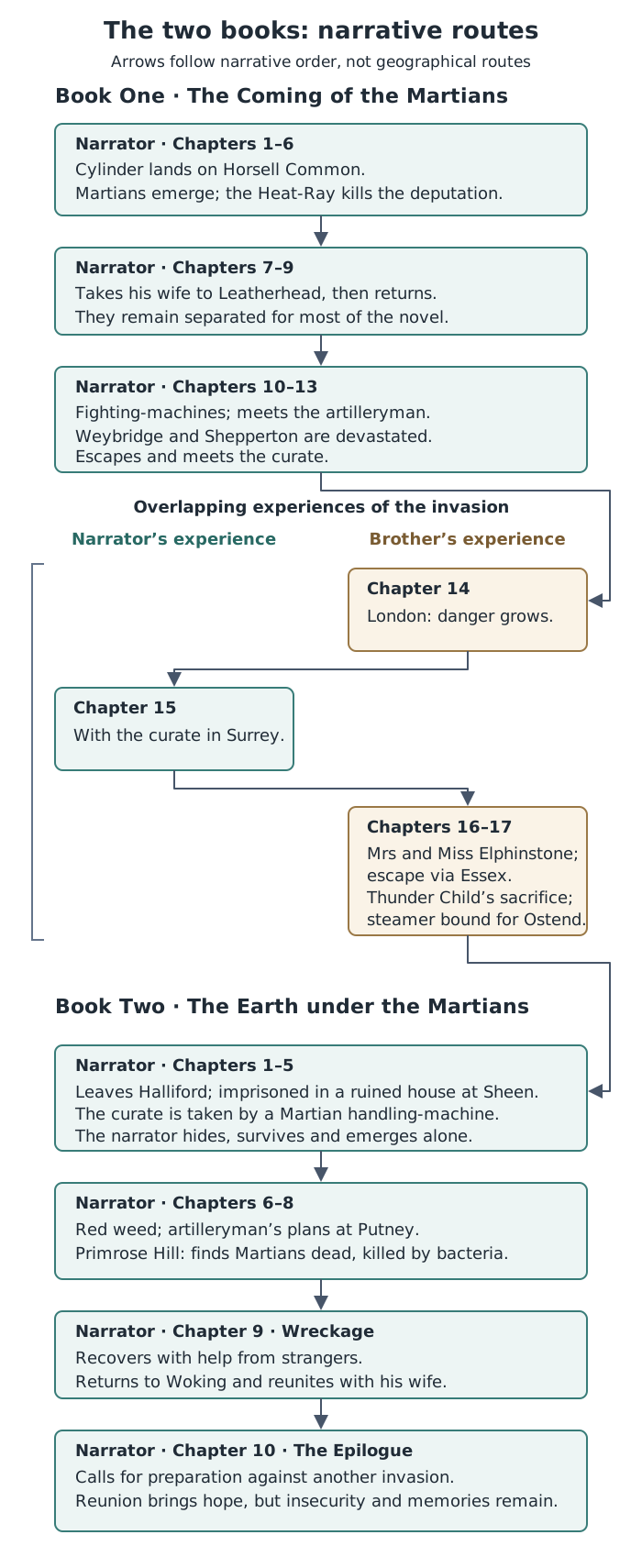
Book One alternates between two overlapping experiences of the invasion; Book Two returns to the narrator’s survival and its aftermath.
Book Two returns to the narrator’s own story. Once the Black Smoke clears, he and the curate leave Halliford. They eventually find food in a house at Sheen, but the fifth cylinder falls nearby and buries them beneath the wreckage.
Through a gap in the ruined wall, they observe the Martians and their machinery. The narrator learns that the invaders feed by taking blood from living humans. Survival now depends on remaining hidden, quiet and careful with their limited food.
Their relationship deteriorates. The curate becomes increasingly distressed, consumes provisions without restraint and speaks loudly enough to endanger them. In Chapter 4, the narrator strikes him with the butt of a meat chopper. A Martian handling-machine investigates and drags the curate away. The narrator survives by hiding among coal and firewood in the cellar.
After further days alone, he discovers that the Martians have left the pit. In Chapter 5, he emerges from the ruined house. The wide-ranging movement of Book One has narrowed into confinement, making the invasion a struggle over food, silence and individual survival.
Outside, the narrator finds a landscape transformed by red weed, a Martian plant that spreads particularly vigorously through water. It later succumbs to disease. He searches for food and makes his way towards Putney.
In Chapter 7, he meets the artilleryman again. The soldier proposes an underground human community that would preserve knowledge and eventually learn to use Martian machines. The narrator is initially impressed, but the artilleryman’s limited digging and preference for drinking and games reveal the gulf between his ambitious plans and his actions. The narrator leaves him and continues into London.
In Chapter 8, ‘Dead London’, he walks through deserted streets and hears a Martian’s haunting cry. At Primrose Hill, he discovers the invaders dead. Earth’s bacteria have killed them: their technological superiority has not protected them from organisms against which their bodies were unprepared.
This reversal connects the plot to Wells’s biological interests. Humanity survives not through a decisive military victory, but because life on Earth has developed resistance through a long struggle with disease.
In Chapter 9, ‘Wreckage’, the narrator suffers a mental collapse and is cared for by strangers. Recovery begins around him as people return and supplies arrive. Believing that his wife died when Leatherhead was destroyed, he makes a sorrowful journey home to Woking. There, unexpectedly, he finds her alive and they are reunited.
Chapter 10, ‘The Epilogue’, considers the invasion’s consequences. The narrator urges preparation for another attack and reflects on humanity’s changed understanding of its place in the universe. Yet memories of destruction still interrupt his ordinary life. The return home completes the journey without restoring his former certainty.
The narrator opens Book One Chapter 1 with ‘No one would have believed in the last years of the nineteenth century’. This retrospective phrase establishes a distance between humanity’s earlier confidence and the knowledge gained through catastrophe. The sweeping opening concerns an entire civilisation, fitting an invasion story that challenges late Victorian confidence in human and British power.
The final sentence, spoken by the narrator in Book Two Chapter 10, is much more intimate: ‘And strangest of all is it to hold my wife’s hand again, and to think that I have counted her, and that she has counted me, among the dead.’
The balanced clauses give husband and wife matching experiences of presumed loss. Holding hands makes their survival tangible, but ‘among the dead’ leaves death present in the final words. The ending can therefore be read as hopeful because their relationship survives, and unsettling because neither can simply forget the invasion. Wells moves from the fate of the world to the emotional cost for two people.
Locate an extract within the plot: explain what has happened before it and how a later event develops or changes its meaning.
Use plot details to support an argument about the question, rather than retelling the whole story.
Distinguish the narrator’s direct experiences from the account he gives of his brother’s escape.
When discussing the ending, include both the reunion and the continuing fear in the Epilogue.
It can see this note and what your specification asks for.
Answers are free with an account.
1 free note left this week
Get more free notesYour answer sets when this note comes back for review, or marks it complete.
Was this note helpful?
Log in to tell us whether it helped, or to report a problem.
Last updated
Plot
The sequence of events in a story, including how one event leads to another.
First-person narrator
A voice that tells a story using ‘I’, presenting events through its own experiences and understanding.
Retrospective narrative
Storytelling that looks back on events after they have happened. The storyteller can combine memories with knowledge gained later.
Parallel narrative
Two connected sequences of events involving different characters, presented as happening during the same period.
Epilogue
A concluding section that considers what happens after the main action and what those events mean.
Put your knowledge into practice — try past paper questions for English Literature
Plot
The sequence of events in a story, including how one event leads to another.
First-person narrator
A voice that tells a story using ‘I’, presenting events through its own experiences and understanding.
Retrospective narrative
Storytelling that looks back on events after they have happened. The storyteller can combine memories with knowledge gained later.
Parallel narrative
Two connected sequences of events involving different characters, presented as happening during the same period.
Epilogue
A concluding section that considers what happens after the main action and what those events mean.