

Loading…
Loading…
Loading…
Eduqas GCSE Design and Technology · C600
Eduqas C600 Check the specification (PDF) (opens in a new tab)
A timber product must carry loads without breaking or changing shape so much that it stops working properly. A chair carries a person’s weight; a shelf carries books. Both natural timber and manufactured boards experience internal stress when forces act on them.
Three important actions are compression, tension and shear. Compression pushes material together: the legs of a loaded stool are mainly being compressed. Tension pulls material apart and tends to stretch it. Shear tends to make one part slide past another, so it matters where parts meet and transfer loads through joints or fixings.
Bending combines different stresses. Imagine a shelf supported at its ends with heavy books in the middle. As it sags, fibres along its upper surface are compressed, while fibres along its lower surface are stretched. A designer therefore needs a shelf that resists both deformation and failure.
Stiffness means resistance to deformation under a load. Strength means resistance to failure. A shelf can be strong enough not to break but insufficiently stiff to remain acceptably straight.
Natural timber has fibres running mainly along its grain. It is generally much stronger and stiffer along these fibres than across them. The direction in which a piece is used therefore matters, not just its size.
Different wood species also have different properties. Oak, for example, is a strong timber used for furniture. However, species alone does not guarantee that every piece will perform equally well. Knots disturb the direction of the fibres and can create weaker regions in a loaded component.
Manufactured boards do not all behave in the same way. Plywood retains wood grain within its veneer layers, but the layers are arranged to provide strength in different directions. MDF has no continuous natural grain running through the board. A designer must consider the particular board rather than treating all manufactured timber as structurally identical.
A cross-section is the shape seen when a component is cut across its length. Increasing its area generally allows more material to carry the load. For the same wood and loading conditions, a larger section can usually withstand a greater load than a smaller one.
For a beam or shelf that bends, the depth of the section is especially important. Depth is the dimension in the direction of bending: for a horizontal beam carrying a downward load, it is the vertical dimension.
Imagine using the same rectangular timber strip in two orientations. Laid flat, it has a shallow vertical depth and bends relatively easily. Turned onto its edge, it has a greater vertical depth and resists bending much more effectively. Its cross-sectional area has not changed, but the distribution of material has.
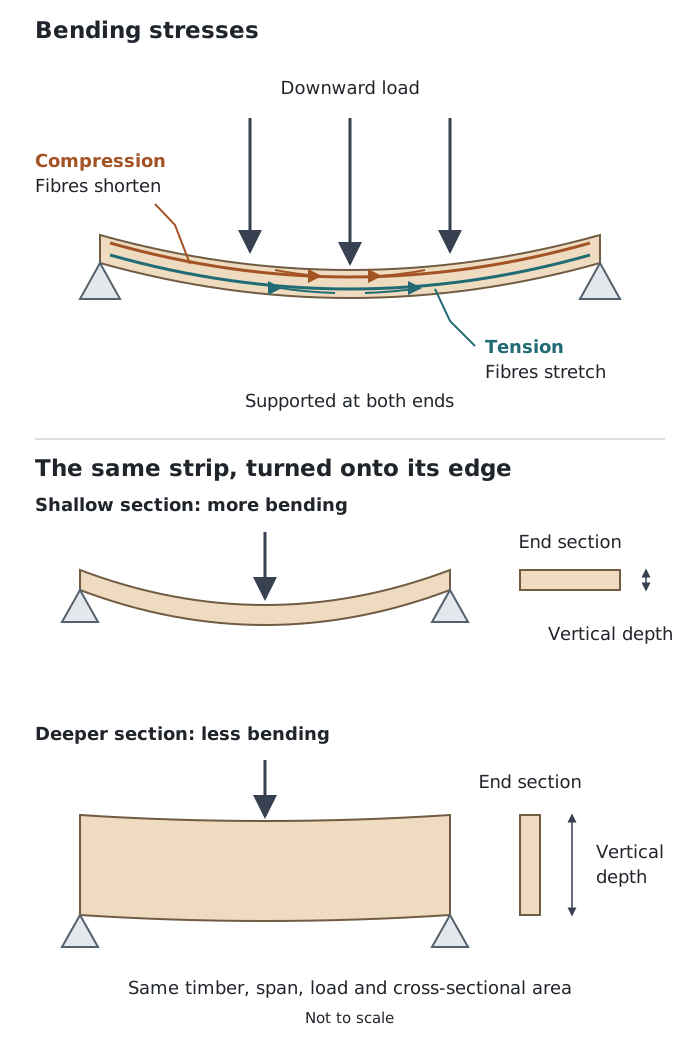
A sagging beam combines compression and tension. Turning a rectangular section onto its edge increases its depth and resistance to bending.
A deeper seat rail can therefore help prevent a bench from sagging. This comparison assumes the same timber, distance between supports and load. Making a member wider can also help, but simply comparing cross-sectional areas misses the important effect of depth.
Lamination bonds layers together so that they act as one component. The adhesive connection is important: loosely stacked strips can slide relative to one another, whereas properly bonded layers work together to resist bending.
Natural timber can be reinforced by bonding thinner timber layers into a thicker laminated member. In a laminated beam, the grain normally runs along the beam in each layer. The resulting deeper section can provide greater stiffness and load-carrying capacity than an individual thin strip. Thin layers can also be shaped over a former before the adhesive cures, allowing curved components to be made.
Plywood uses a different arrangement. It consists of thin wood sheets called veneers, with the grain of adjacent layers at right angles, or , to one another. A layer that is relatively weak across its grain is supported by neighbouring layers whose fibres run in that direction. This gives the board strength and rigidity in more than one direction and helps it resist distortion.
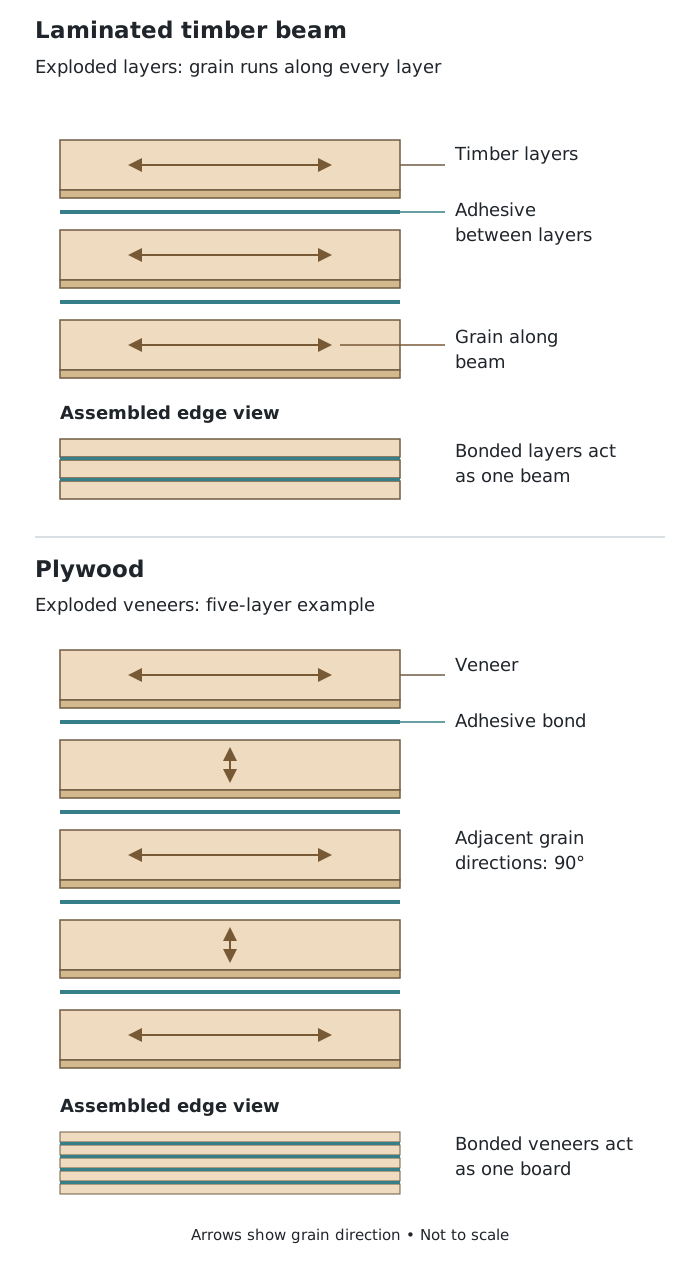
Both products use bonded layers, but laminated beams and plywood arrange their grain differently.
The number of layers also affects plywood’s strength. With comparable veneer material, layer thickness and bonding quality, adding layers makes a thicker board that generally carries more load and resists bending better. Crossed grain does not make plywood unbreakable: layer number, overall thickness and sound adhesive bonds still matter.
Strong timber alone does not guarantee a strong product. Loads must pass from one component to another through its joints and fixings. If a connection separates or allows excessive movement, the whole product can fail even when its individual pieces remain intact.
A glued butt joint, where the edges or ends of pieces meet without interlocking, is simple but relatively weak. A mortise and tenon joint fits a projecting tenon into a matching mortise and is glued. Its fitted surfaces and adhesive bond make it suitable for strong frame connections, such as those in a chair. A dovetail joint uses flared interlocking fingers that resist being pulled apart, making it useful for box or drawer corners. These stronger joints require more accurate and complex manufacture than a simple butt joint.
Screws and nuts and bolts provide connections that can be dismantled. Their suitability depends on how well the fixing engages with the material and transfers the load. A pilot hole guides a woodscrew and helps prevent splitting: a fixing that splits the timber can weaken the connection it was intended to secure.
For a chair frame carrying repeated loads, a well-made mortise and tenon joint may be preferable to a simple glued butt joint. For a product that must be dismantled for transport or repair, suitable screws or bolts may be preferable to a permanent glued connection. The best choice balances load resistance, accurate assembly and whether dismantling is needed.
Distinguish strength from stiffness: a timber part may bend too much before it breaks.
When comparing sections, keep the timber species, span and load the same. State that depth is measured in the direction of bending.
Explain reinforcement through its mechanism: perpendicular grain in adjacent plywood layers provides strength in different directions.
Justify a joint or fixing for the particular load and product, rather than simply calling it ‘strong’.
A larger section increases a component’s load-carrying capacity; it does not change the inherent properties of the wood species.
It can see this note and what your specification asks for.
Answers are free with an account.
1 free note left this week
Get more free notesYour answer sets when this note comes back for review, or marks it complete.
Was this note helpful?
Log in to tell us whether it helped, or to report a problem.
Last updated
Strength
The ability of a material or component to withstand forces without failing.
Stiffness
The resistance of a material or component to deformation, such as bending, under a load.
Stress
The internal force per unit area within a material caused by an applied load.
Compression
A pushing action that tends to squash or shorten a material.
Tension
A pulling action that tends to stretch a material.
Shear
An action that tends to make adjacent parts of a material slide past one another.
Cross-section
The shape and area exposed by cutting across a component, perpendicular to its length.
Lamination
Bonding layers of material together with adhesive to form a single component.
Grain
The direction of the fibres in wood, which affects its strength and stiffness.
Put your knowledge into practice — try past paper questions for Design and Technology
Strength
The ability of a material or component to withstand forces without failing.
Stiffness
The resistance of a material or component to deformation, such as bending, under a load.
Stress
The internal force per unit area within a material caused by an applied load.
Compression
A pushing action that tends to squash or shorten a material.
Tension
A pulling action that tends to stretch a material.
Shear
An action that tends to make adjacent parts of a material slide past one another.
Cross-section
The shape and area exposed by cutting across a component, perpendicular to its length.
Lamination
Bonding layers of material together with adhesive to form a single component.
Grain
The direction of the fibres in wood, which affects its strength and stiffness.