

Loading…
Loading…
Loading…
Eduqas GCSE Design and Technology · C600
Eduqas C600 · Systems Components and Ecological Footprint Check the specification (PDF) (opens in a new tab)
A battery supplies energy and a screen displays information, but their effects do not begin when a phone is switched on or end when it is switched off. Materials must be obtained, components manufactured and products transported. Later, components may be repaired, reused, recycled or discarded.
A product’s ecological footprint concerns its effects on the environment, such as resource use, pollution and waste. Its social footprint concerns its effects on people and communities. A phone can provide useful communication, for example, while its production and disposal also raise questions about working conditions and people’s exposure to harmful processes.
These two footprints are connected. A decision that reduces waste may also make a product more affordable to keep using. However, a product that benefits its owner is not necessarily harmless to the people who make or dispose of it.
Life-cycle analysis (LCA) assesses environmental impacts across the whole life of a material or product, from raw-material extraction to disposal, recycling or reuse. It identifies where the greatest impacts occur and helps designers avoid solving one problem while moving the impact somewhere else.
For a mobile phone, follow these stages:
At each stage, ask what materials and energy enter, and what waste or emissions leave. Alongside this environmental assessment, consider who is affected: workers, users and communities near production or waste-processing activities.
For example, an aluminium housing has both advantages and disadvantages. Mining its ore disturbs habitats, and processing and smelting require considerable energy. However, a durable housing can extend product life, and aluminium can be repeatedly recycled. Its recyclability does not erase the impacts of making it: the judgement must consider the whole life cycle.
A fair comparison must also consider the service provided, not just the number of products. Suppose one phone remains useful for several years while another is replaced much sooner. Comparing only their charging energy would overlook the materials and manufacturing needed for replacement phones.
Sustainable design considers impacts across the life cycle rather than treating recycling as the only solution. Mobile phones are a useful example because new models and features can encourage replacement even when an existing phone still works. Rapid obsolescence combined with demand for new technology increases the volume of discarded electronics, or e-waste.
Keeping a product useful through maintenance, repair or upgrading preserves more of its existing value. A worn battery or damaged screen need not make every other component waste.
Modular design makes this possible by dividing a product into separate units joined by non-permanent connections. Individual modules can be removed without replacing the whole device. The connections must allow replacement while holding the modules securely during normal use.
Fairphone 2 illustrates this approach: its modular construction was intended to make basic maintenance easier. The LG G5 also allowed battery removal and the exchange of modules through an accessory slot at the bottom of the phone.
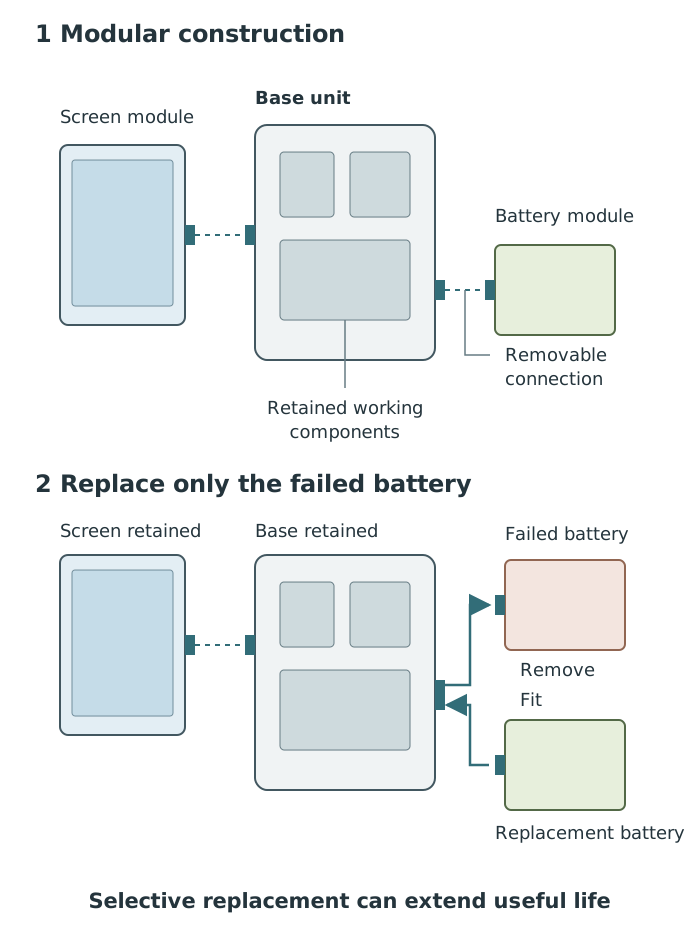
Replacing one failed module can keep the rest of a phone in use.
The environmental benefit depends on what happens afterwards. Replacing one failed module can retain the useful remainder of the phone. Repeatedly buying new modules simply to obtain the latest features still creates demand for materials and generates discarded components. Replacement parts must also be available and compatible. Modularity is therefore a useful design strategy, not a guarantee of sustainability.
An unwanted product is not necessarily a useless product. Passing on a working phone, repairing it or reusing a sound component can keep it in use. Recycling is different: it processes waste to recover materials rather than retaining the finished component.
Electronic equipment contains a mixture of metals, plastics, glass and other materials. Recycling involves collecting unwanted equipment, dismantling it, separating materials and sending recovered materials for further processing. Recovering scarce metals such as gold, palladium and tantalum can reduce pressure on mining sites and the resource conflicts associated with demand for new materials.
However, recovery is not straightforward. Materials may be glued or soldered together, and hazardous substances may be attached to otherwise recoverable materials. Some electronic waste contains toxic metals such as lead and mercury. Safe separation can require intensive labour or sophisticated, costly technology; the value of recovered materials may not cover the cost of responsible treatment.
Designing components for removal and materials for separation helps recovery. Recycling should nevertheless follow opportunities to keep useful products and components in service, rather than justify unnecessary replacement.
Recovering materials can provide employment and income, but the conditions of that work matter. Informal recycling can expose workers to hazardous substances and provide little employment security or protection of labour rights. Environmental pollution can also affect nearby communities.
A Ghanaian case study drawing on research from 2010 shows this balance. Collectors bought obsolete electronics and took them to the Agbogbloshie scrap yard near Accra for dismantling. Recovered metals were sold to traders or refineries. Recycling offered a livelihood, including for people from poorer northern Ghana, but workers faced low incomes, hazardous conditions and poor health. Working days of 10–12 hours and child employment were reported.
This demonstrates why recovering materials is not automatically socially sustainable. A stronger approach preserves livelihoods while supporting safe treatment, decent working conditions and responsible handling of hazardous waste. Simply transferring unwanted electronics elsewhere does not remove their footprint.
Designers and businesses can encourage people to regard waste as a resource by providing clear return information and convenient take-back arrangements. Deposits can provide an incentive to return modules rather than discard them. The Fonkraft phone concept proposed a shop for new and used modules; take-back and deposits on modules were also suggested as ways to support more responsible use.
Making producers responsible for their products’ waste can also encourage better design. If manufacturers bear treatment costs, they have an incentive to use recyclable materials and reduce hazardous substances. This can help, but effective collection, treatment and enforcement are still needed.
These arrangements connect design with behaviour. A repairable product will not fulfil its potential if users cannot obtain parts or choose to replace it unnecessarily. Equally, a recyclable product needs an accessible collection and recycling route.
To judge whether a component or product supports a greener world, connect its features to consequences across its life cycle. Easier repair may extend useful life; reuse retains functioning components; recycling can recover materials once reuse is no longer suitable.
Then consider limitations and social effects. Will people actually keep the product longer? Can they afford and obtain repairs? Can materials be safely separated, and are waste workers protected?
A justified conclusion is conditional: a modular phone can reduce waste if repair and selective replacement genuinely extend its useful life. The strongest solution combines suitable design, practical support for users and responsible treatment at the end of life.
Raw materials → manufacture → distribution → use → end of life.
Consider inputs and outputs at every stage. Compare products over a similar useful service, not just at disposal. Aluminium illustrates the balance: energy-intensive extraction and processing, but durability and repeated recyclability.
For life-cycle analysis, consider raw materials, manufacture, transport, use and end of life—not just disposal.
Distinguish reuse from recycling: reuse retains a product or component; recycling recovers its materials.
Link each design feature to an effect: a replaceable battery can extend a phone’s useful life because the whole device need not be discarded when the battery deteriorates.
When evaluating sustainability, explain benefits and limitations before reaching a judgement. A modular product is not automatically sustainable.
It can see this note and what your specification asks for.
Answers are free with an account.
1 free note left this week
Get more free notesYour answer sets when this note comes back for review, or marks it complete.
Was this note helpful?
Log in to tell us whether it helped, or to report a problem.
Last updated
Ecological footprint
The effects of a material, component or product on the environment throughout its life, including resource use, pollution and waste.
Social footprint
The effects of a material, component or product on people and communities throughout its life, including working conditions and access to useful products.
Life-cycle analysis
An assessment of a material’s or product’s environmental impacts from obtaining raw materials through manufacture, distribution and use to its end of life.
Sustainable design
Designing products to meet people’s needs while reducing environmental harm and considering social impacts throughout their lives.
Reuse
Using a product or component again rather than discarding it or processing it into raw materials.
Recycling
Processing waste materials so they can be used to make new materials or products.
Modular design
Designing a product from separate units joined by non-permanent connections, so individual units can be removed and replaced.
E-waste
Discarded electrical or electronic equipment and its components.
Put your knowledge into practice — try past paper questions for Design and Technology
Ecological footprint
The effects of a material, component or product on the environment throughout its life, including resource use, pollution and waste.
Social footprint
The effects of a material, component or product on people and communities throughout its life, including working conditions and access to useful products.
Life-cycle analysis
An assessment of a material’s or product’s environmental impacts from obtaining raw materials through manufacture, distribution and use to its end of life.
Sustainable design
Designing products to meet people’s needs while reducing environmental harm and considering social impacts throughout their lives.
Reuse
Using a product or component again rather than discarding it or processing it into raw materials.
Recycling
Processing waste materials so they can be used to make new materials or products.
Modular design
Designing a product from separate units joined by non-permanent connections, so individual units can be removed and replaced.
E-waste
Discarded electrical or electronic equipment and its components.
Ghana’s e-waste sector illustrates both livelihoods and risks: hazardous conditions, low incomes, long working days and child employment.
Link design feature → consequence → limitation → judgement. Consider the whole life cycle and effects on people; modular or recyclable does not automatically mean sustainable.