

Loading…
Loading…
Loading…
Eduqas GCSE Design and Technology · C600
Eduqas C600 · Electronic Systems and Programmable Components Check the specification (PDF) (opens in a new tab)
A programmable component is an electronic component whose behaviour can be set by loading instructions into it. Instead of building a separate fixed circuit for every sequence of actions, a designer can describe the required behaviour in a program.
A microcontroller is an integrated circuit containing a processor, memory and input/output connections. It runs a stored program, receives input signals and sends output signals according to its instructions. When it is built into a product to perform particular tasks, it acts as an embedded controller. The user operates the product rather than a separate general-purpose computer.
For example, a programmable warning device could respond to a switch by flashing an LED and sounding a buzzer. The physical components provide the light and sound; the program determines their order, how often they operate and how long they remain on. This is how programming embeds functionality into a product.
A PIC, or Programmable Interface Controller, is a type of microcontroller used to control products and systems. Its program determines how it responds to inputs and controls outputs.
PICAXE is an accessible programming system based on PIC microcontrollers. A PICAXE chip is supplied with built-in software, called firmware, that allows a new control program to be downloaded through a simple cable connection. A blank PIC chip does not contain this PICAXE firmware and cannot simply be substituted into the PICAXE programming system.
A typical PICAXE setup needs the chip, a suitable circuit board, a power supply, a download cable and programming software on a computer. Programs can be written using BASIC instructions, graphical blocks or flowcharts. On-screen simulation helps check their behaviour before testing the actual circuit.
The designer develops the program on the computer and downloads it to the microcontroller. The controller then runs the program within the powered product; the computer is not needed simply to execute that stored control sequence.
Programmable microcontrollers can be reprogrammed repeatedly. This allows a designer to test a product, change its behaviour and test it again without replacing the controller each time.
Consider the warning device. One version might flash rapidly and sound its buzzer for two seconds. A revised program could change the flashing pattern or shorten the sound. These changes customise operation through software, provided the existing hardware can perform the new actions.
Changing a program does not give the hardware new physical abilities. A product cannot display text merely because its program requests it: it must also have a suitable display and connections. Software and hardware must therefore be designed together.
A subroutine is a named section of a program that performs a particular task when called. Once that task is complete, control returns to the instruction immediately after the call. It is like giving a small job a name so the main program can request it whenever needed.
In a PICAXE program, gosub flash calls a subroutine named flash; return sends control back to the calling program. A warning sequence can therefore be organised as:
main:
    gosub flash
    gosub noise
    goto main
Here, the controller completes flash, returns to call noise, then repeats the main sequence. The flashing subroutine can contain the instructions for switching the LED on and off 25 times. The noise subroutine can switch the buzzer on, wait two seconds, switch it off and return.
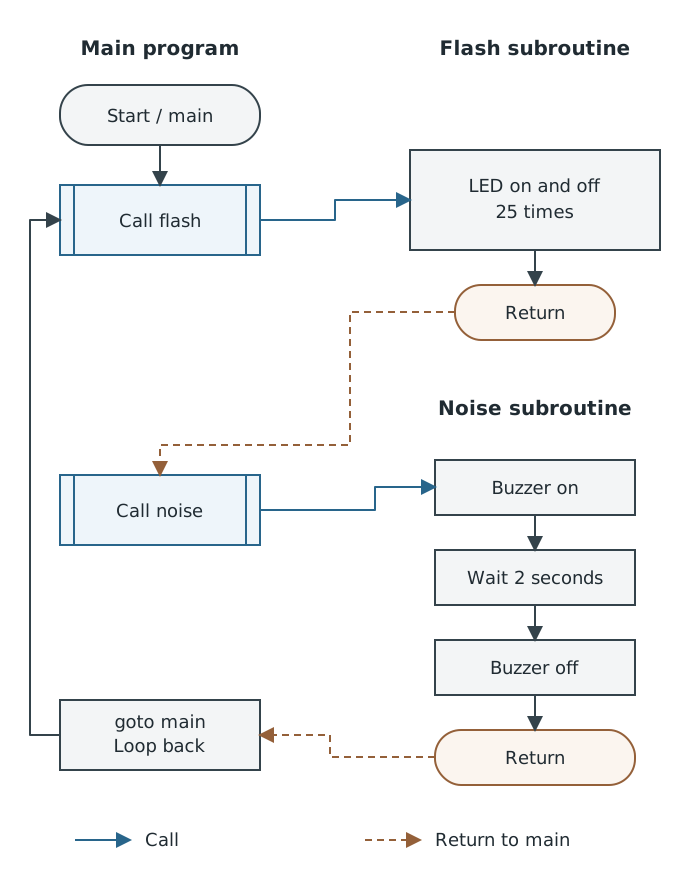
Each subroutine completes its task, then returns to the next instruction in the main program.
Subroutines make a program easier to understand because each section has a clear purpose. They also avoid repeatedly writing the same instructions. A useful routine can be reused elsewhere, saving development time.
A macro also groups a sequence of instructions so a task can be requested with a single command. The way macros are implemented depends on the programming system, but their role is to simplify repeated operations.
A subroutine can also use a variable—a stored value that can change—to adjust its task. For example, the main program can set a flash-count variable to 5, call the flashing routine, then set it to 15 and call the same routine again. The instructions are reused, but the resulting pattern changes.
An interface enables devices to connect and work together. A microcontroller can interface with inputs such as switches, LDRs and thermistors, and outputs such as LEDs, buzzers, motors and displays. It can also exchange information with other electronic systems, including a computer.
The interface must suit the electrical requirements of both devices. A controller output provides a control signal, but many output devices require a transistor switching circuit to operate them. This lets the controller control a device that needs more current than the controller pin can safely supply directly.
Motors, relays and solenoids also need protection against the voltage produced when they are switched off. A suppression diode connected across the device provides this protection. Programming does not remove the need for appropriate supporting circuitry.
Microcontrollers are versatile: the same type of controller can run different programs and connect to different combinations of devices. PICAXE offers low-cost chips and free programming software, making it useful for developing and testing control projects. Different chip sizes provide different numbers of connections, allowing a designer to choose one suited to the product.
However, there are limitations. Programming and testing take time and require skills. Incorrect instructions can produce incorrect behaviour, even when the circuit is assembled properly. The controller needs a suitable power supply, and its available connections and electrical limits restrict what it can control. Extra interface components can add cost and complexity.
A programmable controller is therefore a strong choice when a product needs adjustable timing, repeated sequences or responses to several inputs. For a very simple, fixed function, it may add unnecessary programming work and supporting hardware. The best choice depends on the behaviour the product needs, not simply on whether it can be programmed.
Link each benefit or limitation to the product: reprogramming is useful because it allows its timing or response to change without replacing the controller.
Distinguish the controller’s signal from the power needed by an output device. A motor may need a transistor driver rather than a direct connection to a controller pin.
A subroutine returns to the instruction after its call; it does not restart the whole program.
PICAXE is a system based on PIC microcontrollers, not another name for every PIC chip.
It can see this note and what your specification asks for.
Answers are free with an account.
1 free note left this week
Get more free notesYour answer sets when this note comes back for review, or marks it complete.
Was this note helpful?
Log in to tell us whether it helped, or to report a problem.
Last updated
Programmable component
An electronic component whose operation can be set or changed by loading a program of instructions.
Microcontroller
An integrated circuit containing a processor, memory and input/output connections, used to run a program that controls devices.
Embedded controller
An electronic controller built into a product to carry out particular functions.
Subroutine
A named section of a program that performs a task when called, then returns control to the calling program.
Macro
A named sequence of instructions used to carry out a task through a single command.
Interface
A connection or supporting circuit that enables devices to exchange signals or work together.
PIC
A Programmable Interface Controller: a type of microcontroller that can be programmed to control products and systems.
PICAXE
A programming system using PIC microcontrollers supplied with firmware that allows programs to be downloaded using a simple cable connection.
Put your knowledge into practice — try past paper questions for Design and Technology
Programmable component
An electronic component whose operation can be set or changed by loading a program of instructions.
Microcontroller
An integrated circuit containing a processor, memory and input/output connections, used to run a program that controls devices.
Embedded controller
An electronic controller built into a product to carry out particular functions.
Subroutine
A named section of a program that performs a task when called, then returns control to the calling program.
Macro
A named sequence of instructions used to carry out a task through a single command.
Interface
A connection or supporting circuit that enables devices to exchange signals or work together.
PIC
A Programmable Interface Controller: a type of microcontroller that can be programmed to control products and systems.
PICAXE
A programming system using PIC microcontrollers supplied with firmware that allows programs to be downloaded using a simple cable connection.
gosub to call and return to return.