Loading…


Loading…
Loading…
Loading…
Edexcel GCSE Statistics · 1ST0
Edexcel 1ST0 · 3p.07 Probability representations for multiple events Check the specification (PDF) (opens in a new tab)
An event is a set of outcomes of a probability experiment. For one roll of a six-sided die, ‘roll an even number’ is the event containing 2, 4 and 6. The notation means the probability that event occurs.
Two useful questions about events are: can they happen together, and do they cover every possible outcome?
Mutually exclusive events cannot both occur in the same trial. On one die roll, ‘even’ and ‘odd’ are mutually exclusive: no number is both. Their sets of outcomes do not overlap, so
To find the probability of either of two mutually exclusive events occurring, add their probabilities:
For example, on a fair six-sided die, rolling a 1 and rolling a 2 are mutually exclusive. Each has probability , so the probability of rolling a 1 or a 2 is . Adding works because no outcome is counted twice.
Get unlimited access to all revision notes, key terms, and exam tips.
Check whether the events overlap before adding their probabilities. For overlapping events, subtract the probability of both occurring once.
Probabilities sum to 1 for a set of events that is both mutually exclusive and exhaustive, not merely exhaustive.
In a sport allowing draws, ‘win’ and ‘lose’ are not exhaustive: 1 − P(win) includes both losing and drawing.
In probability, ‘A or B’ includes outcomes where both events occur.
Event
A set of outcomes of a probability experiment, such as rolling an even number on a die.
Mutually exclusive events
Events that cannot both occur in the same trial. For two mutually exclusive events, .
Exhaustive events
A set of events that together includes every possible outcome. At least one of the events must occur.
Union
The event consisting of every outcome in either event, including outcomes in both. It is written , or .
Intersection
The event consisting of outcomes common to both events. It is written , or .
Put your knowledge into practice — try past paper questions for Statistics
Event
A set of outcomes of a probability experiment, such as rolling an even number on a die.
Mutually exclusive events
Events that cannot both occur in the same trial. For two mutually exclusive events, .
Exhaustive events
A set of events that together includes every possible outcome. At least one of the events must occur.
Union
The event consisting of every outcome in either event, including outcomes in both. It is written , or .
Intersection
The event consisting of outcomes common to both events. It is written , or .
An exhaustive set of events includes every possible outcome. ‘Even’ and ‘odd’ are exhaustive for a six-sided die because every possible number belongs to one of them. The six individual events ‘roll a 1’, ‘roll a 2’, and so on up to ‘roll a 6’ also form an exhaustive set.
Mutually exclusive and exhaustive describe different properties. ‘Roll a 1’ and ‘roll a 2’ are mutually exclusive, but not exhaustive: 3, 4, 5 and 6 are left out. Exhaustive events need not be mutually exclusive; covering all outcomes does not itself rule out overlap.
When events are both mutually exclusive and exhaustive, their probabilities add to 1. Every possible outcome is included exactly once.
In particular, ‘ happens’ and ‘ does not happen’ are mutually exclusive and exhaustive. Therefore,
For example, if a spinner has probability 0.2 of landing on yellow, its probability of not landing on yellow is .
Higher tier: the general addition law handles events that can occur together.
For a die roll, let be ‘even’ and be ‘a multiple of 3’. These events overlap because 6 belongs to both. In probability, ‘ or ’ means , , or both. ‘ and ’ means the overlap.
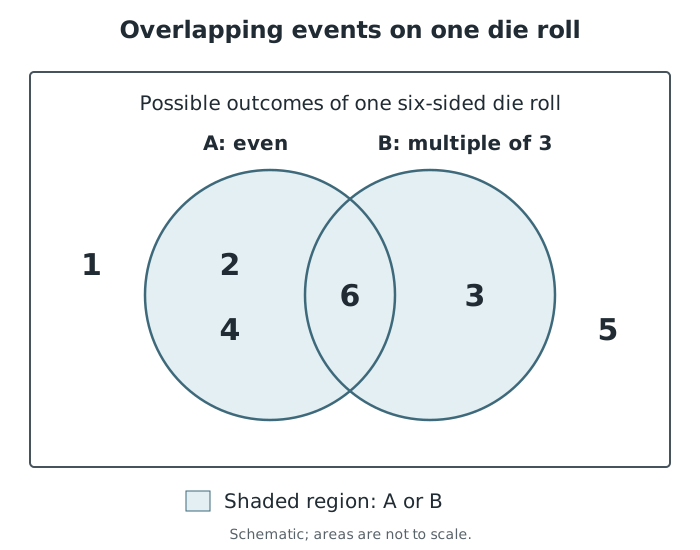
‘A or B’ includes 2, 3, 4 and 6. The overlap, ‘A and B’, contains only 6.
The Venn diagram places each outcome in exactly one region. To find , include the -only region and the overlap; to find , include the -only region and the overlap. Adding these probabilities counts the overlap twice. Subtracting it once leaves each wanted outcome counted once:
For a fair six-sided die, , and . Hence
This matches the four wanted outcomes: 2, 3, 4 and 6. The events are not exhaustive because 1 and 5 are outside both circles.
The general law works for any two events. If they are mutually exclusive, the overlap probability is zero, so it reduces to the simpler addition law.
The general addition law can also be rearranged. Suppose , and . Substitution gives
Therefore . This is the probability of all of , including its overlap with .
For an event and its complement:
‘Or’ includes both; ‘and’ is the overlap. Subtract the overlap once to remove double counting. The general law also works when the overlap is zero.
To find the overlap:
Get unlimited access to all revision notes, key terms, and exam tips.