

Loading…
Loading…
Loading…
Edexcel GCSE Physics · 1PH0
Edexcel 1PH0 · 11.1P Check the specification (PDF) (opens in a new tab)
Matter contains protons, neutrons and electrons. Protons have positive charge, electrons have negative charge and neutrons have no charge. An object is neutral when its total positive and negative charges balance.
During ordinary electrostatic charging, the protons do not move between objects: they are held inside atomic nuclei. Some outer electrons can be removed from one material and transferred to another. Therefore, explanations of charging by friction must describe the movement of electrons.
When two insulating materials are rubbed together, their surfaces repeatedly make very close contact. The two materials hold surface electrons with different strengths, so some electrons can be pulled from one surface and transferred to the other. Rubbing provides the energy and repeated contact needed for this transfer.
It is important that friction does not create electrons or manufacture charge. The electrons were already present: rubbing simply transfers them, separating charge between the two materials.
Imagine two neutral insulating strips. If several electrons move from strip A to strip B, strip A has an electron shortage while strip B has an electron excess. Both strips have therefore become charged, although the total charge of the pair has not been created or destroyed.
An insulator has almost no charges that are free to move through it. Electrons transferred onto or away from one part of its surface therefore cannot easily spread through the material or flow to Earth. The resulting charge remains in place and is described as static electricity.
Examples of insulating materials include polythene, Perspex or acetate, rubber and nylon. A dry insulating rod can consequently remain charged after being rubbed with a cloth. Moisture makes surfaces more conducting, so static charge tends to leak away more quickly in damp conditions.
This differs from a metal conductor held in a bare hand. In a conductor, charge can move freely and may pass through the hand and body to Earth, so it does not remain built up on the metal in the same way.
When a dry polythene rod is rubbed with a woollen cloth, electrons are transferred from the cloth to the rod. The essential mechanism is the transfer itself: the cloth loses exactly the electrons that the rod receives. Once the materials are separated, the transferred charge remains on their surfaces because they are insulators.
Which way electrons move depends on the particular pair of materials. You cannot decide the direction merely from the fact that they were rubbed; a question must identify the materials or provide information about the resulting charge.
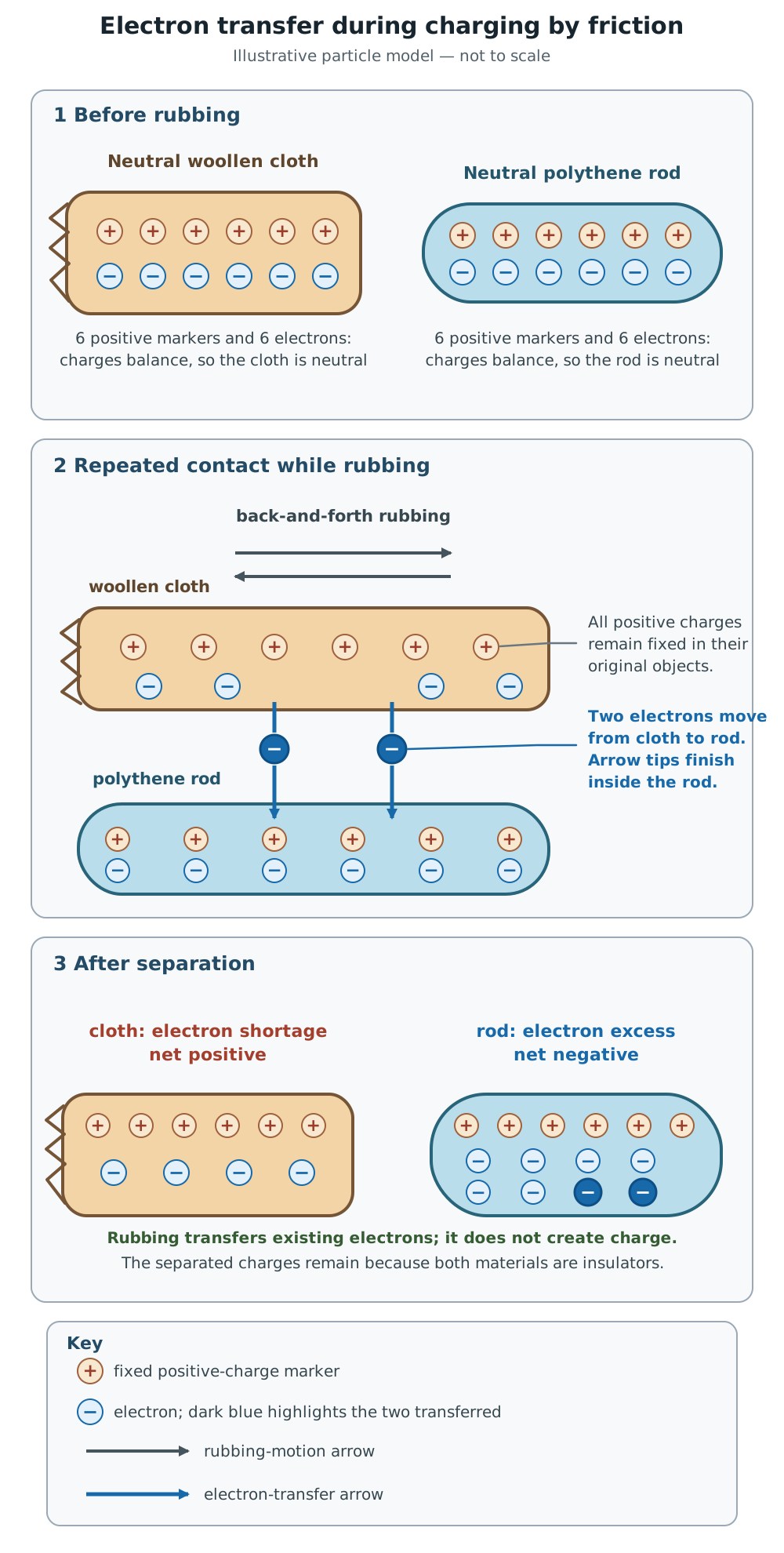
Charging a polythene rod by friction: two illustrated electrons move from the woollen cloth to the rod while the positive charges remain fixed, so no charge is created or destroyed.
The complete causal chain is therefore:
rubbing and repeated surface contact → electrons transfer between the materials → an imbalance of charge is produced → the charge remains because the materials are insulators.
Insulators do not allow charge to move freely. The transferred charge therefore remains on the surface instead of flowing away.
Repeated close contact during rubbing → electron transfer → charge imbalance → static charge remains on the insulators.
The direction of electron transfer depends on the pair of materials used.
When asked to explain charging by friction, name electrons and state that they are transferred from one material to the other.
Do not say that friction creates charge or that protons move. Rubbing separates existing charge; protons remain in atomic nuclei.
Use the objects named in the question and give a clear direction of transfer, such as “electrons move from the cloth to the rod”.
Remember that merely rubbing an object is not a complete explanation: link rubbing to electron transfer and explain that the charge remains because the object is an insulator.
It can see this note and what your specification asks for.
Answers are free with an account.
1 free note left this week
Get more free notesYour answer sets when this note comes back for review, or marks it complete.
Was this note helpful?
Log in to tell us whether it helped, or to report a problem.
Last updated
Electrical insulator
A material in which electric charge cannot move freely, so charge transferred to its surface tends to remain there.
Electron transfer
The movement of electrons from one material to another.
Charging by friction
The transfer of electrons between materials when their surfaces are rubbed together.
Static electricity
An accumulation of electric charge that remains on an object rather than flowing away.
Put your knowledge into practice — try past paper questions for Physics
Electrical insulator
A material in which electric charge cannot move freely, so charge transferred to its surface tends to remain there.
Electron transfer
The movement of electrons from one material to another.
Charging by friction
The transfer of electrons between materials when their surfaces are rubbed together.
Static electricity
An accumulation of electric charge that remains on an object rather than flowing away.