

Loading…
Loading…
Loading…
Edexcel GCSE Physics · 1PH0
Edexcel 1PH0 · 5.23 Check the specification (PDF) (opens in a new tab)
An oscillation is a repeated change back and forth. In an electrical circuit, charge, current and potential difference can oscillate. An alternating current therefore makes electrons move to and fro rather than continuing in only one direction.
When an alternating current drives a transmitting aerial, charges in the aerial accelerate back and forth. Their changing distribution produces changing electric and magnetic fields. These changing fields travel away from the aerial as an electromagnetic wave. If the electrical oscillation is at a radio frequency, the emitted electromagnetic wave is a radio wave.
The radio wave has the same frequency as the oscillation that produced it: if the charges complete more oscillations each second, the transmitted wave has a higher frequency. The wave transfers energy away from the transmitter; the charges themselves do not travel through the space from one aerial to another.
The process can also operate in reverse. When a radio wave reaches a receiving aerial, its changing electric field exerts forces on electrons in the metal. The electrons are driven backwards and forwards, producing an alternating potential difference and an alternating current in the connected receiving circuit. The radio wave has therefore induced electrical oscillations.
The induced oscillation has the frequency of the incoming radio wave. A receiver can be tuned so that it responds strongly to the desired frequency while responding much less to others. Other components can then amplify and process the weak electrical signal, for example to reproduce sound in a radio.
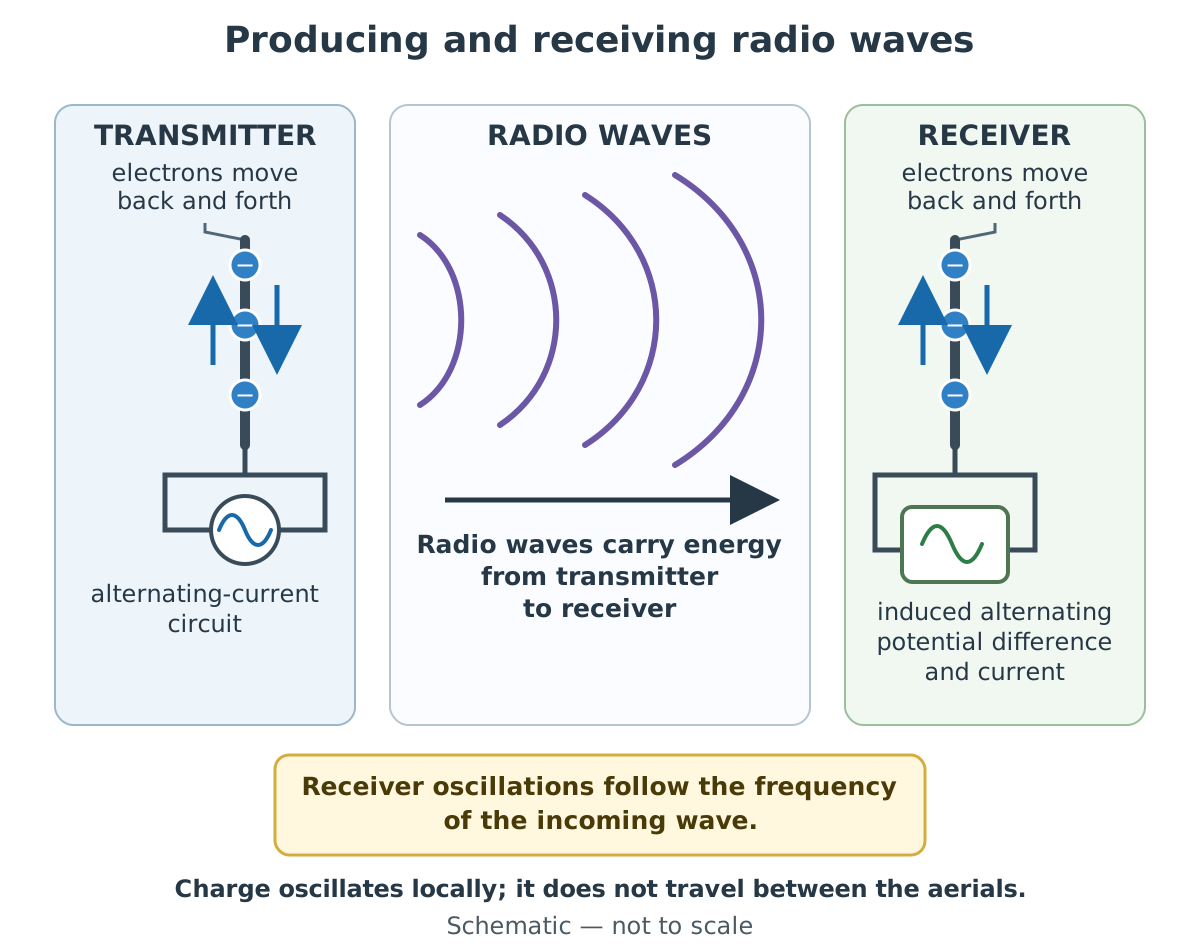
Oscillating charge in a transmitting circuit produces radio waves; an incoming radio wave then induces electrical oscillations in a receiving circuit.
The central relationship is reciprocal:
At the transmitter, electrical energy is converted into energy carried by radio waves. At the receiver, some of the radio-wave energy is transferred to electrons in the aerial and becomes an electrical signal. This is the physical link that makes radio broadcasting and other radio communication possible.
Energy travels between the aerials as an electromagnetic wave; charge does not travel from one aerial to the other.
Describe both directions of the process: an electrical oscillation produces a radio wave, while an incoming radio wave induces an electrical oscillation.
Use the word “alternating” or “oscillating”; a steady direct current does not provide the continuously changing charge motion needed to produce a radio wave.
Do not say that charge travels from the transmitting aerial to the receiving aerial. Energy is transferred by the radio wave, which makes electrons in the receiver oscillate.
It can see this note and what your specification asks for.
Answers are free with an account.
1 free note left this week
Get more free notesYour answer sets when this note comes back for review, or marks it complete.
Was this note helpful?
Log in to tell us whether it helped, or to report a problem.
Last updated
Oscillation
A repeated change back and forth about a central value; in a circuit, current, charge or potential difference can oscillate.
Alternating current (a.c.)
A current that repeatedly changes magnitude and direction.
Radio wave
An electromagnetic wave in the lowest-frequency, longest-wavelength region of the electromagnetic spectrum.
Aerial (antenna)
A conductor used to transmit or receive electromagnetic waves.
Induce
To cause an electrical effect, such as an alternating potential difference or current, through the action of an incoming electromagnetic wave.
Put your knowledge into practice — try past paper questions for Physics
Oscillation
A repeated change back and forth about a central value; in a circuit, current, charge or potential difference can oscillate.
Alternating current (a.c.)
A current that repeatedly changes magnitude and direction.
Radio wave
An electromagnetic wave in the lowest-frequency, longest-wavelength region of the electromagnetic spectrum.
Aerial (antenna)
A conductor used to transmit or receive electromagnetic waves.
Induce
To cause an electrical effect, such as an alternating potential difference or current, through the action of an incoming electromagnetic wave.