

Loading…
Loading…
Loading…
Edexcel GCSE Physical Education · 1PE0
Edexcel 1PE0 · 1.1.3 Check the specification (PDF) (opens in a new tab)
Describe the structure of the skeletal system, identifying the cranium, clavicle, scapula, five regions of the vertebral column (cervical, thoracic, lumbar, sacrum, coccyx), ribs, sternum, humerus, radius, ulna, hand bones (carpals, metacarpals, phalanges), pelvis, femur, patella, tibia, fibula, and foot bones (tarsals, metatarsals, phalanges).
Explain the classification and use of these bones applied to performance in physical activities and sports.
The skeletal system is the body's framework of bones. To understand its contribution to sport, connect three things: where a bone is, how its shape is classified, and what it helps a performer do.
Bones do not move themselves. Muscles pull on bones through tendons, and the bones act as levers to produce movement at joints. Other bones provide protection, bear weight or give muscles a secure place to attach. A football kick, for example, involves long bones acting as levers, while the supporting foot bears the player's weight.
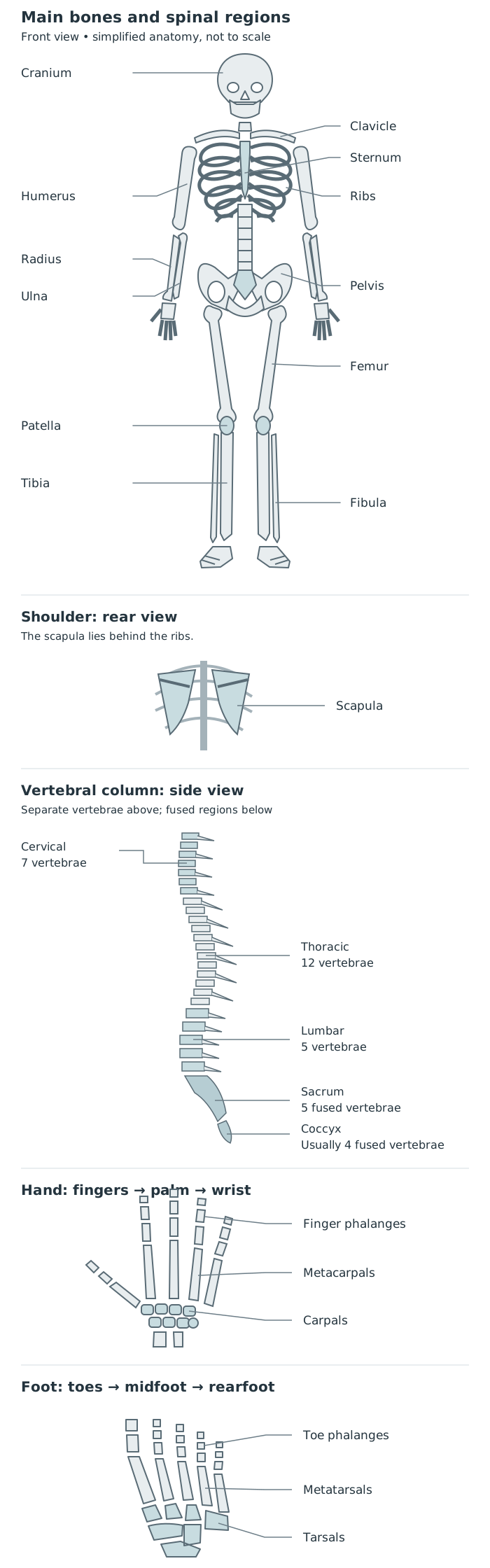
Follow the skeleton from head to foot, then use the insets to distinguish the hand, foot and spinal regions.
The cranium is the part of the skull enclosing the brain. Its flat bones form a protective casing, particularly important when a performer experiences an impact in a contact sport. This protection does not make the brain immune to injury.
The ribs curve around the chest, and the sternum, or breastbone, lies at the centre of the front of the chest. These are flat bones forming a protective cage around the heart and lungs. Protecting these organs matters during physical activity because the heart and lungs help supply working muscles with oxygen.
The clavicle, or collarbone, lies across the upper chest and is a long bone. It helps support the shoulder, contributing to arm movements such as a golf swing. The scapula, or shoulder blade, lies at the back of the shoulder. It is a flat bone with surfaces for muscle attachment: these muscles help control the shoulder and arm during throwing or lifting.
Flat bones therefore have different applications. The cranium is a clear example of protection; the scapula is a clear example of muscle attachment.
The humerus is the long bone of the upper arm. Muscles pull on it during actions such as raising the arm for a volleyball serve. The radius and ulna are the two long bones of the forearm. Together, they contribute to the positioning and movement of the forearm and hand, helping a cricketer control a bat.
Moving from the forearm towards the fingertips gives this sequence:
| Bone group | Location | Classification and sporting use |
|---|---|---|
| Carpals | Wrist | Short bones that help bear weight and allow small movements; they support the hand during a gymnastics handstand. |
| Metacarpals | Palm | Long bones that contribute to hand movement and positioning when holding a racket. |
| Phalanges | Fingers | Long bones that act as small levers when fingers curl around a ball or bat. |
Long describes a bone's shape, not whether it looks large. Finger bones are much smaller than the humerus, but they are still long bones because they are longer than they are wide or deep.
The vertebral column, or spine, runs down the back. Its individual bones are called vertebrae and are classified as irregular bones. Their shapes provide support and muscle attachment, and the column protects the spinal cord, which carries nerve signals between the brain and body.
The five regions run from the neck to the base of the spine:
| Region | Position and structure | Connection to physical activity |
|---|---|---|
| Cervical | Seven vertebrae in the neck | Support the head and allow a netball player to look around for teammates. |
| Thoracic | Twelve vertebrae in the upper back, connected to the ribs | Help support the chest and contribute to trunk movement during a golf swing. |
| Lumbar | Five larger vertebrae in the lower back | Provide strong support during bending and lifting, such as in weight training. |
| Sacrum | Five fused vertebrae connecting the spine to the pelvis | Help transfer body weight towards the legs during running and jumping. |
| Coccyx | The small tailbone below the sacrum, usually formed from four fused vertebrae | Provides attachment points for muscles. |
The upper regions contain separate vertebrae, while the sacrum and coccyx contain fused vertebrae. The spine is therefore not simply a chain of identical, equally movable bones.
The pelvis is the basin-shaped structure below the spine. It is classified as irregular in this skeletal overview. It provides attachment points for muscles involved in powerful leg actions, such as sprinting and kicking, and connects the trunk with the lower limbs.
The femur is the long bone of the thigh. It acts as a lever when muscles move the leg during cycling or a football kick. Below the knee, the tibia and fibula are the two long bones of the lower leg. They contribute to lower-leg support and movement during running, kicking and changing direction.
The patella, or kneecap, lies at the front of the knee. It is a specialised bone within a tendon, anatomically called a sesamoid bone. It helps protect the tendon from friction against the femur as the knee bends and straightens during actions such as squatting or jumping.
The foot follows a similar naming pattern to the hand:
| Bone group | Location | Classification and sporting use |
|---|---|---|
| Tarsals | Ankle and rear part of the foot | Short bones that support body weight during standing, running and landing. |
| Metatarsals | Main part of the foot, between the tarsals and toes | Long bones that contribute to pushing off during running or jumping. |
| Phalanges | Toes | Long bones that contribute to toe movement and control during push-off. |
A useful explanation moves from bone → role → sporting action. For example, the scapula is a flat bone providing muscle attachment. Those attached muscles help move and control the arm during a throw. The tarsals are short bones suited to weight bearing, supporting the performer as they land from a jump.
These examples show why knowing only a bone's name is not enough: its location and classification help explain its contribution to performance.
| Classification | Named examples | Main application |
|---|---|---|
| Long | Clavicle, humerus, radius, ulna, femur, tibia, fibula, metacarpals, metatarsals, phalanges | Leverage and movement |
| Short | Carpals, tarsals | Weight bearing and small movements |
| Flat | Cranium, ribs, sternum, scapula | Protection and muscle attachment |
| Irregular | Vertebrae, pelvis | Protection and muscle attachment |
Patella: kneecap; a specialised bone within a tendon that helps protect it from friction during knee movement.
Cervical → thoracic → lumbar → sacrum → coccyx
The vertebral column supports the body and protects the spinal cord.
Named bone → function → specific sporting action.
Identify bones by their position, not by their size: metacarpals, metatarsals and phalanges are long bones despite being small.
Distinguish carpals at the wrist from metacarpals in the palm, and tarsals at the ankle from metatarsals in the main part of the foot.
For a sporting application, link a named bone to its role and a specific action: the femur acts as a lever during a football kick. Bones do not contract; muscles pull on them.
Learn the five vertebral regions in order from the head downwards: cervical, thoracic, lumbar, sacrum, coccyx.
It can see this note and what your specification asks for.
Answers are free with an account.
1 free note left this week
Get more free notesYour answer sets when this note comes back for review, or marks it complete.
Was this note helpful?
Log in to tell us whether it helped, or to report a problem.
Last updated
Skeletal system
The framework of bones that supports the body, protects internal structures and works with muscles to enable movement.
Long bone
A bone longer than it is wide or deep, which acts as a lever for movement. Examples include the femur and finger phalanges.
Short bone
A small, roughly cube-shaped bone suited to weight bearing and small movements, such as a carpal or tarsal.
Flat bone
A relatively thin, broad bone that provides protection or a surface for muscle attachment, such as the cranium or scapula.
Irregular bone
A bone with a complex shape that does not fit the long, short or flat categories, suited to roles such as protection and muscle attachment.
Vertebral column
The column of vertebrae running down the back, supporting the body and protecting the spinal cord. Its five regions are cervical, thoracic, lumbar, sacrum and coccyx.
Vertebra
An individual bone of the vertebral column.
Put your knowledge into practice — try past paper questions for Physical Education
Skeletal system
The framework of bones that supports the body, protects internal structures and works with muscles to enable movement.
Long bone
A bone longer than it is wide or deep, which acts as a lever for movement. Examples include the femur and finger phalanges.
Short bone
A small, roughly cube-shaped bone suited to weight bearing and small movements, such as a carpal or tarsal.
Flat bone
A relatively thin, broad bone that provides protection or a surface for muscle attachment, such as the cranium or scapula.
Irregular bone
A bone with a complex shape that does not fit the long, short or flat categories, suited to roles such as protection and muscle attachment.
Vertebral column
The column of vertebrae running down the back, supporting the body and protecting the spinal cord. Its five regions are cervical, thoracic, lumbar, sacrum and coccyx.
Vertebra
An individual bone of the vertebral column.