

Loading…
Loading…
Loading…
Edexcel GCSE Physical Education · 1PE0
Edexcel 1PE0 · 1.1.4 Check the specification (PDF) (opens in a new tab)
Identify the classification of joints, including pivot (neck - atlas and axis), hinge (elbow, knee, and ankle), ball and socket (hip and shoulder), and condyloid (wrist).
Evaluate the impact of these joint types on the range of possible movement.
A joint is a place where two or more bones meet. The movable joints in your neck, arms and legs allow the skeleton to change position during physical activity. However, they do not all move in the same way: the shapes of the bone surfaces help determine the directions in which movement is possible.
Think of the difference between a door hinge and a ball moving inside a cup. The hinge swings backwards and forwards along a set path, whereas the ball can move in several directions. Joint classification helps explain why an elbow can bend and straighten, but a shoulder can also move an arm sideways and rotate it.
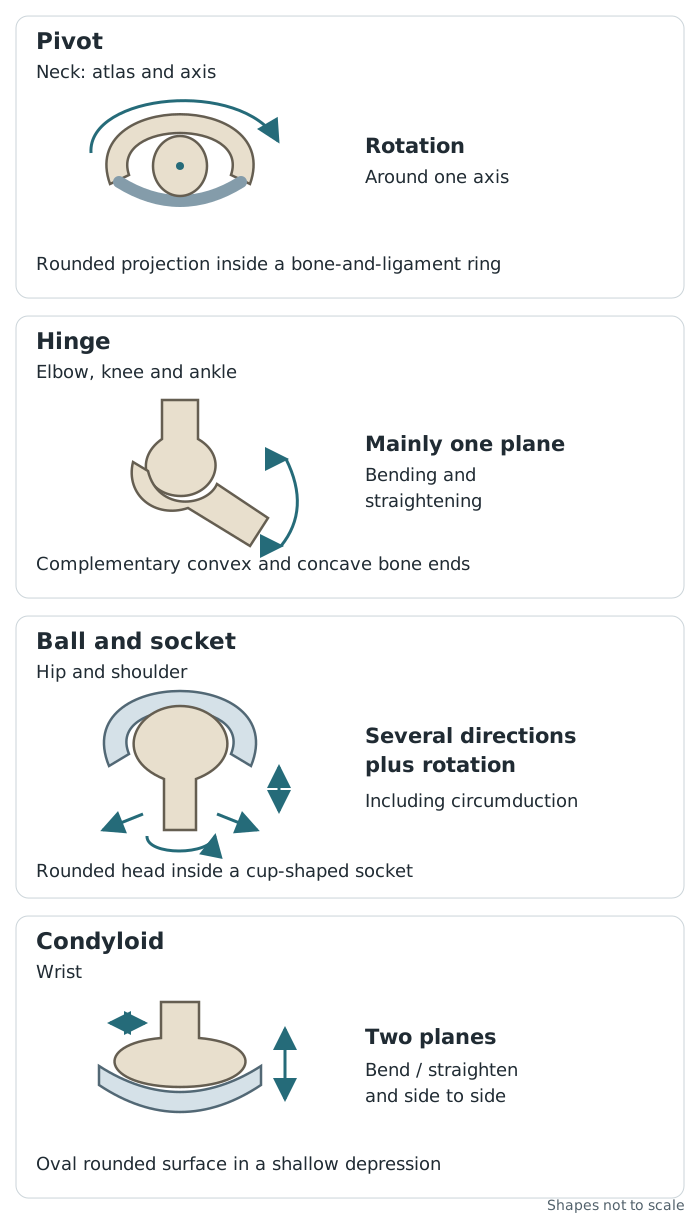
The shape of a joint helps determine the directions in which its bones can move.
A pivot joint allows rotation around a single axis. A rounded part of one bone turns within a ring formed by another bone and a ligament.
The required example is in the neck, between the atlas and axis. These are the first and second vertebrae at the top of the spine. Movement at this joint allows you to turn your head from side to side.
This gives a performer the ability to look to either side without turning the whole body. Its freedom is specialised: it allows turning around an axis rather than the wide variety of movements available at a shoulder.
A hinge joint mainly allows movement in one plane, like a door hinge. The examples to know are the elbow, knee and ankle. This restricts the directions of movement compared with a ball and socket joint, while allowing the repeated bending and straightening needed in many sporting actions.
At the elbow, the humerus and ulna form the hinge. Bending the elbow is called flexion, and straightening it is extension. During a biceps curl, the elbow bends to raise the weight and straightens as the weight is lowered.
At the knee, the femur and tibia meet. The knee bends and straightens during a squat. A footballer also bends the knee and then straightens it when kicking a ball. The hinge directs this movement along a mainly back-and-forth path rather than allowing the lower leg to swing freely in every direction.
At the ankle, the hinge allows the foot to move upwards towards the shin, called dorsi-flexion, or point downwards away from the shin, called plantar-flexion. These movements help a hurdler position the leading foot and a trampolinist point the toes in the air.
In a ball and socket joint, the rounded head of one bone fits into a cup-shaped socket in another. The examples are the hip and shoulder:
This shape allows movement forwards and backwards, towards and away from the body's midline, and rotation. These joints can also produce circumduction, where the limb moves in a circular or conical path. They therefore allow a greater variety of movements than hinge or pivot joints. For example, the shoulder allows the large circular arm action used when bowling in cricket.
Although both joints have the same classification, the shoulder has a greater range of movement than the hip. Its shallower socket allows more freedom. The hip's deeper socket and strong supporting ligaments restrict movement more, but provide stability for supporting body weight. Greater mobility is useful for varied arm actions; greater stability is useful when standing, running and balancing.
A condyloid joint has an oval-shaped rounded surface fitting into a shallow depression. The example to know is the wrist.
The wrist can bend and straighten, and the hand can also move from side to side. These are movements in two planes, giving the wrist more directional freedom than a hinge joint. Combining them allows a circular movement, but the wrist joint does not allow the same twisting rotation as a ball and socket joint.
This combination of movements helps a bowler position the hand when spinning a ball. The wrist's classification explains its ability to adjust the hand in different directions without having the full freedom of a shoulder.
Joint classification determines the kinds of movement available, not simply whether a joint moves. A pivot permits rotation around one axis; a hinge mainly permits bending and straightening in one plane; a condyloid joint permits movement in two planes; and a ball and socket joint permits movement in several directions, including rotation.
The actual range also depends on the particular joint's structure and supporting tissues. The hip and shoulder show why knowing the classification alone is not enough to predict exactly how freely a joint moves.
| Classification | Examples | Movement possibilities |
|---|---|---|
| Pivot | Neck: atlas and axis | Rotation around a single axis; head turns side to side |
| Hinge | Elbow, knee, ankle | Mainly movement in one plane: bending and straightening; foot up and down at the ankle |
| Ball and socket | Hip, shoulder | Movement in several directions, rotation and circumduction |
| Condyloid | Wrist | Bending and straightening plus side-to-side movement; these can combine into a circular path |
Bone pairings: hip = femur–pelvis; shoulder = humerus–scapula; elbow hinge = humerus–ulna; knee = femur–tibia.
Give the precise location of the neck pivot joint: between the atlas and axis, the first two vertebrae.
Distinguish the wrist joint, which is condyloid, from the pivot joints that allow the forearm to turn.
When explaining the impact of a joint type, link its structure to the movements it allows and then to the sporting action.
The hip and shoulder have the same classification, but not the same range of movement: the shoulder has greater freedom.
It can see this note and what your specification asks for.
Answers are free with an account.
1 free note left this week
Get more free notesYour answer sets when this note comes back for review, or marks it complete.
Was this note helpful?
Log in to tell us whether it helped, or to report a problem.
Last updated
Joint
A place where two or more bones meet.
Pivot joint
A joint that allows rotation around a single axis, such as the joint between the atlas and axis in the neck.
Hinge joint
A joint that mainly allows bending and straightening in one plane, such as the elbow, knee or ankle.
Ball and socket joint
A joint where the rounded head of one bone fits into a cup-shaped socket in another, allowing movement in several directions and rotation.
Condyloid joint
A joint with an oval-shaped rounded surface fitting into a shallow depression, allowing movement in two planes, as at the wrist.
Range of movement
The extent of movement available at a joint.
Put your knowledge into practice — try past paper questions for Physical Education
Joint
A place where two or more bones meet.
Pivot joint
A joint that allows rotation around a single axis, such as the joint between the atlas and axis in the neck.
Hinge joint
A joint that mainly allows bending and straightening in one plane, such as the elbow, knee or ankle.
Ball and socket joint
A joint where the rounded head of one bone fits into a cup-shaped socket in another, allowing movement in several directions and rotation.
Condyloid joint
A joint with an oval-shaped rounded surface fitting into a shallow depression, allowing movement in two planes, as at the wrist.
Range of movement
The extent of movement available at a joint.