

Loading…
Loading…
Loading…
Edexcel GCSE Physical Education · 1PE0
Edexcel 1PE0 · 1.1.6 Check the specification (PDF) (opens in a new tab)
A joint is a place where bones meet. At a movable joint, bones need to remain securely connected while muscles produce movement. are strong bands of connective tissue, but their attachments give them different roles: ligaments connect , whereas tendons connect .
This distinction explains how they work together in sport. A muscle can generate the force needed to move a limb, but that force must reach the bone through a tendon. Meanwhile, ligaments help keep the joint stable as the bones move.
Ligaments join bones together and help hold them in their correct relationship at a joint. They limit excessive movement that could otherwise lead to a dislocation, where a bone moves out of its normal position at the joint. They allow normal movement rather than locking the joint completely.
For example, the cruciate ligaments connect the femur, the thigh bone, to the tibia, the main shin bone, at the knee. They help stabilise the knee as it moves.
This stability matters when a footballer plants a foot and changes direction. The knee needs to remain stable while the player turns and continues running. Ligaments help control the movement between the bones, reducing the risk of the joint moving beyond its normal limits. Their relevance is therefore not simply that they join bones: they make controlled sporting movement possible while helping protect the joint.
Tendons attach muscles to bones. When a muscle contracts, it produces a pulling force. The tendon transmits that force to the attached bone, allowing movement at a joint. The tendon does not generate the force itself.
The Achilles tendon, at the back of the ankle, connects the gastrocnemius muscle in the calf to the heel bone. When the calf muscle contracts, force is transmitted through the Achilles tendon to the heel. This helps produce plantar-flexion: pointing the foot downwards at the ankle.
During running or jumping, this action contributes to pushing off the ground. For example, as a basketball player takes off for a jump, the calf muscle’s force reaches the heel through the Achilles tendon. Without that connection, the muscle could not pull effectively on the heel bone to produce the action.
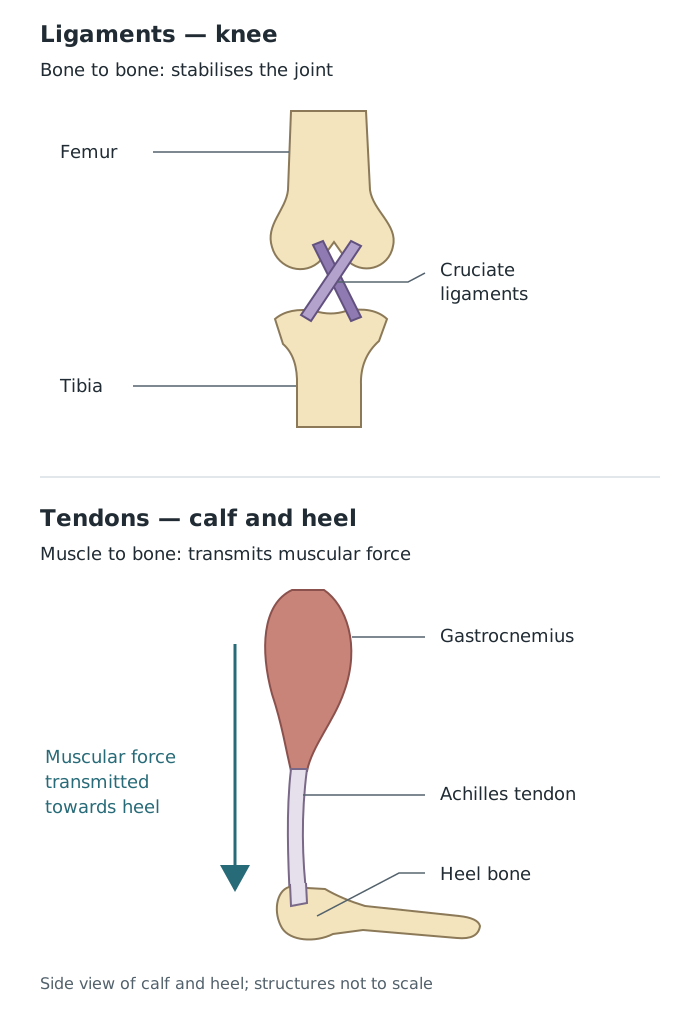
Ligaments stabilise joints by connecting bones; tendons transmit force from muscles to bones.
Ligaments and tendons are both essential to physical activity, but they are not interchangeable. Ligaments primarily provide joint stability and control of excessive movement; tendons provide force transmission from muscle to bone.
In a running stride, tendons enable muscular force to move the bones, while ligaments help keep the moving joints stable. Successful performance needs both: generating force is not enough if the joint is unstable, and a stable joint cannot be moved effectively by a muscle unless its force reaches the bone.
| Tissue | Connects | Main role |
|---|---|---|
| Ligament | Bone to bone | Stabilises joints and limits excessive movement, helping prevent dislocation |
| Tendon | Muscle to bone | Transmits muscular force to move bones |
Ligaments → stability and controlled movement.
Muscle contraction → tendon transmits force → bone moves.
Keep the attachments distinct: ligaments connect bone to bone; tendons connect muscle to bone.
When explaining relevance to sport, link the tissue’s role to a specific action: joint stability during a change of direction, or transmission of muscular force during take-off.
Do not say that tendons contract. Muscles contract; tendons transmit the force to bones.
It can see this note and what your specification asks for.
Answers are free with an account.
1 free note left this week
Get more free notesYour answer sets when this note comes back for review, or marks it complete.
Was this note helpful?
Log in to tell us whether it helped, or to report a problem.
Last updated
Put your knowledge into practice — try past paper questions for Physical Education