

Loading…
Loading…
Loading…
Edexcel GCSE Design and Technology · 1DT0
Edexcel 1DT0 · 6.2.7 Check the specification (PDF) (opens in a new tab)
A textile’s working properties describe how it behaves when something acts on it: a pulling force, repeated rubbing, moisture, electricity or heat. These properties help a designer decide whether a fabric will perform well in a particular product.
The fibre matters, but it is not the whole story. Yarn, fabric construction and finishes also influence performance. A designer therefore selects a finished fabric, not simply a fibre name. A material that is suitable for a towel may be unsuitable for a close-fitting sports garment.
Elasticity is the ability to return to the original size after stretching. Imagine pulling a garment cuff wider to pass your hand through it. It needs to stretch, but it must also recover so that it fits your wrist afterwards. A fabric that stretches and stays stretched has poor elastic recovery.
Elastane, also known as spandex and sold under names such as Lycra, is highly elastic. It is combined with other fibres in products such as leggings and swimwear to provide stretch, comfort and a close fit. Cotton fibres have low elasticity, so adding elastane can give a cotton fabric a useful property that cotton alone lacks.
Resilience is the ability to recover shape after deformation. This includes being compressed, bent, twisted or creased, rather than only being stretched lengthways.
A cushion filling needs to recover after someone sits on it. Clothing benefits from resilience because creases can recover after movement or folding. Polyester has good resilience, making it useful where crease recovery and a neat appearance are important. Cotton and linen have low resilience and crease more readily.
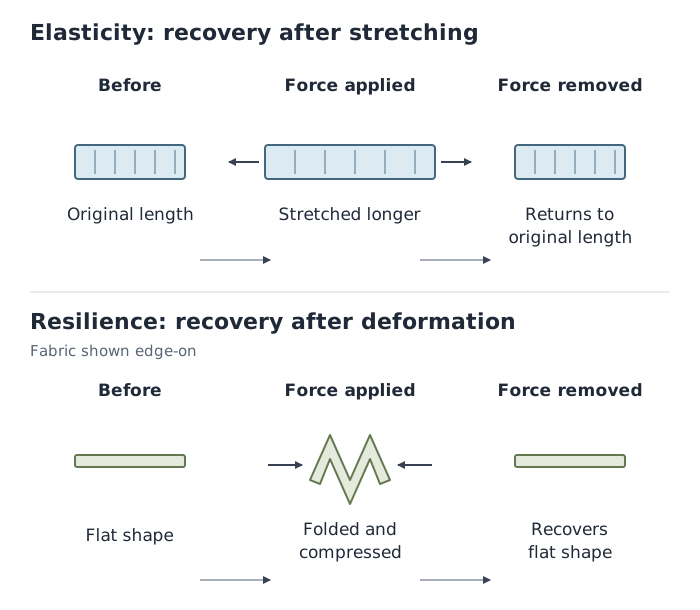
Elasticity concerns recovery after stretching; resilience includes recovery after compression, bending and creasing.
Elasticity and resilience are related, but they emphasise different responses: elasticity concerns recovery from stretching; resilience concerns recovery from deformation more generally.
Tensile strength is the ability to resist a pulling force without breaking. It matters in products such as ropes, parachute fabrics and straps, where the textile must carry a load. Nylon has high tensile strength and is used in ropes and parachutes.
Durability is the ability to withstand wear and deterioration over time. A durable textile must cope with the conditions of its intended use, which might include rubbing, repeated bending, washing, moisture or sunlight.
Nylon is durable and has excellent abrasion resistance: it withstands rubbing well. This helps explain its suitability for demanding uses. However, tensile strength alone does not guarantee durability. A strong textile could still deteriorate under particular conditions. Jute, for example, deteriorates rapidly when exposed to moisture, limiting its suitability for prolonged damp use.
The conditions also matter when comparing strength. Some fibres lose strength when wet; ordinary viscose rayon is one example. A designer must consider the conditions in which the finished product will actually be used.
Breathability is the ability of a fabric to let water vapour pass through it. When someone sweats, a breathable fabric helps moisture escape rather than remain trapped around the body. Cotton fabrics are commonly breathable and useful for comfortable clothing, although the finished fabric’s construction and any coatings also matter.
Absorbency is the ability to take up moisture. Cotton is highly absorbent, making it suitable for towels as well as clothing that takes up perspiration. Rayon is also highly absorbent. Polyester absorbs very little moisture into its fibres, which helps it dry quickly but makes it less suitable when the main purpose is to soak up water.
Breathability and absorbency are not interchangeable. One concerns moisture passing through a fabric; the other concerns moisture being taken up by it.
There is also wicking: liquid moving along fibres or through the spaces within a fabric. A fibre does not need to be highly absorbent for the fabric to wick. This explains how a suitably designed low-absorbency sports fabric can move sweat away from the skin without storing much moisture inside its fibres.
Electrical conductivity describes how easily electric charge flows through a material. Most ordinary dry textile fibres are poor electrical conductors. Nylon and polyester can therefore accumulate static charge rather than allowing it to escape readily. This can cause garments to cling and can create problems during textile processing.
Moisture can provide a path for charge to escape. Low-absorbency synthetic fibres are particularly prone to static in dry conditions, while moisture-absorbing wool is comparatively resistant to static build-up. Special finishes can also reduce static.
Textiles can be modified to conduct electricity, for example by incorporating conductive metal components. This is a deliberately engineered property, not a property shared by all fabrics.
Heat conductivity describes how readily heat passes through a material by conduction. Low heat conductivity helps a material act as an insulator, slowing heat transfer from a warmer region to a cooler one.
The air held within a fabric is important. Wool fibres have a natural crimp, which helps create bulky yarns and fabrics that trap air. Air is a poor heat conductor, so this structure provides thermal insulation. Wool is therefore useful for warm clothing and blankets.
Warmth depends on the finished textile’s structure as well as its fibres. A bulky fabric that retains air can behave differently from a thin, compact fabric. Conductivity must also be distinguished from resistance to heat damage: insulating well does not automatically mean a fabric can tolerate a hot iron.
There is no textile with every desirable property. Selection means deciding which properties matter most and accepting or reducing the disadvantages.
For a towel, cotton’s absorbency is a major advantage; high elasticity is not the priority. For close-fitting leggings, an elastane blend provides stretch and recovery. For a rope, nylon’s tensile strength and durability are important. For a winter blanket, wool’s ability to provide insulation is valuable.
A strong justification connects the material, its relevant working property and the practical benefit to the user.
Match material → property → benefit in use. Consider fibre, construction, finish and service conditions rather than assuming every fabric made from one fibre performs identically.
Link each property to the product’s use: name the property, explain the benefit and identify a suitable textile.
Stretching is not enough to show elasticity: the material must return to its original size after the force is removed.
Distinguish tensile strength from durability. Resisting a pulling force is not the same as resisting years of rubbing, washing and use.
Do not confuse absorbency with breathability or wicking. They describe different ways of handling moisture.
Heat conductivity is not heat resistance. A textile’s ability to transfer heat does not tell you its safe ironing temperature.
It can see this note and what your specification asks for.
Answers are free with an account.
1 free note left this week
Get more free notesYour answer sets when this note comes back for review, or marks it complete.
Was this note helpful?
Log in to tell us whether it helped, or to report a problem.
Last updated
Elasticity
The ability of a material to return to its original size after being stretched and released.
Resilience
The ability of a material to recover its original shape after deformation, such as compression, bending or creasing.
Durability
The ability of a material to withstand wear and deterioration during use over time.
Tensile strength
The ability of a material to resist a pulling force without breaking.
Abrasion resistance
The ability of a material to withstand rubbing without being damaged or worn away.
Breathability
The ability of a fabric to allow water vapour to pass through it, helping moisture escape from around the wearer.
Absorbency
The ability of a material to take up moisture.
Wicking
The movement of liquid along fibres or through a fabric, even when the fibres themselves absorb little moisture.
Electrical conductivity
The ability of a material to allow electric charge to flow through it.
Heat conductivity
The ability of a material to transfer heat through itself by conduction.
Put your knowledge into practice — try past paper questions for Design and Technology
Elasticity
The ability of a material to return to its original size after being stretched and released.
Resilience
The ability of a material to recover its original shape after deformation, such as compression, bending or creasing.
Durability
The ability of a material to withstand wear and deterioration during use over time.
Tensile strength
The ability of a material to resist a pulling force without breaking.
Abrasion resistance
The ability of a material to withstand rubbing without being damaged or worn away.
Breathability
The ability of a fabric to allow water vapour to pass through it, helping moisture escape from around the wearer.
Absorbency
The ability of a material to take up moisture.
Wicking
The movement of liquid along fibres or through a fabric, even when the fibres themselves absorb little moisture.
Electrical conductivity
The ability of a material to allow electric charge to flow through it.
Heat conductivity
The ability of a material to transfer heat through itself by conduction.