

Loading…
Loading…
Loading…
Edexcel GCSE Design and Technology · 1DT0
Edexcel 1DT0 · 6.2.9 Check the specification (PDF) (opens in a new tab)
A textile’s ecological footprint includes the environmental effects of obtaining its raw materials, processing them into fabric, transporting products, using them and dealing with waste. A soft cotton shirt or durable polyester jacket may look harmless, but its production has required resources and may have caused pollution elsewhere.
Sustainability means meeting present needs without undermining the ability of future generations to meet theirs. For textile designers, this involves conserving resources, reducing pollution and waste, and making products that remain useful. No fibre should be judged only by whether it is natural or synthetic: the whole life cycle matters.
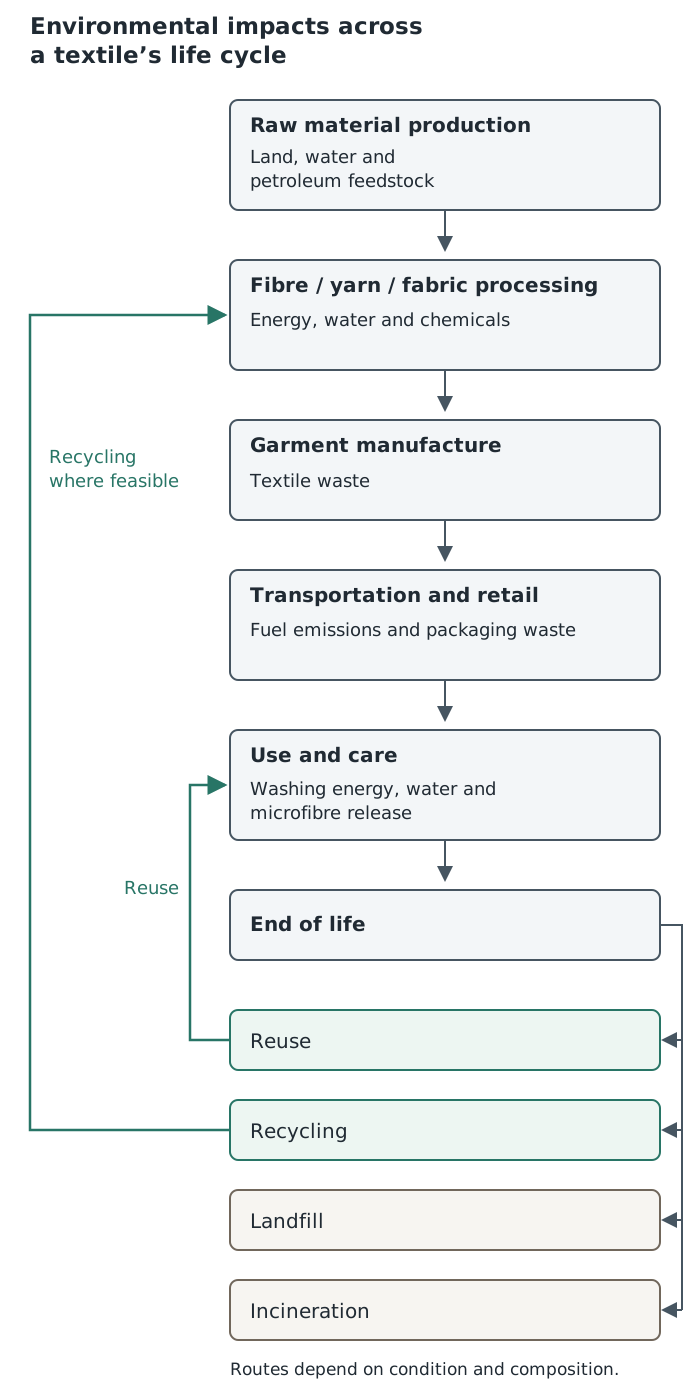
A textile’s ecological footprint extends from its raw materials to its end of life. Keeping products and materials in use can reduce demand for new production.
Natural fibres come from sources that can be renewed, but growing them still has environmental costs. Cotton cultivation uses land and water, and conventional farming can involve fertilisers and pesticides. These chemicals can pollute the surrounding environment. Water demand also matters: irrigation places pressure on available water supplies, especially where water is scarce. Wool production requires land for grazing animals.
Polyester and nylon are synthetic fibres commonly made using petroleum-based raw materials. Crude oil is non-renewable: extracting it uses a resource that cannot be replaced on a human timescale. Resource extraction and synthetic fibre production also contribute greenhouse gas emissions. Synthetic fibres generally have a higher climate impact than natural fibres because of their fossil-fuel origins and the energy used in manufacture. However, climate impact alone does not account for cotton’s water and land requirements.
Wood can also supply textile raw materials. Rayon, including viscose, is made from cellulose that can be obtained from wood. If supplying this wood involves clearing forests, textile production contributes to deforestation. Removing forests destroys habitats and reduces the carbon stored in trees. A plant-based origin therefore does not, by itself, prove that a fibre is environmentally sustainable.
The ecological costs of petroleum-based textiles begin before the oil reaches a fibre factory. Exploration means searching for oil deposits; extraction means bringing the oil out of the ground. Exploration surveys, access roads, drilling sites and pipeline routes can require vegetation clearance. This can destroy habitats or split them into smaller, separated areas — habitat fragmentation. Construction and vehicle movement can also damage soil and increase erosion, allowing sediment to enter waterways.
Noise, vehicles and lighting around drilling operations can disturb or displace wildlife. Losing or damaging habitats reduces the places where animals can feed, shelter and breed. Disturbance can also reduce reproduction, so wildlife loss is not limited to animals killed immediately.
Oil leaks and spills create a further risk by contaminating soil and water. Oil on a bird’s feathers reduces their water repellency, while oil on a sea otter’s fur reduces its insulation. Both animals can become dangerously cold. Animals may also swallow oil when cleaning themselves and be poisoned. Fish eggs and larvae are particularly sensitive to oil exposure, and exposed adult fish may suffer impaired growth and reproduction.
These impacts strengthen the case for reducing demand for newly extracted petroleum, for example by keeping suitable textile products in use for longer. They are part of the environmental disadvantage of virgin synthetic fibres, alongside their resource use and manufacturing emissions.
Spinning fibres into yarn, making fabric and applying finishes all require resources. Machinery uses energy, while processes such as washing, dyeing and finishing use water and chemicals. When energy comes from fossil fuels, generating it releases greenhouse gases that contribute to climate change.
Dyeing adds colour, and finishes can provide useful properties such as water repellency. These benefits need to be weighed against their environmental costs. For example, a water-repellent finish may make an outdoor garment fit for purpose, but applying it adds another processing stage.
Wastewater is particularly important. Untreated or inadequately treated water from dyeing and finishing can carry dyes and harmful chemicals into waterways. Coloured wastewater can reduce light penetration, damaging aquatic plant growth, while toxic substances can harm aquatic organisms. This connects processing and pollution directly to wildlife loss. Reducing hazardous chemicals and treating wastewater can reduce these impacts.
Fibre production, spinning, fabric manufacture and garment construction may take place in different countries. Materials can therefore be transported several times before the finished product reaches a shop.
Transportation uses fuel and produces emissions; distribution also creates packaging waste. Reducing unnecessary journeys can lower this part of the footprint. However, a shorter supply chain is not automatically the most sustainable overall: the energy sources, water use and waste management at the production sites still matter. A locally made textile can still have a substantial production footprint.
Textile waste includes material lost during manufacture and products discarded after use. For example, cutting garment pieces from fabric can leave offcuts. Wasted fabric represents more than wasted material: the water, energy and chemicals already used to produce it have also been spent. Efficient pattern layouts can reduce this avoidable loss.
During use, washing, drying and ironing consume water and energy. Washing can also release chemicals and microfibres into wastewater. Fibres shed by synthetic textiles are plastic and can reach aquatic environments, adding to microplastic pollution.
At the end of their useful lives, textiles may be landfilled or incinerated. Disposal loses the opportunity to keep materials in use, and incineration produces emissions. Reuse and recycling can reduce demand for new materials, although the options depend on the textile’s condition and material composition.
A sustainable choice balances environmental impacts with the job the product must do. Cotton may offer a lower climate impact than a synthetic alternative, but its water demand and farming methods also need consideration. A durable synthetic fabric may suit a demanding application, but its petroleum origin, extraction impacts on wildlife and microplastic release remain disadvantages.
For example, when choosing fabric for a frequently used jacket, consider whether it will withstand wear, whether damage can be repaired and whether it needs resource-intensive care. A fabric that fails quickly and needs replacing may waste the resources invested in its production.
The strongest approach is usually to prevent unnecessary resource use first: make a suitable, durable product, minimise manufacturing waste and keep it in use through repair and reuse. Recycling is valuable, but it does not remove the impacts already caused by producing the original textile.
Balance resource use, pollution, transport, durability, care and end-of-life options against fitness for purpose. Prioritise waste prevention, longer use, repair and reuse; consider recycling afterwards. Neither ‘natural’ nor ‘local’ guarantees sustainability.
Link each environmental impact to its cause: for example, energy used to heat dye baths can produce greenhouse gas emissions when supplied by fossil fuels.
Do not assume that ‘natural’ means sustainable. Consider water, land, chemicals, processing and the product’s useful life.
When selecting a textile, weigh environmental disadvantages against fitness for purpose and durability, then give a justified conclusion.
Distinguish renewable raw materials from recyclable materials: these are not the same property.
For oil exploration and extraction, explain both habitat damage and pollution: roads and drilling sites can fragment habitats, while oil leaks can poison wildlife.
It can see this note and what your specification asks for.
Answers are free with an account.
1 free note left this week
Get more free notesYour answer sets when this note comes back for review, or marks it complete.
Was this note helpful?
Log in to tell us whether it helped, or to report a problem.
Last updated
Ecological footprint
The environmental impact of obtaining resources, making, transporting, using and disposing of a product.
Sustainability
Meeting present needs while conserving resources and environmental conditions so that future generations can meet their needs.
Life cycle
The stages a product passes through, from obtaining its raw materials to manufacture, distribution, use and end of life.
Non-renewable resource
A raw material or energy source that is not replaced on a human timescale, such as crude oil.
Deforestation
The removal of forest, which can destroy habitats and reduce the carbon stored in trees.
Microplastic
A very small plastic particle, including fragments of synthetic textile fibres released during use and washing.
Circular design
Designing products to remain useful for longer and to support repair, reuse and recycling, reducing the need for new resources.
Habitat fragmentation
The division of a continuous habitat into smaller, separated areas, for example by roads or cleared pipeline routes.
Put your knowledge into practice — try past paper questions for Design and Technology
Ecological footprint
The environmental impact of obtaining resources, making, transporting, using and disposing of a product.
Sustainability
Meeting present needs while conserving resources and environmental conditions so that future generations can meet their needs.
Life cycle
The stages a product passes through, from obtaining its raw materials to manufacture, distribution, use and end of life.
Non-renewable resource
A raw material or energy source that is not replaced on a human timescale, such as crude oil.
Deforestation
The removal of forest, which can destroy habitats and reduce the carbon stored in trees.
Microplastic
A very small plastic particle, including fragments of synthetic textile fibres released during use and washing.
Circular design
Designing products to remain useful for longer and to support repair, reuse and recycling, reducing the need for new resources.
Habitat fragmentation
The division of a continuous habitat into smaller, separated areas, for example by roads or cleared pipeline routes.