

Loading…
Loading…
Loading…
Edexcel GCSE Design and Technology · 1DT0
Edexcel 1DT0 · 6.6.1 Check the specification (PDF) (opens in a new tab)
Before fabric pieces can be assembled into a product, they need to be cut to the required shape. A manufacturer must balance accuracy, speed, cost and the edge finish. Cutting a single costume piece is a different task from producing thousands of identical patches.
The material matters too. Shears and cutting dies separate fibres mechanically. Laser cutters and heating elements use heat, so the fibres’ response to heating affects the result. Thermoplastic synthetic fibres, such as polyester and nylon, can melt and fuse together at a cut edge. Cotton does not melt in this way, so it cannot gain the same sealed edge. Blended fabrics contain different fibre types and should not automatically be treated like pure polyester.
Extrusion has a different role: it forms synthetic fibres before they become fabric, rather than cutting an existing textile.
Fabric shears are large, sharp scissors operated manually. The operator follows the required outline, controlling the direction and length of each cut. They can cut natural or synthetic fabrics and are useful when making individual garment pieces, prototypes or bespoke costumes.
Their main advantages are low equipment cost and flexibility. There is no need to manufacture a special cutting tool or program a machine whenever the shape changes. However, cutting is relatively slow, and accuracy depends on the operator’s skill. Repeating the same shape many times can produce variations between pieces.
For controlled cutting, support the fabric on a flat surface and keep it from shifting or stretching. Keep fingers clear of the blades and close the shears when they are not in use. Check that the finished piece follows the intended outline and has no partly cut sections.
In textile cutting, a stamp uses a cutting die: a shaped metal blade matching the outline of the required piece. A press pushes the die through the fabric. Suitable equipment can cut several layers in one operation, producing repeated pieces of the same shape.
This is useful for quantities of identical components, such as simple fabric patches. Once the die has been made, cutting is quick and consistent, and several pieces can be produced together. Mechanical cutting also avoids the heat damage associated with thermal processes.
The disadvantage is the cost of making the die. A changed outline generally needs a different die, so stamping is less flexible than shears or a digitally controlled laser. The tooling cost is easier to justify when many identical pieces are needed.
Presses must be operated with their guards and safety controls in place. Hands must remain outside the cutting area. After cutting, check that each piece separates fully and that the lower layers have been cut cleanly, not just the top layer.
A laser cutter focuses a narrow beam onto the fabric. Its heat cuts the material while computer-controlled movement follows the digital outline. This is an example of computer-aided manufacturing, or CAM.
Laser cutting is useful for intricate shapes and repeated accurate components. Unlike a blade, the beam does not press against the fabric or become blunt. A design can be changed digitally rather than requiring a new cutting die.
On suitable synthetic fabrics, the heat melts and fuses the cut edge, helping to prevent fraying. For example, this is useful when cutting synthetic sail fabric. It can reduce the need for a separate edge-finishing operation.
These benefits have limits. The equipment is expensive, and heat can scorch or discolour material. Natural fibres do not receive the same melt-sealed finish. Laser cutting usually works best on a single layer or a few layers: thick stacks can cut less accurately, and synthetic layers may fuse together. It is therefore not automatically the best method for every large production run.
Use only materials approved for the machine, with its enclosure closed and extraction operating. Never bypass safety interlocks, and follow the supervised operating procedure because cutting produces fumes and presents a fire risk. A test cut helps establish suitable settings. The completed piece should separate cleanly, retain the intended shape and show no unacceptable scorching or layers fused together.
A soldering iron has an electrically heated tip. For textile work, its heat can melt through suitable thermoplastic synthetic fabric while sealing the edge. Here, it is being used as a heating element, not to apply solder.
It is useful for small areas, simple shapes and edge finishing on materials such as nylon or polyester. Compared with a laser cutter, the equipment is inexpensive, and cutting and sealing can happen together.
However, it is a hand-controlled process, so speed and accuracy depend on the operator. Excessive heat or slow movement can distort the fabric, leave a thick melted edge or burn it. It is unsuitable for producing the same melt-sealed result on cotton, and a blend may respond unevenly.
Work on a heat-resistant surface with suitable ventilation or extraction. Keep the tip away from skin and loose materials, return the iron to its stand, and allow it to cool before storage. Check that the cut is complete and the sealed edge is continuous without excessive melting or distortion.
In textile extrusion, molten polymer is forced through the small holes of a spinneret. Each hole forms a continuous filament. The filaments cool and solidify, and can then be collected for use in yarn manufacture. Polyester is an example of a synthetic fibre produced this way.
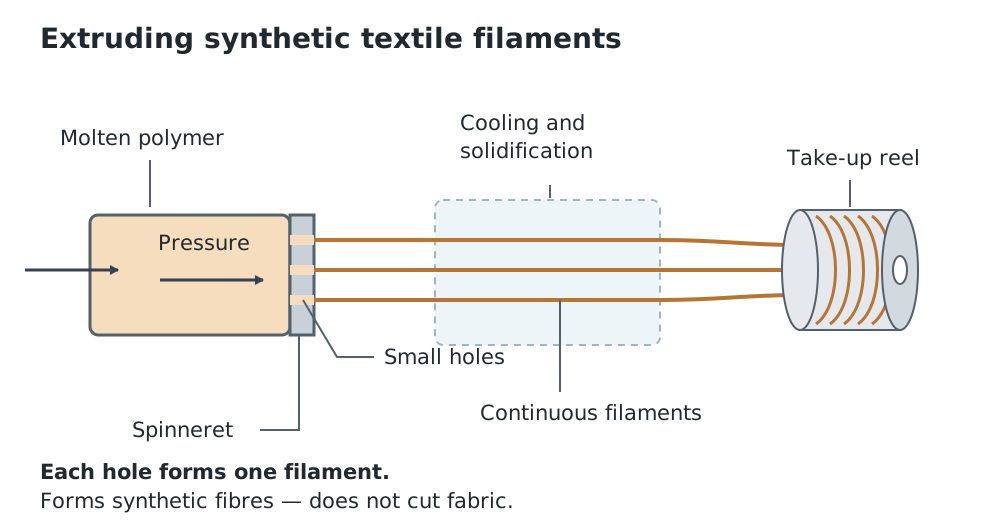
A spinneret forms continuous synthetic filaments from molten polymer; cooling makes the filaments solid.
Extrusion is suitable for industrial production of long, consistent lengths of synthetic fibre. Many spinneret holes can produce filaments at once, making the process efficient for high output.
Its disadvantages include expensive machinery, energy needed for heating, and the need to control the process carefully to maintain consistent filaments. This melt-based method is for suitable polymers: it does not cut garment shapes or turn natural cotton fibres into extruded filaments. Industrial equipment requires guarding against moving parts and protection from hot polymer and heated surfaces.
For a one-off costume, shears offer flexibility without expensive setup. For many identical, simple cotton patches, stamping can provide fast, consistent cutting without heat damage. For intricate polyester components, a laser may justify its higher cost through precision, digital flexibility and sealed edges. A soldering iron suits smaller, simpler thermal cuts, while extrusion is the choice when the task is to manufacture synthetic filaments rather than cut fabric.
A good selection therefore starts with what needs to be made and the material’s properties—not with the assumption that the most advanced machine is always best.
Extrusion: molten polymer → spinneret holes → continuous filaments → cooling and solidification.
Efficient for high-output synthetic fibre manufacture, but requires costly equipment, heating energy and process control. It does not cut existing fabric.
Compare material compatibility, shape complexity, quantity, accuracy, edge finish and total cost. Balance an advantage against a relevant limitation before reaching a conclusion.
Justify a process by linking its advantages to the material, shape, quantity and required finish, then consider a relevant disadvantage.
In this topic, a stamp is a cutting die, not a tool for printing a pattern onto fabric.
Do not claim that heat seals every fabric: thermoplastic synthetic fibres can melt and fuse, whereas natural fibres such as cotton do not.
Distinguish extrusion, which forms fibres from polymer, from processes that cut existing fabric.
It can see this note and what your specification asks for.
Answers are free with an account.
1 free note left this week
Get more free notesYour answer sets when this note comes back for review, or marks it complete.
Was this note helpful?
Log in to tell us whether it helped, or to report a problem.
Last updated
Fabric shears
Large, sharp scissors used to cut fabric manually.
Cutting die
A shaped cutting tool pressed through material to produce pieces with the same outline.
Laser cutting
A process in which a focused laser beam uses heat to cut material along a controlled path.
Computer-aided manufacturing (CAM)
The use of computer-controlled machinery to manufacture a product or component.
Thermoplastic
A polymer that softens or melts when heated and becomes solid again when cooled.
Extrusion
A process that forces material through a shaped opening to form a continuous length; in textile manufacture, it can produce synthetic filaments.
Spinneret
A nozzle containing small holes through which polymer is forced to form textile filaments.
Filament
A long, continuous fibre that can be used to make yarn.
Put your knowledge into practice — try past paper questions for Design and Technology
Fabric shears
Large, sharp scissors used to cut fabric manually.
Cutting die
A shaped cutting tool pressed through material to produce pieces with the same outline.
Laser cutting
A process in which a focused laser beam uses heat to cut material along a controlled path.
Computer-aided manufacturing (CAM)
The use of computer-controlled machinery to manufacture a product or component.
Thermoplastic
A polymer that softens or melts when heated and becomes solid again when cooled.
Extrusion
A process that forces material through a shaped opening to form a continuous length; in textile manufacture, it can produce synthetic filaments.
Spinneret
A nozzle containing small holes through which polymer is forced to form textile filaments.
Filament
A long, continuous fibre that can be used to make yarn.