

Loading…
Loading…
Loading…
Edexcel GCSE Design and Technology · 1DT0
Edexcel 1DT0 · 5.5.2 Electrical Measurements and Calculations Check the specification (PDF) (opens in a new tab)
An electronic system needs suitable resistor values to control the current through its components. Three electrical quantities help you choose those values.
Current is the rate at which electric charge flows through a circuit. Its symbol is , and it is measured in amperes, written A and often called amps. Current flows through a component.
Potential difference, also called voltage, is the energy transferred per unit of charge between two points. Its symbol is , and it is measured in volts, also written V. A supply provides a potential difference that drives current around a complete circuit; a component has a potential difference across it.
Resistance describes how strongly a component opposes current. Its symbol is , and it is measured in ohms, written Ω. At the same potential difference, increasing resistance reduces current; decreasing resistance increases current.
For a resistor whose temperature remains constant, current increases in proportion to the potential difference across it. The relationship between potential difference, current and resistance is:
You can rearrange this equation according to the quantity you need:
Use the potential difference across the resistor and the current through that same resistor. With current in amperes and resistance in ohms, the calculated potential difference is in volts.
For example, suppose a resistor has a resistance of 300 Ω and carries a current of 0.02 A. Its potential difference is . This means that 6 V is required across that resistor to produce a current of 0.02 A, or 20 mA.
The same relationship works in reverse. If you know the potential difference is 6 V and the resistance is 300 Ω, then . If you instead know the potential difference is 6 V and the current is 0.02 A, then .
Resistors are connected in series when current passes through them one after another along a single path. The same current flows through every resistor, while the supply potential difference is shared between them.
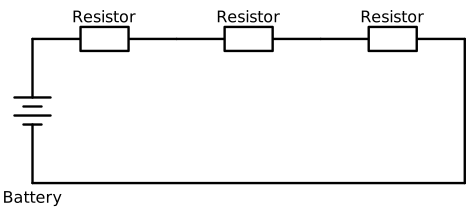
Three resistors connected in series: there is one current path, so their resistances add.
Each resistor adds opposition to the flow of charge, so their resistances add:
The subscripts simply distinguish the individual resistors. Include every resistor in the series path.
Suppose you connect a 60 Ω resistor and two 120 Ω resistors in series. Their total resistance is . The combination behaves like a single 300 Ω resistor. Adding another series resistor would increase the total resistance and, with the supply voltage unchanged, reduce the current.
If a design needs a particular resistance, you can also use subtraction to find a missing value. For example, a series combination totalling 300 Ω, with known resistors of 60 Ω and 120 Ω, needs a third resistor of .
Resistors are connected in parallel when each is connected between the same two points. Current can divide between the branches, and every resistor has the same potential difference across it.
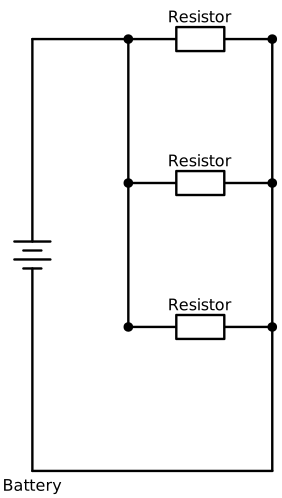
Three parallel resistor branches connect between the same two points. Each provides a separate current path and has the same potential difference across it.
Adding a parallel branch provides an extra route for charge. More current can flow overall at the same supply voltage, so the total resistance decreases. It is smaller than the smallest individual resistor in the parallel combination.
For parallel resistors, add the reciprocals of their resistances:
A reciprocal means one divided by a number. After adding the reciprocals, take the reciprocal again to obtain the total resistance.
For the same 60 Ω, 120 Ω and 120 Ω resistors, now connected in parallel:
Therefore, . The same three components give 300 Ω in series but only 30 Ω in parallel: the connection changes their overall effect. Once you have found the total resistance, you can use to calculate the total current drawn from a supply.
Use amperes, ohms and volts in V = IR. Convert milliamperes to amperes by dividing by 1000, and kilohms to ohms by multiplying by 1000.
In a parallel calculation, adding the reciprocals gives 1/Rtotal. Take the reciprocal of that answer to find Rtotal.
Check your answer: series resistance is greater than any individual resistance; parallel resistance is smaller than the smallest individual resistance.
Identify connections by tracing the paths through the circuit, not just by how the components are positioned on the page.
Show the formula, substitution and final answer with its unit.
It can see this note and what your specification asks for.
Answers are free with an account.
1 free note left this week
Get more free notesYour answer sets when this note comes back for review, or marks it complete.
Was this note helpful?
Log in to tell us whether it helped, or to report a problem.
Last updated
Current
The rate of flow of electric charge through a circuit. Its symbol is and its unit is the ampere (A), often called the amp.
Potential difference
The energy transferred per unit of electric charge between two points in a circuit, also called voltage. Its symbol is and its unit is the volt (V).
Resistance
A measure of how strongly a component opposes electric current. Its symbol is and its unit is the ohm (Ω).
Ohm’s law
For a conductor at constant temperature, current is directly proportional to potential difference. The relationship is expressed as .
Series connection
An arrangement in which components are connected one after another along a single current path.
Parallel connection
An arrangement in which components are connected between the same two points, providing separate current paths.
Total resistance
The resistance of a single resistor that would have the same overall effect as a combination of resistors.
Put your knowledge into practice — try past paper questions for Design and Technology
Current
The rate of flow of electric charge through a circuit. Its symbol is and its unit is the ampere (A), often called the amp.
Potential difference
The energy transferred per unit of electric charge between two points in a circuit, also called voltage. Its symbol is and its unit is the volt (V).
Resistance
A measure of how strongly a component opposes electric current. Its symbol is and its unit is the ohm (Ω).
Ohm’s law
For a conductor at constant temperature, current is directly proportional to potential difference. The relationship is expressed as .
Series connection
An arrangement in which components are connected one after another along a single current path.
Parallel connection
An arrangement in which components are connected between the same two points, providing separate current paths.
Total resistance
The resistance of a single resistor that would have the same overall effect as a combination of resistors.
For a resistor at constant temperature, resistance remains constant. At fixed voltage, greater resistance means smaller current.
Series: one current path; same current through each resistor; potential difference shared.
Adding a series resistor increases total resistance.
Parallel: separate paths between the same two points; same potential difference across each resistor; current divides.
Add reciprocals, then invert the result. Adding a parallel branch decreases total resistance.