

Loading…
Loading…
Loading…
Edexcel GCSE Design and Technology · 1DT0
Edexcel 1DT0 · 5.5.2 Electrical Measurements and Calculations Check the specification (PDF) (opens in a new tab)
An electronic system needs physical space as well as the correct electrical components. A printed circuit board (PCB), for example, must fit inside its enclosure and provide enough room for the components placed on it. Its dimensions also affect how much board material is needed to make a batch.
Area measures the space inside a flat shape's boundary. Diameter measures the distance across a circular shape through its centre. These measurements help you select suitable sizes and calculate quantities, but they answer different questions: area tells you how much surface is involved, while diameter tells you how wide a circular part is.
For a rectangular board, multiply its length by its width:
Suppose a PCB is 60 mm long and 40 mm wide. Its area is . This represents the surface within the board's outline, not the total surface area of all its faces.
For 12 identical boards, multiply the area of one board by the number required:
The boards therefore occupy in total. This is the area of the finished boards; the stock needed may be greater because cutting and unused spaces consume material.
A smaller board can use less material and fit a smaller enclosure. However, reducing its size is only useful if the required components and connections still fit. Size selection balances material efficiency against the system's needs.
The radius is the distance from a circle's centre to its edge. A diameter contains two radii, so:
The area of a circular board or part is:
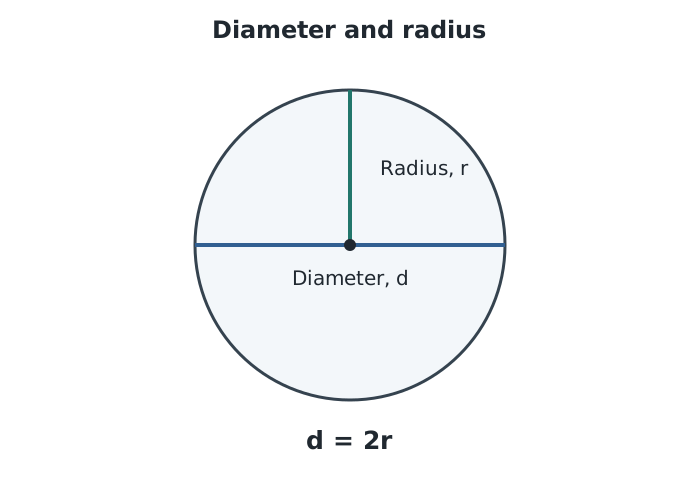
A diameter crosses the whole circle through its centre; a radius reaches from the centre to the edge.
Suppose a circular board has a diameter of 20 mm. Its radius is 10 mm, giving an area of .
Diameter also helps you check whether a circular component will fit an opening. Compare the component's specified diameter with the available space rather than comparing their areas. Any required clearance must also be considered.
Length is measured in units such as millimetres or centimetres; area is measured in squared units. A square measuring 1 cm on each side also measures 10 mm on each side. Its area is therefore :
Similarly, . The conversion factor is squared because both dimensions change. It is usually simplest to convert the lengths first, then calculate the area.
Dividing the stock area by the area of one part gives an initial quantity estimate, but the shapes must also fit within the stock's length and width.
Suppose a rectangular sheet measures 120 mm by 80 mm, and each board measures 60 mm by 40 mm. Two boards fit along the 120 mm edge and two along the 80 mm edge, making four boards in a rectangular arrangement. This assumes no cutting gap or edge margin.
For a real layout, allow for any specified gaps and margins before counting complete parts. Circular parts also leave spaces between their curved edges, so dividing the sheet area by the area of one circle cannot by itself establish the usable quantity.
Convert all lengths to the same unit before calculating an area. Give area answers in squared units, such as mm².
If a circle's diameter is given, halve it before using A = πr².
An area ratio alone does not prove that components will fit: check their dimensions and arrangement, allowing for any stated cutting gaps or margins.
Keep calculator precision during calculations and round the final answer as requested.
It can see this note and what your specification asks for.
Answers are free with an account.
1 free note left this week
Get more free notesYour answer sets when this note comes back for review, or marks it complete.
Was this note helpful?
Log in to tell us whether it helped, or to report a problem.
Last updated
Put your knowledge into practice — try past paper questions for Design and Technology