

Loading…
Loading…
Loading…
Edexcel GCSE Design and Technology · 1DT0
Edexcel 1DT0 · 3.2.1 Check the specification (PDF) (opens in a new tab)
Paper is not one uniform material. A sheet intended to pass through a photocopier needs different properties from one used to trace a drawing or transfer a design onto fabric. A useful choice links what the paper must do to its surface, strength, stiffness and ability to transmit light.
Surface finish affects how a sheet feels and accepts marks. Stiffness is resistance to bending, whereas strength concerns resistance to damage such as tearing. Opacity describes how effectively a sheet blocks light: high opacity helps prevent printed text on the reverse showing through, while low opacity is useful for tracing.
Grammage is the mass of one square metre of paper, measured in . A higher grammage means more mass for the same area, but does not by itself tell you the exact thickness, strength or finish. Compare the actual grade as well as its name.
Copier paper is a lightweight, dimensionally stable paper used for copying correspondence and documents. Dimensionally stable means that it maintains its size and shape sufficiently well for its intended use.
Its balance of flexibility and stiffness matters. The sheet must bend around the machine’s feed rollers without being so flimsy that it feeds poorly. A very stiff sheet can also cause problems in a copier, so greater stiffness is not always an advantage.
Choose copier paper for printed instructions, worksheets and everyday correspondence. For double-sided work, check its opacity so that the reverse-side printing does not interfere with reading. Its limitation is that suitability for ordinary printing does not make it the best surface for every drawing technique, or give it the translucency needed for tracing.
Cartridge paper is tough and has a slightly rough surface. This texture gives pencil marks something to grip, making it useful for sketches, shading and design development. Its toughness is helpful when a drawing is handled and worked on.
For example, cartridge paper is a sensible choice for a page of shaded product ideas. Copier paper can carry a printed design, but cartridge paper’s textured surface is more useful when building up a drawing by hand.
The same texture can be a disadvantage when the task needs a very smooth surface for exceptionally fine lines. Cartridge paper is also not the appropriate choice for copying an underlying drawing by looking through the sheet: that is the job of tracing paper.
Tracing paper is translucent: it allows enough light through for lines underneath to remain visible. Lay it over a drawing and follow those lines to produce a copy. It also allows a designer to try changes on a separate overlay while keeping the original drawing intact.
Suppose a designer wants to alter the shape of a product without redrawing its unchanged features. Tracing paper can be placed over the original, the retained features traced, and the new outline added. Keeping the sheets aligned is important if the copied drawing is to remain accurate.
Its low opacity is its main advantage for this task, but a disadvantage for an ordinary double-sided document. Text and marks beneath it remain visible and can make the page difficult to read. Translucency is therefore neither universally good nor bad: its value depends on the application.
Bond paper is a writing and printing paper used for stationery and documents. Useful stiffness helps it lie flat, and resistance to repeated folding is valuable for documents that will be folded and handled.
Choose a suitable bond grade for correspondence or business forms where writing, printing and handling are important. A letter that will be folded into an envelope needs a sheet that accepts print and tolerates that folding.
Bond and copier paper are not completely separate categories in everyday use: some office papers are described as bond. Rather than assuming that bond is always superior, compare the particular sheets’ finish, opacity, stiffness and printer compatibility. A bond sheet still cannot replace translucent tracing paper or specialist sublimation transfer paper.
Heat transfer printing paper for sublimation has a different role from the other papers. It carries a printed image temporarily; the finished image belongs on another material, called the substrate.
Special heat-activated sublimation inks are printed onto the transfer paper, usually as a mirror image. When the printed side is placed face down against the substrate, the transfer reverses it again, so lettering appears the correct way round.
The receiving material must be polyester fabric or have a suitable polyester coating. This allows designs to be applied to fabric and to prepared rigid objects made from materials such as glass, metal, wood, plastics or ceramics. Ordinary uncoated glass or ceramic is not interchangeable with a polyester-coated blank.
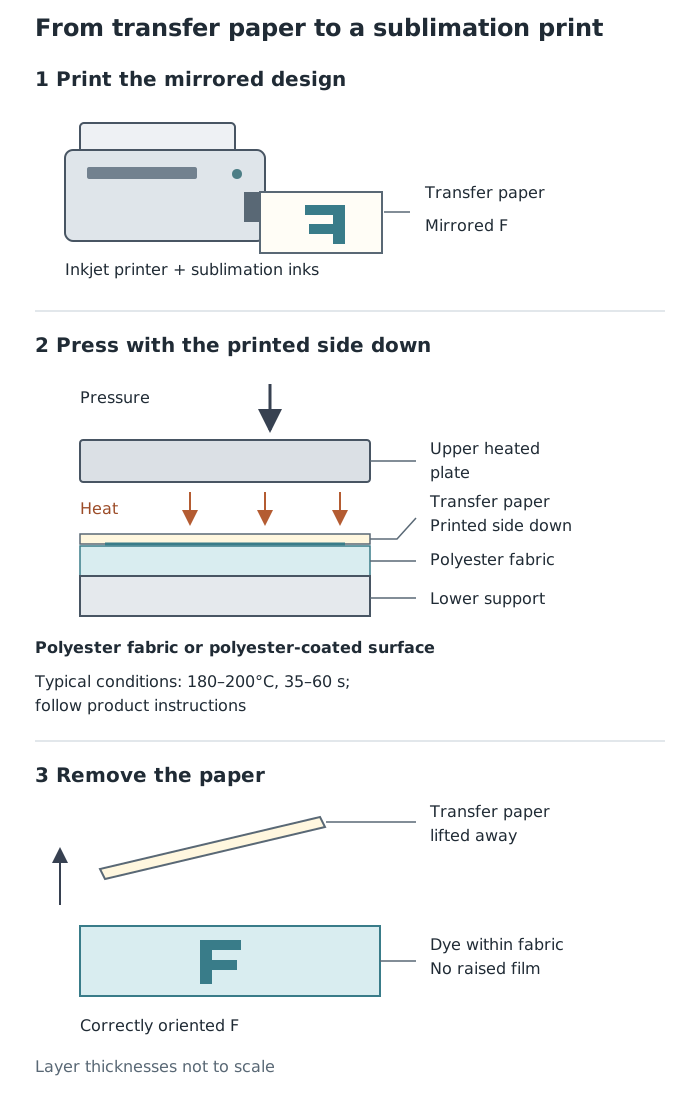
The paper carries the design temporarily; heat and pressure transfer the dye into a compatible polyester receiving material.
Place the paper with its printed side against the receiving surface. A heat press applies heat and pressure to separate items; industrial roll-fed material can pass through a heated roller machine called a calender. Typical transfer conditions are 180–200°C for 35–60 seconds, but the correct settings depend on the ink, paper and substrate, so follow their instructions.
The heat activates the dyes and the image transfers into the polyester fabric or coating. After the specified pressing cycle, remove the paper as instructed. The transfer is complete at this stage: no further drying or post-treatment is needed. Check that the design has transferred clearly, with lettering the right way round and no missing areas.
A heat press presents burn and trapping hazards. Use it under appropriate supervision, keep hands away from hot plates and closing mechanisms, and use suitable heat protection when handling hot items. Follow the equipment instructions and allow the item to cool safely before normal handling.
On polyester fabric, the dye becomes part of the material rather than forming a raised layer on top. The fabric retains its feel, and the image does not crack, peel or flake like a separate surface layer. It can withstand washing with minimal loss of colour. On a suitable coated rigid object, the image lies within the coating and is difficult to scratch or remove.
These qualities make sublimation useful where a durable printed design is needed. Its restrictions are equally important: it requires specialist inks, transfer paper, heating equipment and a compatible receiving surface. The transfer sheet itself is not the finished product.
A good selection therefore starts with the task: copier paper for routine printed documents, cartridge paper for textured drawing work, tracing paper for visible overlays, bond paper for suitable stationery, and sublimation transfer paper for moving a design onto a compatible substrate.
| Paper | Key characteristic | Suitable application | Main limitation |
|---|---|---|---|
| Copier | Lightweight and dimensionally stable | Photocopied and printed documents | Not a specialist drawing or tracing surface |
| Cartridge | Tough, slightly rough surface | Sketching and shading | Texture is less suitable where a very smooth surface is needed |
| Tracing | Translucent, low opacity | Tracing drawings and design overlays | Underlying marks show through |
| Bond | Writing/printing paper with useful stiffness and folding endurance | Correspondence and business forms | Grade must suit the printer and task |
| Sublimation transfer | Carries heat-activated dye for transfer | Designs on polyester fabric or polyester-coated objects | Requires specialist inks, heat and a compatible substrate |
Print a usually mirrored design with sublimation inks → place printed side against the substrate → apply heat and pressure → remove transfer paper.
Justify a material choice by linking a property to the product’s needs: cartridge paper’s slightly rough surface is useful for pencil sketching.
Distinguish tracing paper’s translucency from the opacity wanted for double-sided documents.
For sublimation printing, identify both the special transfer paper and the compatible receiver: polyester fabric or a polyester-coated surface.
Do not assume that every paper sold under the same name has identical properties. The grade, finish and grammage also matter.
It can see this note and what your specification asks for.
Answers are free with an account.
1 free note left this week
Get more free notesYour answer sets when this note comes back for review, or marks it complete.
Was this note helpful?
Log in to tell us whether it helped, or to report a problem.
Last updated
Copier paper
Lightweight, dimensionally stable paper designed for photocopying and printing documents.
Cartridge paper
Tough paper with a slightly rough surface, suitable for drawing and sketching.
Tracing paper
Translucent paper that allows an underlying drawing to be seen and traced.
Bond paper
A writing and printing paper used for stationery and documents, with useful stiffness and resistance to repeated folding.
Heat transfer printing paper
Special paper that temporarily carries a printed design before heat and pressure transfer the dye to a compatible material.
Sublimation printing
A printing process in which heat-activated dyes transfer into polyester fabric or a polyester-coated surface.
Opacity
The extent to which a material prevents light passing through it; high-opacity paper reduces show-through from printing underneath.
Grammage
The mass of paper per unit area, measured in . It is not a direct measurement of thickness.
Substrate
The material that receives a printed image, such as polyester fabric or a coated ceramic object.
Put your knowledge into practice — try past paper questions for Design and Technology
Copier paper
Lightweight, dimensionally stable paper designed for photocopying and printing documents.
Cartridge paper
Tough paper with a slightly rough surface, suitable for drawing and sketching.
Tracing paper
Translucent paper that allows an underlying drawing to be seen and traced.
Bond paper
A writing and printing paper used for stationery and documents, with useful stiffness and resistance to repeated folding.
Heat transfer printing paper
Special paper that temporarily carries a printed design before heat and pressure transfer the dye to a compatible material.
Sublimation printing
A printing process in which heat-activated dyes transfer into polyester fabric or a polyester-coated surface.
Opacity
The extent to which a material prevents light passing through it; high-opacity paper reduces show-through from printing underneath.
Grammage
The mass of paper per unit area, measured in . It is not a direct measurement of thickness.
Substrate
The material that receives a printed image, such as polyester fabric or a coated ceramic object.