

Loading…
Loading…
Loading…
Edexcel GCSE Design and Technology · 1DT0
Edexcel 1DT0 · 1.5.4 Check the specification (PDF) (opens in a new tab)
A is a shaped component fixed to a rotating shaft. A rests against its edge. As the shaft turns, the cam's changing outline pushes the follower to different positions. With a guide keeping the follower on a straight path, this converts into : repeated movement up and down, or backwards and forwards.
Imagine turning the handle of a mechanical toy. The handle rotates a cam beneath a guided rod carrying a figure. A part of the cam that extends further from the shaft pushes the rod upwards; a part closer to the shaft allows it to move downwards. Gravity or a spring keeps the follower against the cam as the profile falls away.
The cam's profile, meaning its outline, determines the sequence of movement. Designers therefore choose a cam shape to suit what the product needs to do, rather than simply to make something move.
A follower's upward movement is called lift, and its downward movement is called fall. A dwell is a pause in the follower's movement even though the cam keeps rotating. This happens when the part passing beneath the follower stays the same distance from the shaft axis.
The stroke is the total distance between the follower's lowest and highest positions. Changing the cam's profile can change both the stroke and the way that movement is spread through each revolution. A product might need a smooth continuous movement, a movement followed by a pause, or a slow lift followed by sudden release.
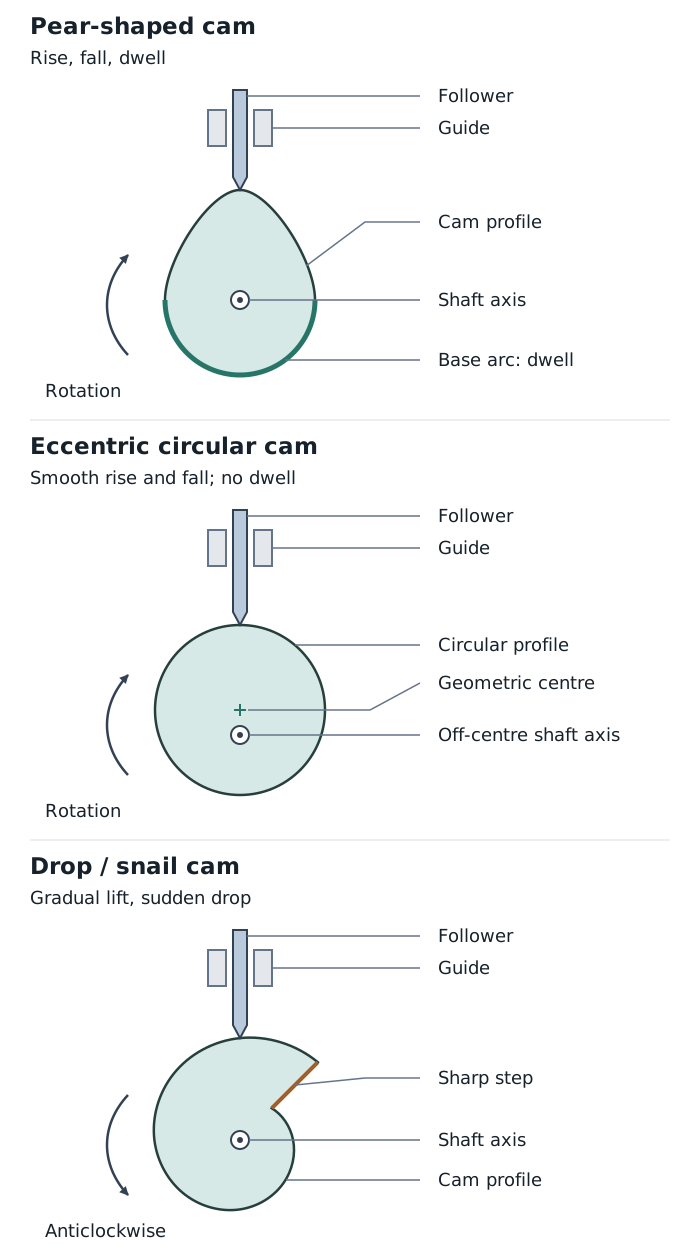
The cam profile and shaft position determine whether the follower pauses, moves continuously or drops suddenly.
A pear-shaped cam has a rounded base and a projecting lobe. As the lobe passes beneath the follower, it causes the follower to rise and then fall. The circular base portion, centred on the shaft, provides a dwell before the movement repeats.
This makes the pear-shaped cam useful when a part must move and then remain still for part of the cycle. For example, a mechanical toy figure could rise, lower and then wait before repeating its action. The pause gives the toy a different character from one that continually bobs up and down.
Cams also control the opening and closing of engine valves. The important design connection is that the profile controls when movement happens and when the valve remains in position; different profiles can provide different timing. A pear-shaped profile demonstrates this combination of lift, fall and dwell.
An eccentric cam is circular, but its shaft is positioned off-centre. Although the outline is a circle, its edge is therefore at different distances from the shaft axis as it turns. This produces a smooth rise and fall with no dwell.
In a mechanical toy, an eccentric cam can keep a figure bobbing continuously. It suits a repeated flowing movement, but not a design that needs the figure to pause between movements.
The off-centre mounting is essential. A circular disc rotating about its exact centre would keep its edge at a constant distance from the shaft and would not produce the required rise and fall.
A drop cam, also called a snail cam, has a profile that gradually increases in distance from the shaft and then ends in a sharp step. Turning it in the intended direction lifts the follower gradually. When the follower reaches the step, it drops suddenly back to its lowest position.
This action is useful in a trip hammer: the cam gradually lifts the hammer, then releases it to deliver a blow. It can also operate an alarm-clock striker. The sudden release is the useful action, rather than an unwanted interruption to smooth movement.
Rotation direction matters. The cam must turn so that the follower travels up the gradual slope before reaching the drop.
The three profiles solve different movement problems. A pear-shaped cam provides movement with a pause; an eccentric cam provides continuous smooth movement; a snail cam provides gradual lift followed by sudden release. For a toy that should bob gently without stopping, an eccentric cam is more suitable than a snail cam. For lifting and releasing a hammer, the snail cam's abrupt drop is an advantage.
Reliable operation also depends on keeping the follower in contact with the cam and reducing wear where the parts touch. Lubrication reduces friction and wear, helping the mechanism maintain its intended movement over time.
| Cam | Follower movement | Suitable application |
|---|---|---|
| Pear-shaped | Rise, fall, then dwell | A toy figure that moves and pauses |
| Eccentric/circular | Smooth continuous rise and fall; no dwell | A continuously bobbing toy figure |
| Drop/snail | Gradual lift followed by sudden drop | Trip hammer or alarm-clock striker |
Describe both the input and output: a rotating cam produces reciprocating motion of a guided follower.
Link a cam choice to the required movement: pear-shaped for a pause, eccentric for continuous smooth rise and fall, or drop/snail for gradual lift followed by sudden release.
Dwell means the follower is stationary while the cam continues to rotate.
When sketching an eccentric cam, show its shaft off-centre. For a drop cam, show the direction of rotation that produces gradual lift followed by sudden fall.
It can see this note and what your specification asks for.
Answers are free with an account.
1 free note left this week
Get more free notesYour answer sets when this note comes back for review, or marks it complete.
Was this note helpful?
Log in to tell us whether it helped, or to report a problem.
Last updated
Cam
A shaped mechanical component mounted on a rotating shaft whose profile controls the movement of a contacting follower.
Follower
A component that contacts a cam and moves as the cam's profile passes beneath it.
Cam profile
The outline or shape of a cam that determines the follower's movement.
Rotary motion
Movement around an axis, such as the turning of a shaft.
Reciprocating motion
Repeated backwards-and-forwards movement along a straight line.
Lift
The part of a cam's cycle during which the follower moves upwards.
Fall
The part of a cam's cycle during which the follower moves downwards.
Dwell
A period during which the follower remains stationary while the cam continues to rotate.
Stroke
The total distance between a follower's lowest and highest positions.
Put your knowledge into practice — try past paper questions for Design and Technology
Cam
A shaped mechanical component mounted on a rotating shaft whose profile controls the movement of a contacting follower.
Follower
A component that contacts a cam and moves as the cam's profile passes beneath it.
Cam profile
The outline or shape of a cam that determines the follower's movement.
Rotary motion
Movement around an axis, such as the turning of a shaft.
Reciprocating motion
Repeated backwards-and-forwards movement along a straight line.
Lift
The part of a cam's cycle during which the follower moves upwards.
Fall
The part of a cam's cycle during which the follower moves downwards.
Dwell
A period during which the follower remains stationary while the cam continues to rotate.
Stroke
The total distance between a follower's lowest and highest positions.