Loading…


Loading…
Loading…
Loading…
Edexcel GCSE Combined Science · 1SC0
Edexcel 1SC0 · Radioactive decay and radiation Check the specification (PDF) (opens in a new tab)
An atom has a nucleus containing protons and neutrons, surrounded by electrons. Some nuclei are unstable. They can become more stable by emitting particles or electromagnetic radiation, carrying energy away. This process is called radioactive decay.
Unstable nuclei can emit alpha particles, beta-minus particles, beta-plus particles, gamma rays and neutrons. An individual nucleus does not necessarily emit all these types.
Radioactive decay is random: it is impossible to predict exactly when a particular nucleus will decay. For example, knowing that a carbon-14 nucleus is unstable does not tell us when that one nucleus will emit radiation.
The different emissions are not all the same kind of thing. Some are particles; gamma rays are electromagnetic radiation.
| Radiation | What is emitted? | Charge |
|---|---|---|
| Alpha, α | Two protons and two neutrons: a helium nucleus | +2 |
| Beta minus, β⁻ | A fast-moving electron from the nucleus | −1 |
| Beta plus, β⁺ | A fast-moving positron | +1 |
| Gamma, γ | High-energy electromagnetic radiation | 0 |
| Neutron radiation | A neutron | 0 |
An alpha particle is a helium nucleus, not a complete helium atom: it has no surrounding electrons. A beta-minus electron comes from the nucleus, rather than from the electron shells. A positron has the same mass as an electron but a positive charge. Gamma radiation is a wave, not a particle made of protons and neutrons.
Alpha, beta-minus, beta-plus and gamma radiation are all ionising. They can transfer enough energy to remove electrons from atoms. An atom that loses an electron is left as a positively charged ion.
Ionising power describes how readily radiation produces ions as it passes through matter. Penetrating power describes how well it passes through a material. These are different properties: radiation that produces many ions along a short path transfers its energy quickly and is therefore stopped relatively easily.
Alpha radiation is the most strongly ionising of these radiations. Alpha particles are relatively massive and have a charge of +2. They lose energy rapidly through interactions with matter, so they travel only a few centimetres in air and are stopped by paper.
Beta radiation is less ionising than alpha but more penetrating. Both beta-minus and beta-plus radiation pass through paper, but a few millimetres of aluminium can stop them.
Gamma radiation is the least ionising but the most penetrating. Its lack of charge does not prevent it from transferring energy and causing ionisation. Gamma rays pass through paper and thin aluminium. Lead or thick concrete reduces their intensity; shielding does not simply stop every gamma ray at one fixed thickness.
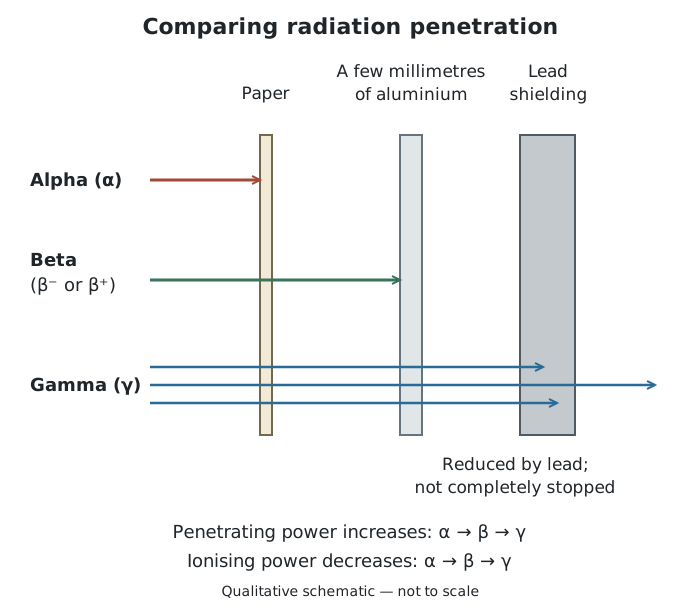
Alpha is stopped most easily. Gamma penetrates most strongly, but lead shielding reduces its intensity.
The key comparison is therefore: from alpha → beta → gamma, penetrating power increases while ionising power decreases.
A radiation detector can register radiation even when no radioactive source has been placed beside it. This is because background radiation is present around us in the environment. It has both natural and human-made origins.
Natural sources on Earth include radioactive substances in rocks and soil. Uranium decay produces radon gas, which can escape from the ground into the air. Radioactive substances also occur naturally in food, drink and living organisms: examples include potassium-40 in foods and carbon-14 in biological material. Small amounts of naturally occurring radioactive material in food are not, by themselves, a reason to avoid it.
Radiation also arrives from space as cosmic rays. These originate from the Sun and other high-energy events, such as supernovae. Incoming particles can interact with Earth's atmosphere and produce further radiation.
Human activities add to radiation exposure. Examples include medical X-rays, CT scans and radioactive tracers, as well as radioactive material released by nuclear weapons testing or nuclear accidents. Background radiation is therefore not solely a result of human activity: natural sources have always existed.
Photographic film becomes darker when it absorbs radiation and is developed. Greater exposure produces greater darkening. This allows film to record radiation exposure accumulated over a period of time, rather than giving an immediate reading.
People who work with radiation, such as radiographers, can wear a film badge. The film is protected from visible light by a light-proof covering. Different regions of the film sit behind different absorbing materials, such as paper, aluminium and lead. Comparing the darkening in these regions helps assess the amount and type of radiation received.
The pattern can be understood using penetrating power. Alpha is unlikely to reach the film because the paper covering stops it. Beta can reach less shielded regions but is absorbed by the aluminium. Gamma can affect regions behind these materials, although lead reduces the amount reaching the film. The badge is checked regularly to monitor the wearer's exposure.
A Geiger–Müller tube is connected to a counter. When the tube detects radiation, it produces an electrical pulse. The counter records the pulses and may make a click for each detection or display a count rate. More frequent clicks mean a higher count rate.
Count rate is the number of detections per unit time. It tells us how much radiation the detector is registering, not the total number of emissions from the source: some radiation never reaches the tube. Moving the detector farther from a source generally lowers its count rate, so distance matters when comparing readings.
To measure radiation from a particular source, first take a background reading with that source absent. Then measure with the source present under the same conditions. Subtract the background count rate:
Both rates must use the same units. The corrected rate estimates the detections due to the source rather than radiation already present in the environment. Unlike a film badge, the Geiger–Müller counter provides an immediate indication of radiation being detected.
Get unlimited access to all revision notes, key terms, and exam tips.
Alpha, both beta types and gamma are ionising: they can remove electrons from atoms.
| Radiation | Ionising power | Penetration |
|---|---|---|
| Alpha | Highest | Stopped by paper |
| Beta | Intermediate | Stopped by a few mm of aluminium |
| Gamma | Lowest | Reduced by lead or thick concrete |
Get unlimited access to all revision notes, key terms, and exam tips.
A beta-minus particle is emitted from the nucleus; it is not an electron lost from an atomic shell.
Random decay means you cannot predict exactly when a particular nucleus will decay.
Distinguish ionising power from penetrating power: alpha is the most ionising but the least penetrating.
Say that lead reduces gamma radiation, rather than claiming that a thin sheet stops it completely.
When comparing detector readings, keep the source–detector distance the same and account for background radiation.
Radioactive decay
The process in which an unstable atomic nucleus emits radiation.
Ionising radiation
Radiation capable of removing electrons from atoms, leaving charged ions.
Alpha particle
A particle consisting of two protons and two neutrons, equivalent to a helium nucleus.
Beta-minus particle
A fast-moving electron emitted from an unstable nucleus.
Positron
A particle with the same mass as an electron but an equal and opposite positive charge; emitted as beta-plus radiation.
Gamma ray
High-energy electromagnetic radiation emitted from an atomic nucleus.
Background radiation
Ionising radiation present around us in the environment, even when no deliberate radioactive source is nearby.
Penetrating power
The ability of radiation to pass through a material.
Count rate
The number of radiation detections recorded per unit time, usually in counts per second or counts per minute.
Put your knowledge into practice — try past paper questions for Combined Science
Radioactive decay
The process in which an unstable atomic nucleus emits radiation.
Ionising radiation
Radiation capable of removing electrons from atoms, leaving charged ions.
Alpha particle
A particle consisting of two protons and two neutrons, equivalent to a helium nucleus.
Beta-minus particle
A fast-moving electron emitted from an unstable nucleus.
Positron
A particle with the same mass as an electron but an equal and opposite positive charge; emitted as beta-plus radiation.
Gamma ray
High-energy electromagnetic radiation emitted from an atomic nucleus.
Background radiation
Ionising radiation present around us in the environment, even when no deliberate radioactive source is nearby.
Penetrating power
The ability of radiation to pass through a material.
Count rate
The number of radiation detections recorded per unit time, usually in counts per second or counts per minute.