Loading…


Loading…
Loading…
Loading…
Edexcel GCSE Combined Science · 1SC0
Edexcel 1SC0 · Radioactive decay and radiation Check the specification (PDF) (opens in a new tab)
An atomic model represents the structure of an atom and helps scientists explain observations and predict experimental results. A useful model must agree with the evidence. If new results cannot be explained by it, scientists need to change or replace it.
Atoms were once pictured as tiny, indivisible solid spheres. The discovery of negatively charged electrons by J. J. Thomson in 1897 showed that atoms contained smaller particles, so this simple picture was no longer sufficient.
Thomson proposed that an atom was a sphere of positive charge with negatively charged electrons embedded throughout it. Think of the electrons as pieces of fruit in a pudding: the positive material fills the atom around them.
The positive and negative charges balanced, making the atom neutral overall. Crucially, this model had no nucleus: its positive charge was spread throughout the atom rather than concentrated at the centre.
In 1909, Hans Geiger and Ernest Marsden, working under Ernest Rutherford’s direction, fired a beam of positively charged alpha particles at very thin gold foil. They investigated whether the particles passed straight through or changed direction. A change of direction is called scattering.
According to the plum pudding model, the spread-out positive charge should cause, at most, small changes in direction. It should not turn an approaching alpha particle back towards where it came from.
The results were surprising: most particles passed straight through, some were deflected, and a very small number turned back.
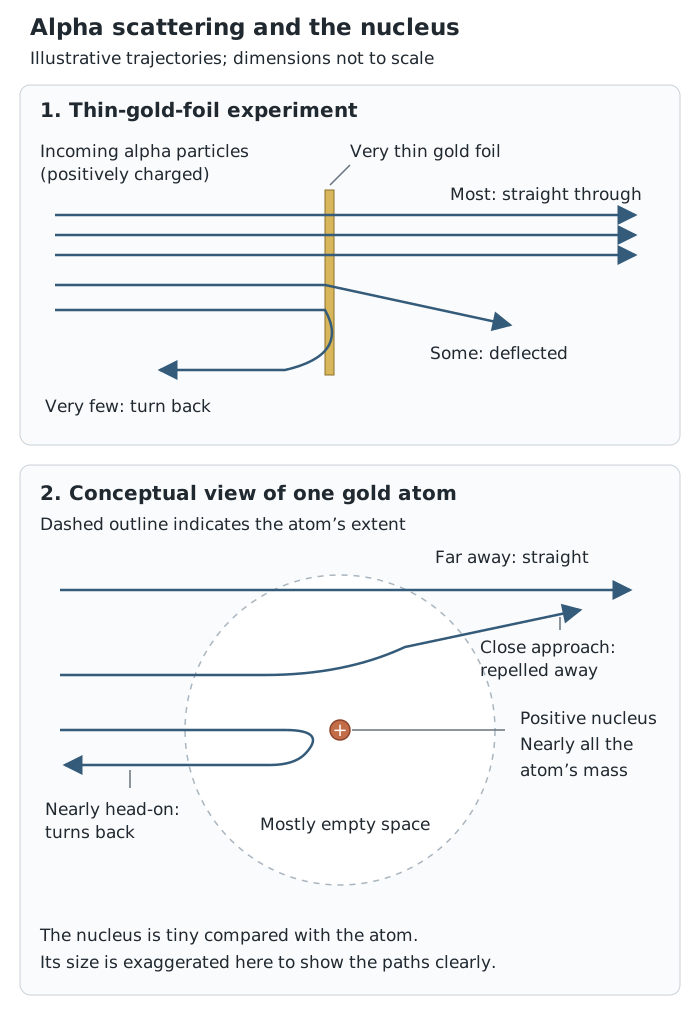
Most alpha particles pass through empty space; close approaches to the small positive nucleus cause deflection.
Each observation supplied a different clue about atomic structure.
| Observation | What it suggested about the atom |
|---|---|
| Most alpha particles passed straight through. | Most of the atom is empty space. |
| Some alpha particles changed direction. | Positive charge is concentrated in a nucleus, which repels the positively charged alpha particles. |
| Very few alpha particles were deflected backwards. | The nucleus is very small, dense and contains nearly all the atom’s mass. |
The rarity of large deflections matters: if the dense centre occupied much of the atom, many more particles would encounter it. Instead, most passed through the surrounding empty space. A particle approaching the concentrated positive charge closely could experience strong repulsion and be turned back.
Rutherford’s nuclear model therefore placed a tiny, positively charged nucleus at the centre, containing nearly all the atom’s mass. Negatively charged electrons orbited at a distance, leaving most of the atom empty.
This was not just a different drawing. The concentrated nucleus explained the large deflections that the plum pudding model could not explain, so the evidence supported replacing the older model.
In 1913, Niels Bohr developed the nuclear model further. He proposed that electrons could occupy only particular orbits at fixed distances from the nucleus. These orbits corresponded to distinct energy levels, with higher energy levels farther from the nucleus.
This was more specific than simply saying that electrons orbited a nucleus. Electrons could move between allowed levels by absorbing or emitting electromagnetic radiation: absorption could move an electron to a higher level, while a transition to a lower level released radiation.
Bohr’s model explained experimental evidence about absorption and emission better than the earlier nuclear model, and its calculations agreed with experimental results.
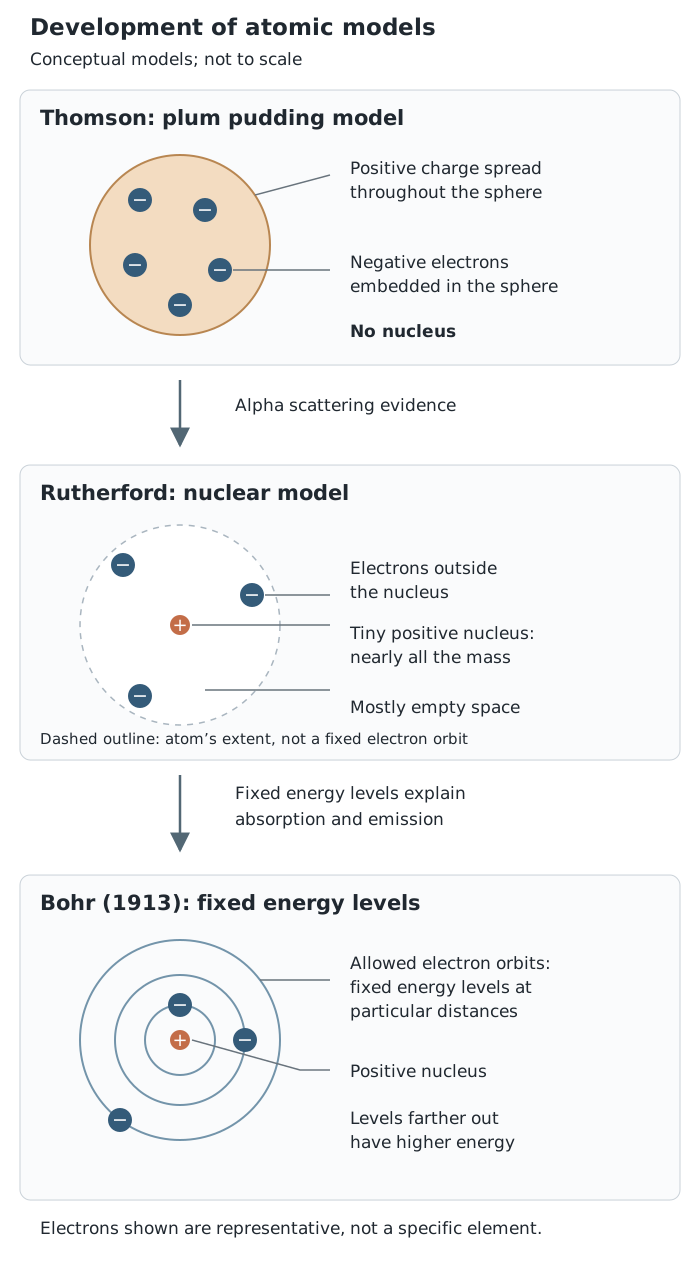
Rutherford introduced a concentrated nucleus; Bohr refined the model by adding fixed electron energy levels.
The development follows a consistent pattern: a model makes predictions, experiments test those predictions, and evidence guides improvements. Thomson introduced electrons into the model; Rutherford concentrated the positive charge and mass into a nucleus; Bohr added fixed electron energy levels.
Get unlimited access to all revision notes, key terms, and exam tips.
Positive alpha particles were fired at thin gold foil:
| Result | Conclusion |
|---|---|
| Most passed straight through. | Atom mostly empty space. |
| Some were deflected. | Positive nucleus repels alpha particles. |
| Very few turned back. | Nucleus tiny, dense and contains most of the mass. |
Large backward deflections contradicted the plum pudding model’s spread-out positive charge.
New experimental evidence could not be explained by the old model. Rutherford explained scattering; Bohr’s fixed energy levels explained absorption and emission of electromagnetic radiation better.
Get unlimited access to all revision notes, key terms, and exam tips.
Link each scattering observation to a conclusion: most pass straight through → mostly empty space; some deflect → positive nucleus; very few turn back → a tiny, dense nucleus containing most of the mass.
The plum pudding model already included electrons. Its key difference from the nuclear model was that positive charge was spread throughout the atom, rather than concentrated in a nucleus.
For Bohr’s improvement, state that electrons occupy fixed energy levels at particular distances from the nucleus—not simply that electrons orbit.
Agreement with experimental results supports a model; it does not prove that the model can never be improved.
Atomic model
A representation used to explain observations and make predictions about how atoms behave.
Plum pudding model
An atomic model in which negatively charged electrons are embedded in a sphere of spread-out positive charge.
Alpha particle
A positively charged particle consisting of two protons and two neutrons, equivalent to a helium nucleus.
Nuclear model
An atomic model with a small, positively charged central nucleus containing nearly all the atom’s mass, surrounded by electrons, with most of the atom being empty space.
Energy level
One of the allowed energies an electron can have in an atom; in the Bohr model, each level corresponds to a particular orbital distance from the nucleus.
Put your knowledge into practice — try past paper questions for Combined Science
Atomic model
A representation used to explain observations and make predictions about how atoms behave.
Plum pudding model
An atomic model in which negatively charged electrons are embedded in a sphere of spread-out positive charge.
Alpha particle
A positively charged particle consisting of two protons and two neutrons, equivalent to a helium nucleus.
Nuclear model
An atomic model with a small, positively charged central nucleus containing nearly all the atom’s mass, surrounded by electrons, with most of the atom being empty space.
Energy level
One of the allowed energies an electron can have in an atom; in the Bohr model, each level corresponds to a particular orbital distance from the nucleus.