Loading…


Loading…
Loading…
Loading…
Edexcel GCSE Combined Science · 1SC0
Edexcel 1SC0 · Atomic structure Atomic structure Check the specification (PDF) (opens in a new tab)
Describe how the Dalton model of the atom evolved over time due to the discovery of subatomic particles.
Describe the structure of an atom as a central nucleus containing protons and neutrons, surrounded by electrons in shells.
Recall the relative charge and relative mass of a proton, a neutron, and an electron.
Explain why atoms contain equal numbers of protons and electrons, resulting in no overall charge.
Describe the nucleus of an atom as extremely small compared to the overall size of the atom.
Understand that most of the mass of an atom is concentrated in its nucleus.
Define and understand the term mass number of an atom.
Describe atoms of a given element as having a unique and identical number of protons in their nucleus.
Describe isotopes as different atoms of the same element that contain the same number of protons but different numbers of neutrons.
Calculate the numbers of protons, neutrons, and electrons in atoms when provided with the atomic number and mass number.
Explain how the existence of isotopes causes the relative atomic masses of some elements to not be whole numbers.
Calculate the relative atomic mass of an element using the relative masses and abundances of its isotopes.
An atomic model is a representation that helps us explain the structure of an atom. Models can change when experiments reveal something that the existing model cannot explain.
In 1803, John Dalton proposed that matter was made of tiny atoms. He pictured each atom as a solid, indivisible particle, often represented as a billiard ball. In his theory, atoms of the same element were identical, atoms of different elements were different, and different atoms combined to form new substances.
The important word here is indivisible: Dalton’s model did not contain smaller particles inside an atom. Discovering such particles would therefore require a change to the model.
In 1897, J. J. Thomson discovered the electron using a cathode-ray tube. In the experiment, a beam of electrons was deflected towards a positively charged metal plate and away from a negatively charged plate. Opposite charges attract, so this behaviour showed that electrons were negatively charged.
An electron is a subatomic particle: a particle smaller than an atom that forms part of its structure. Its discovery showed that an atom was not an indivisible solid ball.
Thomson proposed the plum pudding model. In this model, negative electrons were embedded throughout a ball of positively charged material, rather like pieces of fruit within a pudding. Unlike the modern model, it had no small central nucleus: the positive material was spread throughout the atom.
Rutherford’s model, developed in 1909–1911, placed a nucleus at the centre of the atom, with electrons outside it. This was a major change from Thomson’s picture of positive material spread throughout the atom.
The change followed experiments in which positively charged particles were directed at thin gold foil. Most passed through, but some were deflected and a few turned back. These results could not be explained by positive charge spread throughout the atom. Instead, they supported a model in which the atom was mainly empty space, with its positive charge and most of its mass concentrated in a small central nucleus.
In 1913, Bohr developed the nuclear model by proposing that electrons occupied shells at set distances from the nucleus. His calculations agreed with experimental results.
Further investigations showed that the nucleus itself contained smaller particles. The discovery of the proton, a positively charged particle, explained the nucleus’s positive charge. Positive charge was no longer represented as a continuous material spread through the atom: it belonged to particles within the nucleus.
In 1932, James Chadwick provided evidence for neutrons: particles with no electrical charge. The nuclear model was developed to include both protons and neutrons in the nucleus. Neutrons contribute mass without adding positive or negative charge.
The progression shows how the picture of an atom changed from a single solid particle to a structure containing different subatomic particles.
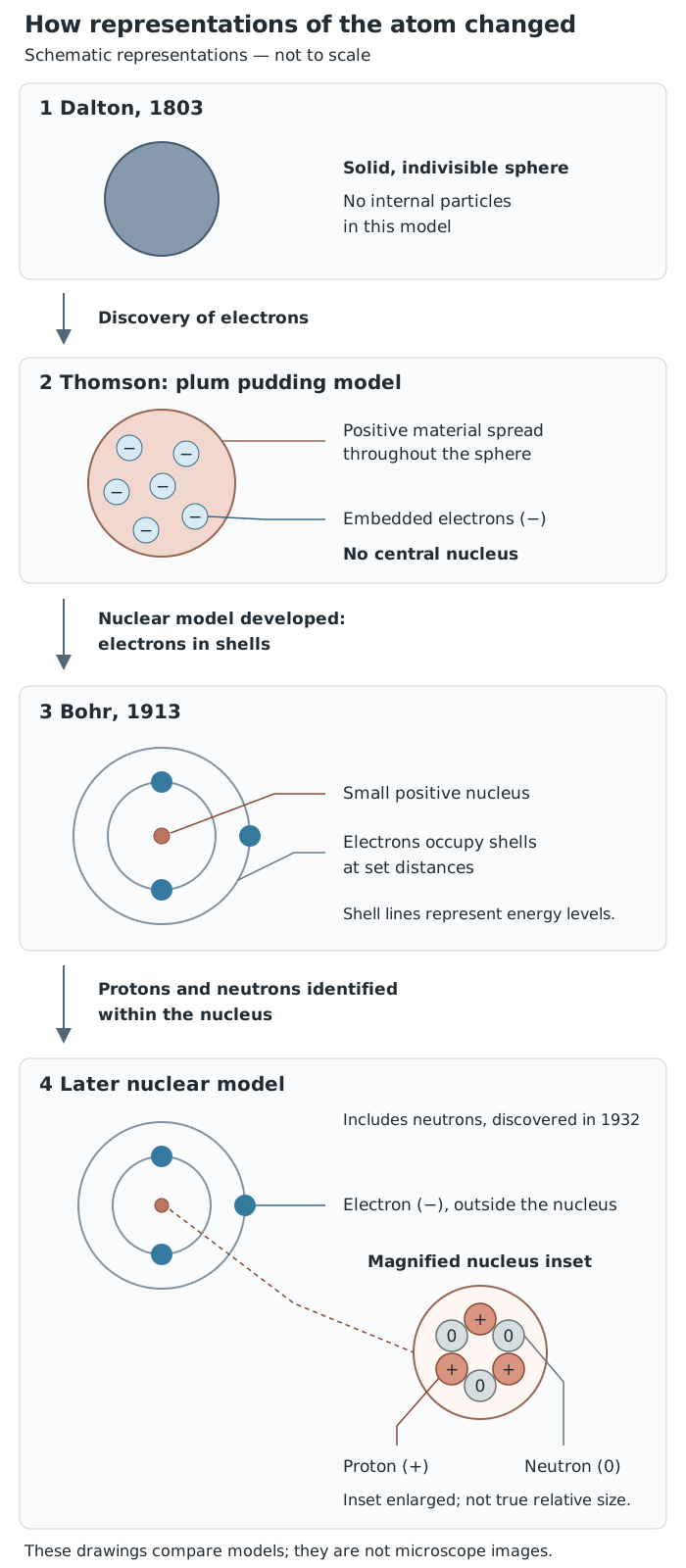
Atomic models changed from an indivisible sphere to a nucleus containing protons and neutrons, surrounded by electrons in shells. Representations are not to scale.
These drawings are representations, not pictures of atoms taken through a microscope. Their purpose is to show the differences between the models, rather than the true sizes of the particles.
In the model used at GCSE, an atom has a central nucleus containing protons and neutrons, surrounded by electrons in shells.
The position of each particle matters: protons and neutrons belong in the nucleus, whereas electrons occupy shells outside it.
A shell represents an energy level occupied by electrons. The circular lines in a school diagram help us show these levels; they are not solid rings of material.
Relative values let us compare the particles without using their extremely small masses in kilograms or charges in coulombs. A proton’s mass is taken as approximately 1, and its charge as +1.
| Particle | Relative mass | Relative charge |
|---|---|---|
| Proton | 1 | +1 |
| Neutron | 1 | 0 |
| Electron | Approximately | −1 |
Protons and neutrons have almost the same mass. An electron has only about one eighteen-hundred-and-fortieth of a proton’s mass, so its mass is often described as negligible when considering the mass of an atom.
The charges of a proton and an electron are equal in size but opposite in sign. A neutron has no electrical charge.
An atom is electrically neutral. It therefore contains equal numbers of protons and electrons: each proton’s positive charge is balanced by one electron’s negative charge.
For example, an atom with three protons and three electrons has three positive charges balanced by three negative charges. Its overall charge is zero. The neutrons do not affect this balance because they have no charge.
The nucleus is very small compared with the overall size of the atom. Most of the space within an atom lies outside the nucleus, in the region occupied by the electrons.
Nevertheless, most of the atom’s mass is concentrated in the nucleus. Protons and neutrons contribute almost all of this mass; electrons contribute very little. This separates two ideas that can otherwise be confused: the nucleus occupies only a tiny part of an atom’s volume, but contains most of its mass.
New experimental evidence can cause a model to be changed or replaced.
| Particle | Location | Relative mass | Relative charge |
|---|---|---|---|
| Proton | Nucleus | 1 | +1 |
| Neutron | Nucleus | 1 | 0 |
| Electron | Shells outside nucleus | Approximately | −1 |
Neutral atom: equal numbers of protons and electrons → equal and opposite charges cancel.
The nucleus is very small compared with the atom, but contains most of its mass. Electrons contribute very little mass.
When explaining a change in an atomic model, link the new evidence to the part of the earlier model it contradicted.
Distinguish the nucleus from the whole atom: electrons are outside the nucleus, in shells.
Explain electrical neutrality using the cancellation of proton and electron charges, not simply by saying that an atom contains neutrons.
Most of an atom’s mass is in the nucleus; this does not mean that the nucleus takes up most of its volume.
An electron has a very small mass, not zero mass. Its relative mass is approximately 1/1840, often described as negligible.
Atomic model
A representation of the structure of an atom, developed to explain experimental evidence.
Subatomic particle
A particle smaller than an atom that forms part of its structure, such as a proton, neutron or electron.
Electron
A negatively charged subatomic particle found in shells surrounding the nucleus.
Proton
A positively charged subatomic particle found in the nucleus of an atom.
Neutron
An electrically neutral subatomic particle found in the nucleus of an atom.
Nucleus
The very small central region of an atom, containing protons and neutrons and most of the atom’s mass.
Electron shell
An energy level occupied by electrons around an atom’s nucleus.
Plum pudding model
An atomic model in which negatively charged electrons are embedded throughout a ball of positively charged material.
Put your knowledge into practice — try past paper questions for Combined Science
Atomic model
A representation of the structure of an atom, developed to explain experimental evidence.
Subatomic particle
A particle smaller than an atom that forms part of its structure, such as a proton, neutron or electron.
Electron
A negatively charged subatomic particle found in shells surrounding the nucleus.
Proton
A positively charged subatomic particle found in the nucleus of an atom.
Neutron
An electrically neutral subatomic particle found in the nucleus of an atom.
Nucleus
The very small central region of an atom, containing protons and neutrons and most of the atom’s mass.
Electron shell
An energy level occupied by electrons around an atom’s nucleus.
Plum pudding model
An atomic model in which negatively charged electrons are embedded throughout a ball of positively charged material.