Loading…


Loading…
Loading…
Loading…
Edexcel GCSE Combined Science · 1SC0
Edexcel 1SC0 · Group 7 Group 7 Check the specification (PDF) (opens in a new tab)
Recall the distinct colours and physical states of chlorine, bromine, and iodine at room temperature.
Describe the periodic trends in the physical properties of halogens (chlorine, bromine, iodine) and apply these trends to predict the properties of other halogens.
Describe the standard chemical test used to identify chlorine gas.
Describe the chemical reactions of halogens with metals to form metal halides, and use this reactivity pattern to predict the behaviour of other halogens.
Understand that halogens form hydrogen halides that dissolve in water to produce acidic solutions, and predict similar reactions for other halogens.
Describe the relative reactivity of halogens through their displacement reactions with halide ions in aqueous solutions, and use this trend to predict the reactions of astatine.
Explain why halogen displacement reactions are classified as redox reactions by analyzing the gain and loss of electrons and identifying oxidized and reduced substances.
Explain the relative reactivity trends of the halogens using their electronic configurations.
The halogens are the elements in Group 7. Their atoms have seven electrons in the outer shell, so gaining one electron gives them a full outer shell. The resulting ion has a charge of −1 because it has one more electron than protons. Chlorine forms chloride ions, Cl⁻; bromine forms bromide ions, Br⁻; and iodine forms iodide ions, I⁻.
The elements themselves consist of diatomic molecules: Cl₂, Br₂ and I₂. These neutral molecules are different from the negatively charged halide ions found in their salts.
Chlorine, bromine and iodine react with metals to form metal halides:
metal + halogen → metal halide
In these reactions, metal atoms lose electrons and halogen atoms gain them. The positive metal ions and negative halide ions attract each other, forming an ionic compound.
For example, sodium reacts with chlorine to form sodium chloride:
Each sodium atom transfers one electron to a chlorine atom. The resulting Na⁺ and Cl⁻ ions combine in a 1:1 ratio because their charges balance.
A metal ion with a charge of +2 needs two halide ions. Magnesium bromide therefore has the formula MgBr₂: one Mg²⁺ ion balances two Br⁻ ions. Similarly, calcium reacts with bromine to form calcium bromide:
Iodine also forms metal halides, called iodides. For example, sodium and iodine form sodium iodide, NaI.
Reactivity decreases down Group 7. With a comparable metal under comparable conditions, chlorine reacts more vigorously than bromine, and iodine reacts less vigorously still. The shared reaction pattern lets us predict that other halogens also form metal halides: fluorine forms fluorides, while astatine is predicted to form astatides. A less vigorous reaction does not mean that no reaction can occur.
Halogens also react with hydrogen, but the products are covalent molecular compounds called hydrogen halides:
hydrogen + halogen → hydrogen halide
Chlorine forms hydrogen chloride, HCl; bromine forms hydrogen bromide, HBr; and iodine forms hydrogen iodide, HI. For chlorine:
These hydrogen halides dissolve in water to form acidic solutions containing H⁺ ions. Hydrogen chloride gas dissolved in water forms hydrochloric acid. Hydrogen bromide and hydrogen iodide likewise form acidic solutions.
The reactions with hydrogen become less vigorous down the group. Chlorine can react with hydrogen in sunlight, whereas bromine requires a higher temperature. Iodine reacts less vigorously than chlorine.
The common pattern predicts that other halogens also form hydrogen halides which give acidic solutions in water. For example, fluorine forms hydrogen fluoride. Predicting an acidic solution does not mean that every hydrogen halide produces an acid of the same strength.
A more reactive halogen displaces a less reactive halogen from an aqueous solution of its halide. Here, aqueous means dissolved in water.
For example, adding chlorine solution to potassium bromide solution produces potassium chloride and bromine:
chlorine + potassium bromide → potassium chloride + bromine
The solution becomes orange as bromine forms. Chlorine also displaces iodine from potassium iodide solution, producing a brown solution containing iodine:
Bromine displaces iodine from potassium iodide, but cannot displace chlorine from a chloride:
The outcomes can be summarised as follows. Each row names the halogen added; each column names the ions in the dissolved salt.
| Halogen added | Chloride ions | Bromide ions | Iodide ions |
|---|---|---|---|
| Chlorine | No displacement | Bromine formed | Iodine formed |
| Bromine | No displacement | No displacement | Iodine formed |
| Iodine | No displacement | No displacement | No displacement |
These reactions establish the order chlorine > bromine > iodine in reactivity. Astatine lies below iodine, so it is predicted to be less reactive than all three. Chlorine, bromine and iodine should therefore displace astatine from an aqueous astatide solution; astatine should not displace any of them from their halide solutions.
Halogens react by gaining an electron. Their relative reactivity depends on how strongly their nuclei attract an incoming electron.
Fluorine has the electronic configuration 2,7, while chlorine has 2,8,7. Both have seven outer electrons, but chlorine has an extra occupied shell. Moving further down Group 7 adds more occupied shells.
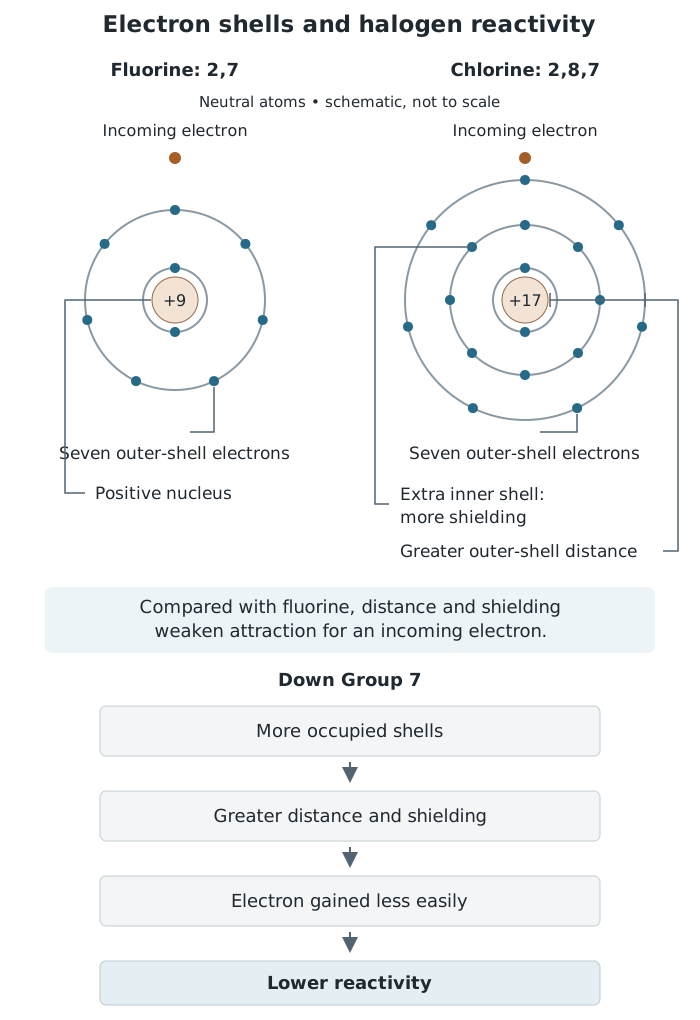
Both atoms have seven outer electrons, but chlorine has an extra occupied shell. Increased distance and shielding make gaining an electron less easy down Group 7.
Down the group, the outer shell is further from the positively charged nucleus, and there are more inner electrons to shield an incoming electron from its attraction. Together, the greater distance and increased shielding weaken the attraction for an electron entering the outer shell. An electron is gained less easily, so reactivity decreases.
This explains both the less vigorous reactions down the group and why chlorine can displace bromine and iodine, rather than the reverse.
Halogen displacement reactions are redox reactions because oxidation and reduction happen together. Oxidation is loss of electrons; reduction is gain of electrons.
Consider chlorine displacing bromine from potassium bromide. The potassium ions remain unchanged, so they are spectator ions. Leaving them out gives the ionic equation:
Chlorine gains electrons to become chloride ions, so chlorine is reduced:
Bromide ions lose electrons to become bromine, so bromide ions are oxidised:
The two electrons lost by the bromide ions are gained by chlorine. The same reasoning applies to the other displacement reactions: the added, more reactive halogen is reduced, while the halide ions of the less reactive halogen are oxidised.
Get unlimited access to all revision notes, key terms, and exam tips.
Chlorine > bromine > iodine > astatine in predicted reactivity.
Fluorine: 2,7; chlorine: 2,8,7. Both have seven outer electrons.
Down Group 7: more occupied shells → greater distance and shielding → weaker attraction for an incoming electron → electron gained less easily → lower reactivity.
OIL RIG: oxidation is loss; reduction is gain of electrons.
Distinguish a halogen molecule, such as Cl₂, from a halide ion, such as Cl⁻. Halide ions have a −1 charge.
For displacement, compare the added halogen with the halogen in the dissolved halide: the added halogen must be more reactive.
Explain decreasing reactivity using both increased distance from the nucleus and increased shielding, then link these to gaining an electron less easily.
Balance equations using diatomic halogen molecules: Cl₂, Br₂ and I₂.
Higher tier: name the species precisely. Chlorine is reduced, while bromide ions—not bromine molecules—are oxidised when chlorine displaces bromine.
Halogen
An element in Group 7 of the periodic table, whose atoms have seven electrons in their outer shell.
Halide ion
A negative ion formed when a halogen atom gains one electron; it has a charge of −1.
Metal halide
An ionic compound containing positive metal ions and negative halide ions.
Hydrogen halide
A covalent compound of hydrogen and a halogen, such as hydrogen chloride, HCl.
Aqueous solution
A solution in which water is the solvent, shown by (aq) in a chemical equation.
Displacement reaction
A reaction in which a more reactive element replaces a less reactive element in a compound.
Electronic configuration
The arrangement of electrons in an atom's shells.
Electron shielding
The reduction in the attraction between the nucleus and an outer or incoming electron caused by electrons in inner shells.
Oxidation
The loss of electrons by a substance in a reaction.
Reduction
The gain of electrons by a substance in a reaction.
Redox reaction
A reaction in which oxidation and reduction occur together, involving transfer of electrons.
Put your knowledge into practice — try past paper questions for Combined Science
Halogen
An element in Group 7 of the periodic table, whose atoms have seven electrons in their outer shell.
Halide ion
A negative ion formed when a halogen atom gains one electron; it has a charge of −1.
Metal halide
An ionic compound containing positive metal ions and negative halide ions.
Hydrogen halide
A covalent compound of hydrogen and a halogen, such as hydrogen chloride, HCl.
Aqueous solution
A solution in which water is the solvent, shown by (aq) in a chemical equation.
Displacement reaction
A reaction in which a more reactive element replaces a less reactive element in a compound.
Electronic configuration
The arrangement of electrons in an atom's shells.
Electron shielding
The reduction in the attraction between the nucleus and an outer or incoming electron caused by electrons in inner shells.
Oxidation
The loss of electrons by a substance in a reaction.
Reduction
The gain of electrons by a substance in a reaction.
Redox reaction
A reaction in which oxidation and reduction occur together, involving transfer of electrons.
Chlorine gains electrons and is reduced. Bromide ions lose electrons and are oxidised. Both changes occur together.
Get unlimited access to all revision notes, key terms, and exam tips.