

Loading…
Loading…
Loading…
AQA GCSE Religious Studies B · 8063
AQA 8063 · The Kingdom of God Check the specification (PDF) (opens in a new tab)
The Kingdom of God means God’s rule or reign. It is not simply a country with borders. Christians understand it as present wherever people live according to God’s will, but also as something still awaiting its complete fulfilment. It can refer to heaven or eternal life with God, and to the final fulfilment of God’s rule associated with Jesus’ Second Coming and judgement.
This helps explain why Jesus compares the Kingdom to growing plants. Something can already be present without yet being fully developed. The three seed parables in Mark 4 explore how people respond to God’s message, how the Kingdom grows and what it can become.
A parable communicates a spiritual teaching through a familiar story or comparison. Farming imagery made Jesus’ teaching accessible to listeners who knew about sowing, soil and harvests. It also invited them to think: what does this ordinary experience reveal about God?
At the beginning of Mark 4, a large crowd gathers beside the lake. Jesus teaches from a boat while the people listen from the shore. His call to listen matters: the Parable of the Sower is itself about the difference between merely hearing a message and genuinely accepting it.
In Mark 4:1–9, a farmer scatters seed. Some falls on a path, some on rocky ground, some among thorns and some on good soil. The seed has very different outcomes depending on where it lands.
In Mark 4:14–20, Jesus explains the meaning. This makes the story an allegory: particular details represent something beyond themselves. The farmer sows the word — God’s message — and the different ground represents different responses to it.
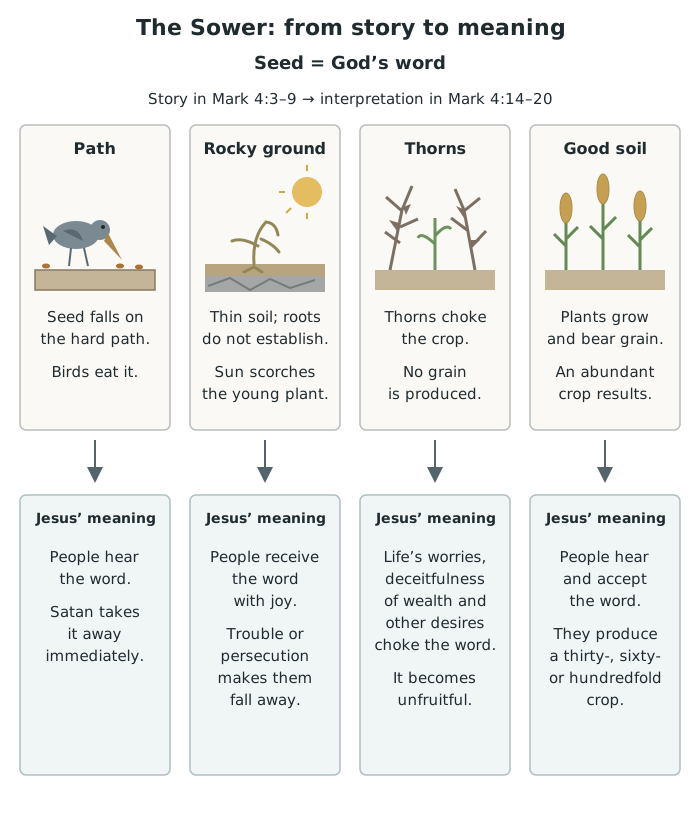
Jesus connects four outcomes for seed with four responses to God’s word.
The same word is offered, but hearing alone is not enough. The good-soil response involves accepting the message and allowing it to shape life. Being ‘fruitful’ can therefore mean living by Jesus’ teaching and helping the message spread to others.
For Jesus’ early followers, this explained why not everyone who heard him remained committed. It also encouraged them: despite rejection and difficulties, the message could produce an abundant result. For Christians today, the parable invites reflection on what strengthens or obstructs faith. For example, concern with possessions can displace the commitment to live according to God’s will.
In Mark 4:26–29, a man scatters seed on the ground. He continues his ordinary routine of sleeping and getting up, while the seed sprouts and grows, although he does not know how. Growth happens in stages: first the stalk, then the head, then the full grain. Once it is ripe, he harvests it with a sickle.
The central contrast is between the man’s limited activity and the growth that happens beyond his control. People can share God’s message, but they cannot manufacture the Kingdom’s growth. Christians understand this growth as the work of God’s grace, his freely given gift and help. The Kingdom cannot be bought or demanded.
The stages of the plant’s development also show that growth is gradual. A lack of immediate, visible results does not mean that nothing is happening. This offers encouragement to followers who teach or serve without seeing quick changes: they can continue their work while trusting God.
The harvest gives the story an endpoint. It can represent final judgement, when God’s Kingdom reaches its fulfilment. This interpretation connects the parable with the biblical use of harvest imagery for judgement, as in Joel 3:13. The Kingdom is therefore not only a process continuing indefinitely; it is moving towards completion.
In Mark 4:30–32, Jesus compares the Kingdom to a mustard seed. He describes a striking contrast: a tiny seed becomes a large garden plant with branches in whose shade birds can shelter.
The point is that the Kingdom’s beginnings do not reveal its eventual size or importance. Jesus and his early followers might appear insignificant, yet Christians understand the parable as reassurance that God’s work can develop far beyond those beginnings.
The birds sheltering in the branches also suggest the Kingdom as a place of welcome and refuge. Its growth is not simply about becoming powerful or impressive; it provides shelter for others. Christians today may take this as encouragement not to dismiss small acts of teaching, service or welcome because their immediate effect seems limited.
The parables complement one another. The Sower stresses people’s responsibility to receive the word and remain committed. The Growing Seed stresses that growth ultimately depends on God, not human control. The Mustard Seed stresses the difference between modest beginnings and a much greater outcome. Trusting God does not remove the responsibility to listen and act.
Christians may emphasise different aspects: personal growth in faith, the growth of a community shaped by Jesus’ teaching, or the future fulfilment of God’s Kingdom. These readings can overlap rather than exclude one another.
In contemporary Britain, an atheist would not accept the claim that God causes the Kingdom to grow, but could still value the stories’ insights into perseverance and competing priorities. A humanist might apply the contrast between a small seed and a large plant to the way small acts can benefit a community, while grounding their value in human welfare rather than divine authority. The stories can therefore have practical relevance beyond Christianity, without everyone accepting their spiritual claims.
God’s rule: present where people follow God’s will, with complete fulfilment associated with eternal life and final judgement.
Seed = God’s word; ground = responses.
Tiny seed → large garden plant → birds shelter in its shade.
Small beginnings can lead to a great outcome; the Kingdom offers welcome and refuge.
Human response + God-given growth + confidence despite small beginnings.
Christians apply these teachings to faith and sharing the Gospel. Non-religious readers may value perseverance and community benefit without accepting God’s rule or action.
Explain what a detail teaches about the Kingdom of God, rather than only retelling the story.
Keep the three parables distinct: the Sower concerns responses to God’s word; the Growing Seed stresses God’s power and gradual growth; the Mustard Seed contrasts small beginnings with a large outcome.
Support explanations with precise details from the prescribed passage. A short quotation or accurate reference to an event can connect your point to St Mark’s Gospel.
In the Sower, the seed represents the word, not different kinds of people. The different places where it falls represent people’s responses.
It can see this note and what your specification asks for.
Answers are free with an account.
1 free note left this week
Get more free notesYour answer sets when this note comes back for review, or marks it complete.
Was this note helpful?
Log in to tell us whether it helped, or to report a problem.
Last updated
Kingdom of God
God’s rule or reign: realised where people live according to God’s will, and understood by Christians as reaching its fulfilment in eternal life and final judgement.
Parable
A story or comparison using familiar experiences to communicate a spiritual teaching.
Allegory
A story in which particular characters, objects or events represent something beyond their literal meaning.
Grace
God’s freely given gift and help, which people cannot buy or demand.
Persecution
Hostility or mistreatment directed at people because of their beliefs.
Judgement
God’s final assessment of human lives, associated in Christian belief with the fulfilment of God’s Kingdom.
Put your knowledge into practice — try past paper questions for Religious Studies B
Kingdom of God
God’s rule or reign: realised where people live according to God’s will, and understood by Christians as reaching its fulfilment in eternal life and final judgement.
Parable
A story or comparison using familiar experiences to communicate a spiritual teaching.
Allegory
A story in which particular characters, objects or events represent something beyond their literal meaning.
Grace
God’s freely given gift and help, which people cannot buy or demand.
Persecution
Hostility or mistreatment directed at people because of their beliefs.
Judgement
God’s final assessment of human lives, associated in Christian belief with the fulfilment of God’s Kingdom.