

Loading…
Loading…
Loading…
AQA GCSE Religious Studies B · 8063
AQA 8063 · 3.1.5.2 Beliefs and Teachings on the Kingdom Check the specification (PDF) (opens in a new tab)
The Catholic Church is a worldwide community with a hierarchy: a structure of different levels of authority and responsibility. Its leaders teach the faith, guide worship and care for the Church’s communities. This organisation supports the Church’s mission to make God’s Kingdom present through Christian life and service.
Catholics understand this leadership as rooted in Jesus and the apostles. The Pope is the successor of St Peter, whom Jesus gave a particular responsibility for the Church. In Matthew 16:18–19, Jesus tells Peter, “on this rock I will build my church” and promises him “the keys to the kingdom of heaven”. Catholics interpret this as a foundation for the Pope’s authority. Bishops are understood as successors of the apostles.
The different roles connect the worldwide Church with its local communities:
| Role | Authority and responsibility |
|---|---|
| Pope | Head of the Catholic Church, with supreme authority; leads and guides the worldwide Church. |
| Cardinal | A senior churchman who advises the Pope; eligible cardinals elect a new Pope when the previous Pope dies or retires. |
| Bishop | Leads a local Church, normally a diocese, and oversees its teaching, worship and pastoral care. |
| Archbishop | A bishop with additional responsibilities, leading an archdiocese. |
| Priest | Preaches God’s word and celebrates the sacraments; most care for a local parish. |
A diocese contains parish communities. This means that a Catholic’s local parish is part of a wider community led by a bishop, who is united with the Pope and other bishops.
These roles should not be understood simply as a ladder of personal importance. Different responsibilities serve the whole Church. Lay people are not ordained, but their contribution to parish life and the Church’s mission is essential.
The Pope has supreme authority, but Catholic leadership also involves consultation: listening to others and discussing questions before reaching decisions. Bishops bring knowledge of the needs of their local Churches, while theological experts can help clarify teachings.
An ecumenical council is a formal gathering of bishops from across the Catholic Church with the Pope to consider matters affecting the whole Church. Here, “ecumenical” means worldwide; it does not mean that all Christian denominations have equal decision-making authority at the council.
The bishops act together with the Pope, not independently of him. This shared responsibility is often called collegiality. Lumen Gentium explains that the body of bishops has no authority unless it is understood together with the Pope as its head. Consultation therefore does not replace the hierarchy: it is a way in which the hierarchy works.
The Second Vatican Council, often called Vatican II, met in Rome in four sessions between 1962 and 1965. Pope John XXIII announced his intention to call it in 1959 and opened it on 11 October 1962. After his death in June 1963, Pope Paul VI continued the Council and brought it to its close on 8 December 1965.
John XXIII wanted to renew the Church’s life and help it communicate the Christian faith more effectively in the modern world. This was not intended as abandoning Catholic belief. The aim was to deepen understanding, use a merciful approach and seek greater unity, while considering how the Church should respond to contemporary life.
About 2,500 bishops participated in one or more sessions. The Council’s consultative nature was visible even before it opened: bishops and Catholic universities were asked to suggest matters for discussion. During the Council, bishops debated draft documents, proposed amendments and voted. Theological experts assisted them, and invited non-Catholic observers attended without voting.
The Council produced sixteen documents, approved and promulgated with the Pope’s authority. Four major documents, called constitutions, express its central themes.
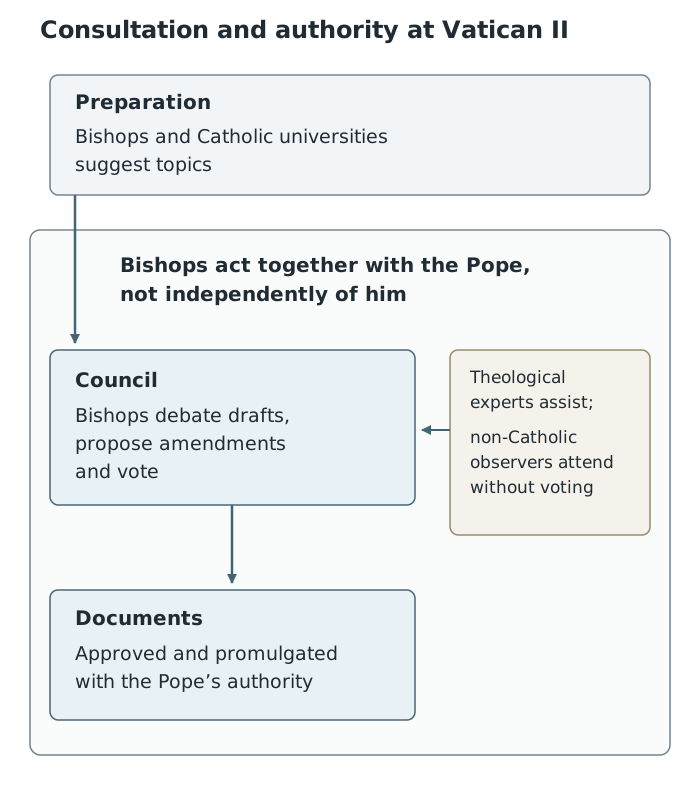
Vatican II combined wide consultation with the authority of bishops acting together with the Pope.
Dei Verbum, meaning “The Word of God”, concerns divine revelation: how God makes himself known. It explains the importance of the Bible, Church Tradition and the Church’s teaching authority, the Magisterium.
Catholics regard the Bible as authoritative, but understanding it involves interpretation rather than treating every passage as a straightforward literal account. Church teaching and Tradition guide that interpretation. The document connects reading Scripture with the wider faith of the Church, rather than treating the Bible as isolated from it.
Lumen Gentium, meaning “Light of the Nations”, concerns the nature and structure of the Church. It presents the Church as the Body of Christ: its members have different roles but belong to one community.
This image helps explain why leadership and shared participation belong together. The Pope and bishops retain their responsibilities, while lay people also have an active part in the Church’s life and mission. For example, parish work and service are not solely the priest’s responsibility. The document emphasises the importance of the laity rather than treating them as passive spectators.
Sacrosanctum Concilium, the Constitution on the Sacred Liturgy, concerns the Church’s public worship, especially Mass. It encouraged the faithful’s fuller, active participation.
It permitted greater use of the language spoken by the congregation, rather than requiring worship to be entirely in Latin. This helped people understand and join in the words of the service. It also allowed appropriate adaptation of sacred music. The central purpose was participation in worship, not change merely for its own sake.
Gaudium et Spes, meaning “Joy and Hope”, concerns the Church in the modern world. It stresses that the Church should engage with human life and its problems, rather than withdraw from society.
Its themes include family life, economic and political affairs, human dignity and peace between nations. It also recognises conscience as a way in which people encounter moral responsibility and God’s guidance. These themes connect faith with everyday decisions and public life: Christian responsibility extends beyond attending church.
Taken together, the four constitutions link God’s revelation, the Church’s identity, its worship and its mission in the world. Vatican II shows how the Catholic Church can consult widely and renew its practices while retaining its hierarchy and continuity with its faith.
Consultative, not independent: bishops discuss and decide together with the Pope. A council does not remove papal authority.
| Document | Essential theme |
|---|---|
| Dei Verbum — The Word of God | Revelation; Scripture understood with Tradition and Magisterial guidance. |
| Lumen Gentium — Light of the Nations | Nature and structure of the Church; Body of Christ; active role of the laity. |
| Sacrosanctum Concilium — Sacred Liturgy | Active participation in worship; greater use of local languages. |
| Gaudium et Spes — Joy and Hope | Church engagement with modern society: family, economics, politics, conscience and peace. |
Distinguish authority from importance: lay people do not have the Pope’s teaching authority, but they have an important role in the Church’s mission.
For a question about the Council’s influence, link a named document to a specific effect, such as Sacrosanctum Concilium allowing greater use of local languages in worship.
Do not say Vatican II abolished Latin or that the bishops could make decisions independently of the Pope.
It can see this note and what your specification asks for.
Answers are free with an account.
1 free note left this week
Get more free notesYour answer sets when this note comes back for review, or marks it complete.
Was this note helpful?
Log in to tell us whether it helped, or to report a problem.
Last updated
Hierarchy
The structure of different levels of authority and responsibility within the Church.
Pope
The Bishop of Rome, successor of St Peter and head of the Catholic Church.
Bishop
An ordained leader whom Catholics understand to be a successor of the apostles, normally responsible for a diocese.
Diocese
An area of the Church overseen by a bishop and containing local parish communities.
Parish
A local Catholic community, normally cared for by a priest.
Laity
The non-ordained members of the Church.
Magisterium
The teaching authority of the Catholic Church, exercised by the Pope and bishops in communion with him.
Liturgy
The Church’s official public worship, including the celebration of Mass.
Ecumenical council
A worldwide gathering of Catholic bishops with the Pope to consider matters affecting the whole Church.
Put your knowledge into practice — try past paper questions for Religious Studies B
Hierarchy
The structure of different levels of authority and responsibility within the Church.
Pope
The Bishop of Rome, successor of St Peter and head of the Catholic Church.
Bishop
An ordained leader whom Catholics understand to be a successor of the apostles, normally responsible for a diocese.
Diocese
An area of the Church overseen by a bishop and containing local parish communities.
Parish
A local Catholic community, normally cared for by a priest.
Laity
The non-ordained members of the Church.
Magisterium
The teaching authority of the Catholic Church, exercised by the Pope and bishops in communion with him.
Liturgy
The Church’s official public worship, including the celebration of Mass.
Ecumenical council
A worldwide gathering of Catholic bishops with the Pope to consider matters affecting the whole Church.
| Deacon | Assists in the Church’s ministry, including preaching and supporting priests. |
| Lay person | A non-ordained member of the Church who shares in its worship, service and mission. |