Loading…


Loading…
Loading…
Loading…
AQA GCSE Physical Education · 8582
AQA 8582 Check the specification (PDF) (opens in a new tab)
The heart supplies the body with blood. To understand how its work changes during exercise, we need to distinguish how often it beats, how much blood it pumps with each beat and how much it pumps altogether in a minute.
Heart rate (HR) is the number of heartbeats per minute, measured in beats per minute (bpm). Stroke volume (SV) is the volume of blood pumped out of the left ventricle with each heartbeat, usually measured in ml per beat. The left ventricle is the chamber that pumps oxygenated blood towards the body.
Cardiac output (Q) is the volume of blood pumped by the heart each minute. It is usually measured in ml/min or L/min. Heart rate counts beats; cardiac output measures blood volume.
Each heartbeat pumps one stroke volume of blood. Multiplying the amount pumped per beat by the number of beats in a minute gives the total pumped that minute:
For example, with a stroke volume of 75 ml per beat and a heart rate of 68 bpm:
This means the heart pumps 5.1 litres of blood in one minute. The conversion uses 1000 ml = 1 litre.
If stroke volume increases while heart rate stays the same, cardiac output increases. If heart rate increases while stroke volume stays the same, cardiac output also increases. During exercise, both usually increase, allowing more oxygenated blood to reach the working muscles as their oxygen demand rises.
A heart-rate graph often shows time on the horizontal axis and heart rate in bpm on the vertical axis. Read the activity timings alongside the line: they help explain why heart rate changes. A higher point represents a faster heart rate; a steeper upward section represents a quicker increase, not simply a higher heart rate.
Exercise begins at minute 3: walking lasts until minute 5, jogging until minute 7, and sprinting until exercise stops at minute 8.
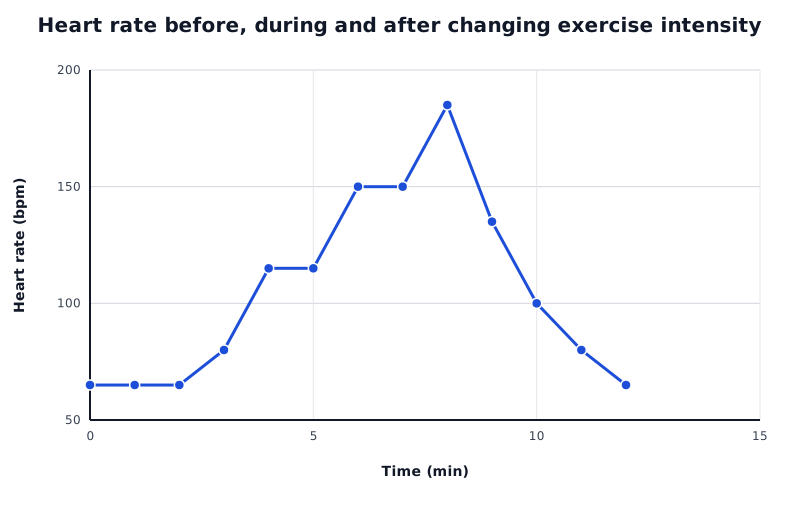
Heart-rate profile. Rest: minutes 0–2; anticipation: 2–3; walking: 3–5; jogging: 5–7; sprinting: 7–8; recovery after exercise stops at minute 8. These timings describe this example only.
Data for Heart rate before, during and after changing exercise intensity
| Series | Time (min) | Heart rate (bpm) |
|---|---|---|
| Illustrative heart rate | 0 | 65 |
| Illustrative heart rate | 1 | 65 |
| Illustrative heart rate | 2 | 65 |
| Illustrative heart rate | 3 | 80 |
| Illustrative heart rate | 4 | 115 |
| Illustrative heart rate | 5 | 115 |
| Illustrative heart rate | 6 | 150 |
| Illustrative heart rate | 7 | 150 |
| Illustrative heart rate | 8 | 185 |
| Illustrative heart rate | 9 | 135 |
| Illustrative heart rate | 10 | 100 |
| Illustrative heart rate | 11 | 80 |
| Illustrative heart rate | 12 | 65 |
Before exercise, the resting heart rate is 65 bpm. Between minutes 2 and 3, it rises to 80 bpm even though exercise has not yet started. This is an anticipatory rise: adrenaline is released as the body prepares for activity, causing heart rate to increase.
Once walking begins, heart rate rises further and then levels off at 115 bpm. A level section means that heart rate is fairly steady; it does not mean the heart has stopped or that the person has stopped exercising.
In this example, the change from walking to jogging at minute 5 is followed by a rise towards 150 bpm. The change to sprinting at minute 7 is followed by a rise to 185 bpm. These higher heart rates accompany increasing exercise intensity: the muscles need more oxygen, so the heart pumps more blood each minute.
Notice that heart rate takes time to respond. It does not jump instantly to its new level when the activity changes. To interpret a graph, identify the activity change, read the heart-rate values and connect the trend to the change in demand.
When exercise stops at minute 8, heart rate falls gradually towards its resting level. This is the recovery period. The falling line shows recovery, rather than an immediate return to the resting heart rate.
Get unlimited access to all revision notes, key terms, and exam tips.
SV in ml per beat gives Q in ml/min. Divide by 1000 for L/min.
Exercise usually increases HR and SV, raising Q to deliver more oxygenated blood to working muscles.
Read the axes, activity timings and numerical values together.
Get unlimited access to all revision notes, key terms, and exam tips.
Distinguish blood per beat (stroke volume), beats per minute (heart rate) and blood per minute (cardiac output).
Show the multiplication when calculating cardiac output. If stroke volume is in ml per beat, the result is in ml/min; divide by 1000 to convert to L/min.
Identify an anticipatory rise by its timing: it occurs before exercise begins, not after.
Support graph interpretations with times and heart-rate readings, including units. Use activity labels to identify changes in intensity rather than assuming every rise means the performer has sped up.
Cardiac output
The volume of blood pumped by the heart each minute, usually measured in ml/min or L/min.
Stroke volume
The volume of blood pumped out of the left ventricle with each heartbeat, usually measured in ml per beat.
Heart rate
The number of times the heart beats in one minute, measured in beats per minute (bpm).
Anticipatory rise
An increase in heart rate before physical activity begins, caused by adrenaline release as the body prepares for exercise.
Exercise intensity
How hard the body is working during physical activity.
Recovery period
The time after exercise during which heart rate falls towards its resting level.
Put your knowledge into practice — try past paper questions for Physical Education
Cardiac output
The volume of blood pumped by the heart each minute, usually measured in ml/min or L/min.
Stroke volume
The volume of blood pumped out of the left ventricle with each heartbeat, usually measured in ml per beat.
Heart rate
The number of times the heart beats in one minute, measured in beats per minute (bpm).
Anticipatory rise
An increase in heart rate before physical activity begins, caused by adrenaline release as the body prepares for exercise.
Exercise intensity
How hard the body is working during physical activity.
Recovery period
The time after exercise during which heart rate falls towards its resting level.