

Loading…
Loading…
Loading…
AQA Level 2 Certificate Further Mathematics · 8365
AQA 8365 · 6.8 Check the specification (PDF) (opens in a new tab)
For some angles, sine, cosine and tangent can be written exactly using fractions and square roots. For example, . A decimal such as is only an approximation: the surd expression retains the full value.
Two right-angled triangles provide the exact values for , and . Their usefulness comes from similarity: all triangles with the same angles have the same side ratios, even when their sizes differ.
For a chosen acute angle , the opposite side is across from the angle, the adjacent side is next to it but is not the hypotenuse, and the hypotenuse is opposite the right angle. The ratios are:
These are remembered as SOHCAHTOA. Since each is a ratio of two lengths, their units cancel.
Start with an equilateral triangle whose sides are each units long. Every angle is . Draw the perpendicular from the top vertex to the midpoint of the base. This line of symmetry splits the triangle into two identical right-angled triangles.
Each half has a hypotenuse of units and a base of unit. The top angle is halved to , while the angle at the original base remains .
Use Pythagoras’ theorem to find the height :
So the sides opposite , and are in the ratio:
Now take a right-angled isosceles triangle with both shorter sides unit long. The two remaining angles are equal and add to , so each is .
Pythagoras’ theorem gives its hypotenuse :
The side ratio is therefore:
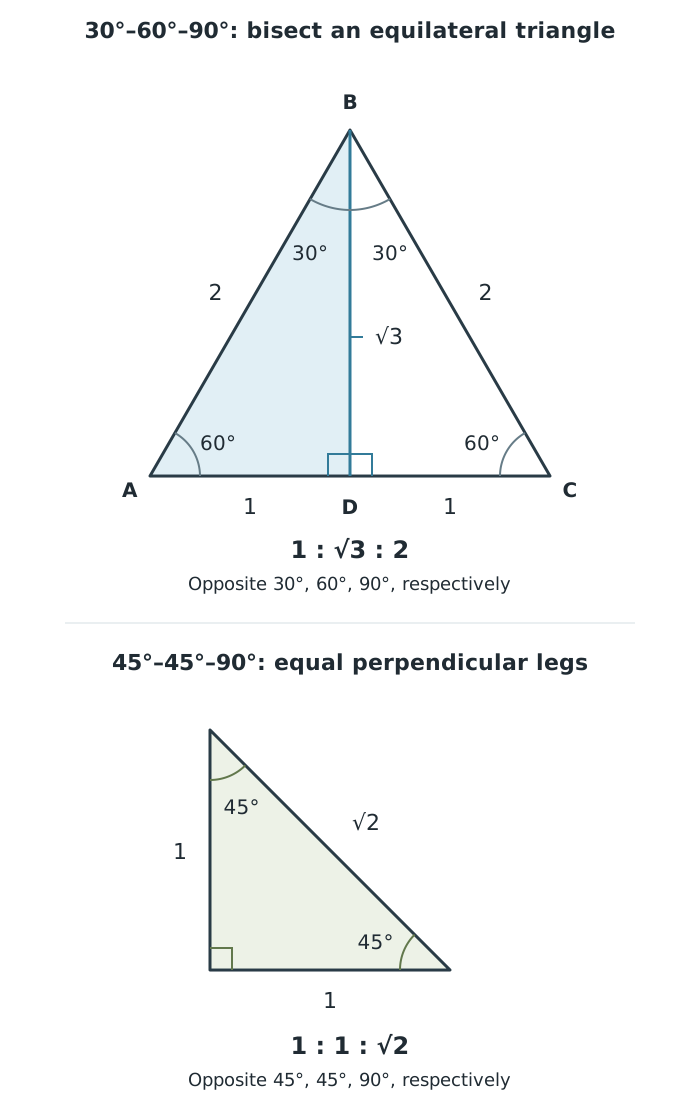
Pythagoras’ theorem gives the missing side in each special triangle; similarity preserves these side ratios at every size.
In the –– triangle, choose the angle first. Its opposite side is , its adjacent side is and its hypotenuse is . Therefore:
The final tangent form comes from multiplying the numerator and denominator by : the denominator becomes .
When you choose the angle instead, opposite and adjacent swap roles. The hypotenuse remains , giving:
For either angle in the isosceles triangle, opposite and adjacent are both . Hence:
Sine and cosine are equal at because the two shorter sides are equal. For and , the sine values match the cosine values in reverse order because the opposite and adjacent sides exchange roles.
The numbers in these ratios are not fixed side lengths. Multiplying every side by the same positive scale factor gives:
For example, suppose a –– triangle has a hypotenuse of . Since , the scale factor is . Its shorter side is and its longer side is .
The same longer side can be found using : multiplying this ratio by the hypotenuse gives . The side-ratio method and the trigonometric method are two ways of using the same relationship.
| Angle | |||
|---|---|---|---|
Halve an equilateral triangle of side to obtain sides , , . Use a right-angled isosceles triangle with legs to obtain .
Then apply , and .
If you forget an exact value, sketch the appropriate special triangle, label its sides and use SOHCAHTOA.
In the ratio , the sides are opposite , and , respectively.
Relabel opposite and adjacent when you change the chosen angle; the hypotenuse stays the same.
Keep fractions and surds in an exact answer rather than replacing them with rounded decimals.
It can see this note and what your specification asks for.
Answers are free with an account.
1 free note left this week
Get more free notesYour answer sets when this note comes back for review, or marks it complete.
Was this note helpful?
Log in to tell us whether it helped, or to report a problem.
Last updated
Exact value
A value written without rounding or approximation, for example rather than .
Surd
An irrational root written exactly, such as or .
Hypotenuse
The longest side of a right-angled triangle, opposite its right angle.
Similar triangles
Triangles with equal corresponding angles and proportional corresponding side lengths.
Put your knowledge into practice — try past paper questions for Further Mathematics
Exact value
A value written without rounding or approximation, for example rather than .
Surd
An irrational root written exactly, such as or .
Hypotenuse
The longest side of a right-angled triangle, opposite its right angle.
Similar triangles
Triangles with equal corresponding angles and proportional corresponding side lengths.