Loading…


Loading…
Loading…
Loading…
AQA GCSE Design and Technology · 8552
AQA 8552 · Shaping and forming techniques Check the specification (PDF) (opens in a new tab)
Paper and board can be cut to an outline and folded to create three-dimensional forms. For example, making a card carton involves cutting its outer shape, preparing its fold lines and then bending its panels into position. These operations do different jobs: cutting separates material, while creasing and scoring help control where it bends.
Cutting means separating material by cutting through its thickness. Scissors are suitable for straight and curved cuts in paper and thin card. A craft knife is useful for accurate straight cuts, while a scalpel can cut precise, detailed shapes. Guillotines and paper trimmers are useful for cutting large sheets, and a circle cutter produces accurate circular shapes.
For a straight craft-knife cut, place the card on a cutting mat and position a steel rule along the intended cutting line. Hold the rule securely and run the knife along its edge, making several light cuts until the blade passes through the card.
Each tool has a purpose. The steel rule guides the blade along a straight line. The cutting mat protects the work surface beneath the card and provides a suitable surface for cutting. Several light passes give greater control than trying to force the blade through in one heavy cut.
A crease is a line pressed into paper or card so that it folds neatly. To crease by hand, gently bend the card over, align the parts being folded and flatten the bend last. Pressing along the bend establishes the crease. Hand creasing can produce a wider, less sharply defined fold than preparing the line by scoring first.
Scoring prepares a precise line before folding. Place the card on a cutting mat, position a steel rule along the intended fold and draw a scoring tool, scoring stylus or bone folder along the rule. This makes a straight impression without cutting through and separating the card.
The prepared line encourages the card to bend in the intended place. This is useful when carton panels need to meet neatly: an accurately positioned score helps produce a controlled fold rather than an uneven bend elsewhere in the panel.
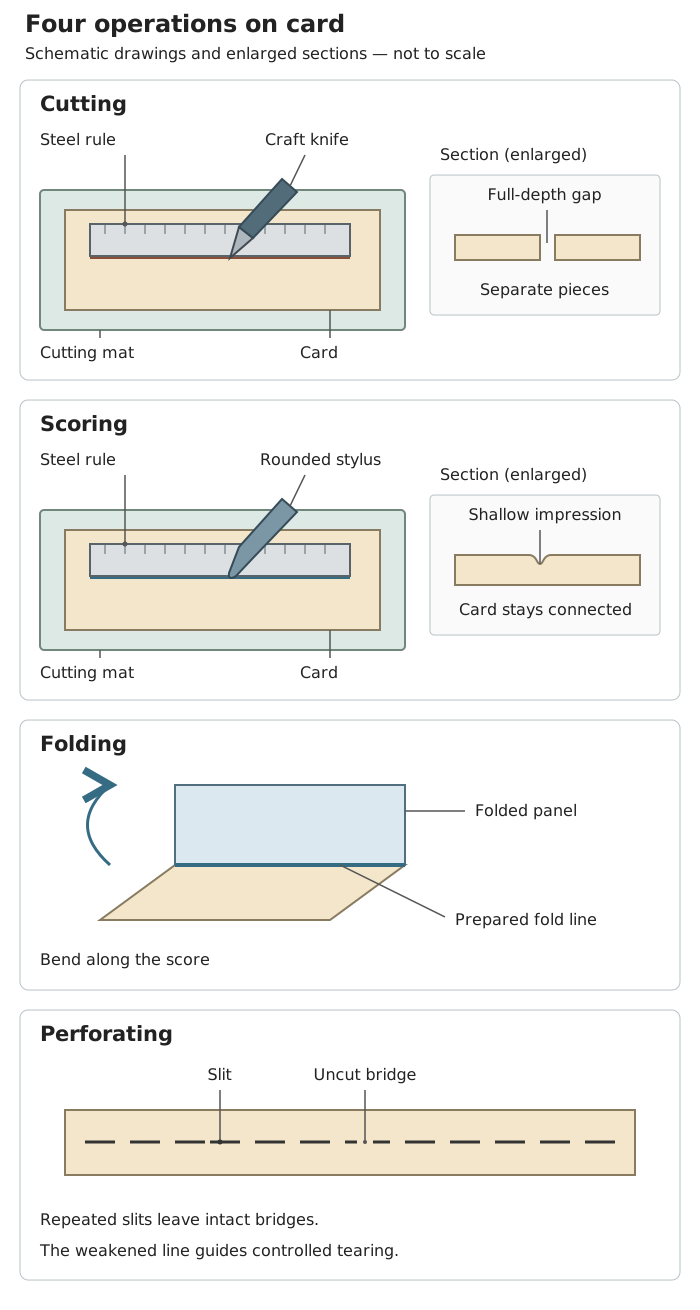
A continuous cut separates card; a score prepares a fold; folding bends it; perforation leaves bridges along a weakened line.
Folding is the bending operation itself. Creasing and scoring help establish where the fold will occur; folding changes the direction of the material on either side of that line.
For a small quantity, card can be folded by hand. If a line has been scored, bend the card along that line and press the fold into its final position. For larger quantities, a folding machine works more quickly and produces more consistent, accurate folds, reducing variation caused by hand work.
Perforation means making small, repeated holes or slits in paper or card. Unlike a continuous cut, it leaves bridges of material between the openings. The sheet stays connected, but the line is weakened so that it can tear cleanly where intended. Perforation can also make card easier to fold along that line.
A rotary perforation cutter uses a perforating blade to make the repeated incisions. Guide it along a steel rule to produce a straight perforated line. The important result is a pattern of cuts and uncut sections, rather than complete separation of the sheet.
Get unlimited access to all revision notes, key terms, and exam tips.
Get unlimited access to all revision notes, key terms, and exam tips.
When describing a technique, name the tool, explain how it is used and state the effect on the card.
Distinguish scoring from cutting: a scored line prepares card for folding without separating it into pieces.
Explain why a cutting mat and steel rule are used, rather than simply listing them.
For perforation, describe repeated holes or slits with material left between them, not a continuous cut.
Cutting
Separating paper or board along a line by cutting through its thickness.
Crease
A line pressed into paper or card that allows it to fold neatly.
Scoring
Making a controlled line or impression in card to prepare it for folding, without cutting right through it.
Folding
Bending paper or card so that one part changes direction relative to another.
Perforation
Making a repeated series of small holes or slits in paper or card to weaken a line for tearing or folding.
Put your knowledge into practice — try past paper questions for Design and Technology
Cutting
Separating paper or board along a line by cutting through its thickness.
Crease
A line pressed into paper or card that allows it to fold neatly.
Scoring
Making a controlled line or impression in card to prepare it for folding, without cutting right through it.
Folding
Bending paper or card so that one part changes direction relative to another.
Perforation
Making a repeated series of small holes or slits in paper or card to weaken a line for tearing or folding.