Loading…


Loading…
Loading…
Loading…
AQA GCSE Design and Technology · 8552
AQA 8552 · Commercial processes Check the specification (PDF) (opens in a new tab)
An electronic product needs its components to be positioned correctly and connected securely. A printed circuit board (PCB) supports the components and provides conductive tracks between them. Its contact pads are the areas where component terminals make their connections to the board.
In surface-mount technology, components sit directly on these pads rather than having their leads inserted through holes in the board. Many surface-mount components are extremely small, so placing and connecting them individually by hand would be slow and difficult. Commercial manufacture uses two linked processes: pick-and-place assembly positions the components, and flow/reflow soldering joins them to the PCB.
Pick-and-place assembly uses a programmed robotic machine to select components and place them at predetermined positions on a PCB.
First, solder paste is applied to the board’s contact pads, usually through a stencil that controls where the paste goes. Components are supplied to the machine in reels or trays. A robotic head picks up each component and moves it to its programmed location and orientation on the board. The paste temporarily holds the components in place before soldering.
For example, when assembling a mobile phone’s circuit board, the machine can repeatedly place many tiny components in their correct positions. This is useful because the same circuit layout must be reproduced across large numbers of boards.
The commercial advantages follow from how the machine works. Automated movement is quick, programmed positions make placement precise and consistent, and the machine can handle components that are difficult to position manually. These features make pick-and-place suitable for high-volume electronic products such as phones, computers and controls.
Placing a component on a pad does not yet create its permanent connection. Flow/reflow soldering heats the solder already on the pads so that it melts and flows around the component terminals. When it cools, it forms solid solder joints that secure the components and make electrical connections to the PCB.
Solder paste contains powdered solder and flux, which helps clean and prepare the surfaces for soldering. After pick-and-place assembly, the populated board passes through a reflow oven. Controlled heating melts the solder without melting the components themselves. The board then cools and the joints solidify.
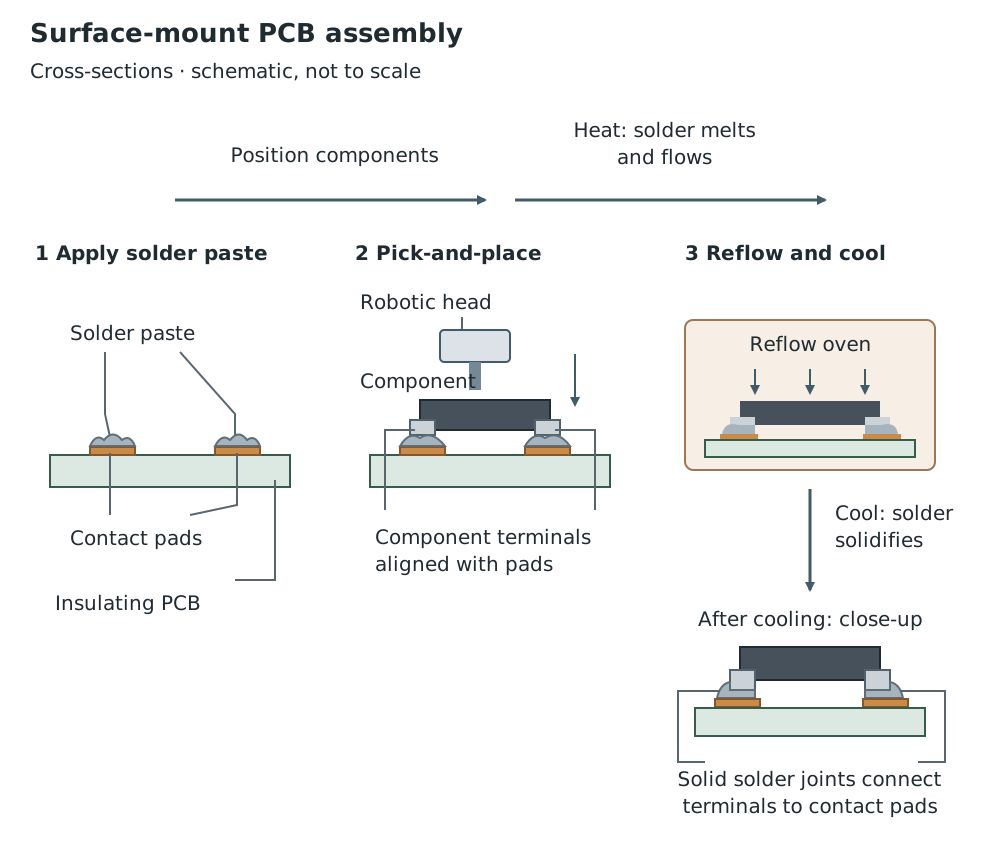
Pick-and-place positions the components; reflow heating and cooling create the solder joints.
This sequence allows many connections on a board to be made without someone soldering each joint separately by hand. Automated, controlled heating supports precise and repeatable commercial production.
In AQA’s terminology, flow/reflow soldering describes the surface-mount process: solder is already on the contact pads and is melted by heating the board.
Wave soldering is a different arrangement. Components have leads inserted through pre-drilled holes in the PCB. A conveyor carries the board over a wave of molten solder, which contacts its underside. As the solder cools, it joins the leads to the board.
The key distinction is where the solder comes from: reflow melts solder already on the pads; wave soldering brings the underside of the board into contact with molten solder.
Get unlimited access to all revision notes, key terms, and exam tips.
Solder paste on PCB pads → pick-and-place positions components → reflow oven melts solder → cooling forms solid joints.
Get unlimited access to all revision notes, key terms, and exam tips.
Distinguish positioning from joining: pick-and-place positions components; soldering makes the permanent connections.
For AQA, describe flow/reflow soldering using surface-mounted components, solder on contact pads and heating in a reflow oven. Wave soldering is listed separately.
Explain benefits rather than just naming them: programmed placement positions tiny components quickly and consistently, making it suitable for high-volume production.
Printed circuit board (PCB)
An insulating board with conductive tracks and contact pads that connect and support electronic components.
Surface-mount technology
A method of assembly in which electronic components are attached directly to contact pads on the surface of a printed circuit board.
Pick-and-place assembly
An automated process in which a robotic machine selects electronic components and positions them at programmed locations on a printed circuit board.
Solder paste
A mixture of powdered solder and flux applied to PCB contact pads before components are placed and the board is heated.
Flow/reflow soldering
A process in which solder on PCB contact pads is heated until it melts and flows, then cools to form joints connecting surface-mounted components to the board.
Put your knowledge into practice — try past paper questions for Design and Technology
Printed circuit board (PCB)
An insulating board with conductive tracks and contact pads that connect and support electronic components.
Surface-mount technology
A method of assembly in which electronic components are attached directly to contact pads on the surface of a printed circuit board.
Pick-and-place assembly
An automated process in which a robotic machine selects electronic components and positions them at programmed locations on a printed circuit board.
Solder paste
A mixture of powdered solder and flux applied to PCB contact pads before components are placed and the board is heated.
Flow/reflow soldering
A process in which solder on PCB contact pads is heated until it melts and flows, then cools to form joints connecting surface-mounted components to the board.