

Loading…
Loading…
Loading…
AQA GCSE Combined Science: Synergy · 8465
AQA 8465 · 4.2.1.5 Human Digestive System Check the specification (PDF) (opens in a new tab)
A food can contain several types of biological molecule. Sugars and starch are carbohydrates, lipids are fats and oils, and proteins are another major group of food molecules. Looking at a food is not enough to identify which molecules it contains.
In Required Practical 7, you use qualitative tests to identify carbohydrates, lipids and proteins in a range of foods. Each test uses a reagent: a chemical that produces a recognisable change when the substance being tested for is present. These tests identify substances; they do not measure their exact amounts.
You will need food samples, labelled test tubes and a rack, pipettes, distilled water and the reagents for each test. Benedict’s test also needs a hot water bath and thermometer. A measuring cylinder is needed to measure the Biuret solutions.
For a solid food, an aqueous sample can be prepared by crushing it with a pestle and mortar, adding distilled water and stirring with a glass rod. Filter through a funnel and filter paper if necessary to collect a solution for the Benedict’s, iodine and Biuret tests. Keep a separate portion of the food for the lipid test.
Use a fresh portion of each sample for each test. Otherwise, a reagent left over from one test could interfere with another. Label the tubes clearly and use clean equipment to avoid transferring substances between samples.
Wear safety goggles and never taste the samples or reagents. Tie back long hair when using a Bunsen burner. Hot water and hot glass can cause burns, so handle heated tubes with a test-tube holder and keep their openings pointed away from people. Iodine can irritate the eyes. Biuret solutions contain poisonous copper sulphate and corrosive sodium hydroxide: avoid contact, wash any splashes off skin immediately and report spills to your teacher.
Ethanol is highly flammable. Turn off Bunsen burners completely before the lipid test and keep ethanol away from flames.
Benedict’s solution is blue. It detects reducing sugars, including glucose. This is more specific than testing for all sugars or all carbohydrates.
A brick-red precipitate is a positive result: reducing sugar has been detected. A precipitate is a solid formed within the liquid. If the mixture remains blue, the test is negative. Heating is part of the test, so an unchanged colour before heating is not a completed negative result.
Starch is a carbohydrate, but it needs a different test from reducing sugars.
Put a fresh portion of the food sample into a test tube and add a few drops of iodine solution using a pipette. No heating is needed. Observe the colour after adding the reagent.
Iodine solution changes from brown to blue-black if starch is present. If it remains brown, starch has not been detected.
Put a fresh portion of the food sample into a test tube. Measure and add 1 cm³ of Biuret solution A and 1 cm³ of Biuret solution B. Gently shake the tube to mix, then allow a few minutes for the colour to develop. No heating is needed.
A change from blue to purple indicates protein. If the mixture remains blue, the result is negative. The Biuret reagents provide copper sulphate and sodium hydroxide; both are needed for the test.
The lipid test uses ethanol and distilled water rather than a coloured reagent. Ethanol extracts lipids from the food before the extract is added to water.
A cloudy white emulsion indicates lipids. An emulsion contains tiny droplets dispersed in a liquid, giving it a cloudy appearance. Look for cloudiness that develops when the ethanol extract meets the water, rather than mistaking food particles for a positive result. If no white cloudiness develops, lipids have not been detected.
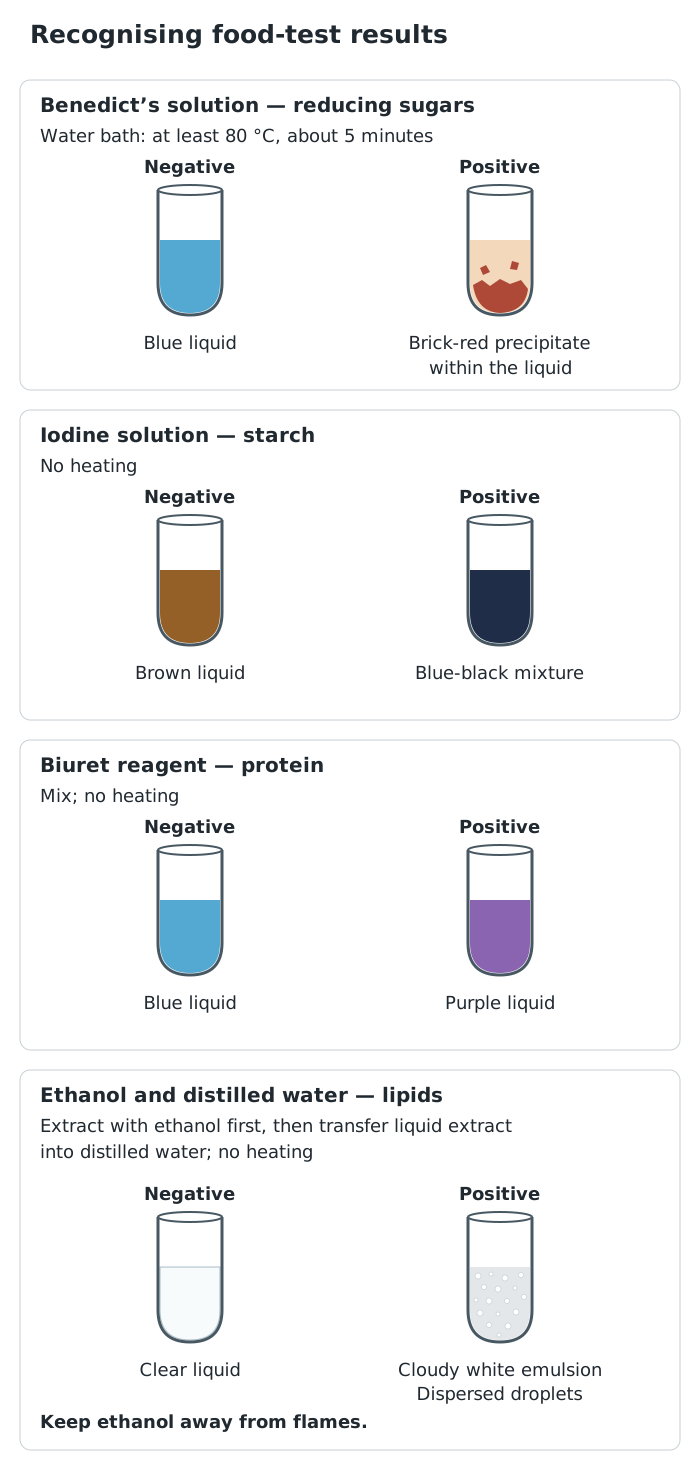
Each test has a characteristic positive result. For lipids, extract with ethanol before adding the extract to water. Only Benedict’s test requires heating.
Record what you actually see before deciding which molecules are present. For each food, record the colour produced with Benedict’s solution, the colour produced with iodine solution, whether a cloudy layer is produced with ethanol, and the colour produced with Biuret solution.
A conclusion should name the substance detected and give the evidence. For example, suppose a sample turns blue-black with iodine and purple with Biuret reagent. You can conclude that it contains starch and protein, because both tests gave their characteristic positive results. A food can give more than one positive result.
A negative result means the substance was not detected under the test conditions. Very low concentrations can produce subtle changes that are difficult to judge, particularly with Benedict’s and Biuret tests. Careful observation, consistent methods and repeating unclear tests help make conclusions more dependable.
| Substance tested for | Reagent and method | Positive result | Negative result |
|---|---|---|---|
| Reducing sugar | Benedict’s solution; water bath at least 80 °C for about 5 minutes | Brick-red precipitate | Remains blue |
| Starch | Add iodine solution; no heating | Blue-black | Remains brown |
| Protein | Add 1 cm³ each of Biuret A and B; mix; no heating | Purple | Remains blue |
| Lipid | Extract with a few cm³ of ethanol; transfer liquid extract into an equal volume of distilled water; no heating | Cloudy white emulsion |
Link each conclusion to an observation: for example, a purple colour with Biuret reagent indicates protein.
Benedict’s test needs heating in a hot water bath; simply adding the reagent is not enough.
Benedict’s solution tests for reducing sugars, not every type of sugar. A negative result does not show that all carbohydrates are absent.
For the lipid test, extract with ethanol first, then transfer the liquid extract into distilled water. Describe a cloudy white emulsion, not just a colour change or visible food particles.
Keep observations separate from conclusions: ‘blue-black’ is an observation; ‘starch detected’ is a conclusion.
It can see this note and what your specification asks for.
Answers are free with an account.
1 free note left this week
Get more free notesYour answer sets when this note comes back for review, or marks it complete.
Was this note helpful?
Log in to tell us whether it helped, or to report a problem.
Last updated
Qualitative test
A test that identifies whether a substance is present, rather than measuring its exact amount or concentration.
Reagent
A chemical added to a sample to produce a reaction or change that helps identify a substance.
Reducing sugar
A sugar that gives a positive result with Benedict’s solution when heated, such as glucose.
Precipitate
An insoluble solid formed during a reaction in a solution.
Emulsion
A mixture in which tiny droplets of one liquid are dispersed in another. A cloudy white emulsion is a positive result in the ethanol test for lipids.
Put your knowledge into practice — try past paper questions for Combined Science: Synergy
Qualitative test
A test that identifies whether a substance is present, rather than measuring its exact amount or concentration.
Reagent
A chemical added to a sample to produce a reaction or change that helps identify a substance.
Reducing sugar
A sugar that gives a positive result with Benedict’s solution when heated, such as glucose.
Precipitate
An insoluble solid formed during a reaction in a solution.
Emulsion
A mixture in which tiny droplets of one liquid are dispersed in another. A cloudy white emulsion is a positive result in the ethanol test for lipids.
| No white cloudiness |
Wear goggles; handle hot water and tubes carefully. Biuret contains poisonous copper sulphate and corrosive sodium hydroxide. Wash off skin splashes immediately. Ethanol is highly flammable: keep it away from flames and turn Bunsen burners off before using it.