

Loading…
Loading…
Loading…
AQA GCSE Combined Science: Synergy · 8465
AQA 8465 · 4.2.1.5 Human Digestive System Check the specification (PDF) (opens in a new tab)
Food provides materials for growth and repair as well as substances that can release energy. However, large molecules such as starch, proteins and lipids cannot simply pass through the wall of the gut into the blood. They must first be broken down into smaller, soluble molecules. This chemical breakdown is digestion.
The digestive system is an organ system: a group of organs working together to digest food and absorb useful substances. Digestive enzymes speed up the reactions that break food molecules apart. An enzyme is a biological catalyst, so it speeds up a reaction without being used up. Different types of digestive enzyme act on different food molecules.
The small, soluble products are absorbed through the wall of the small intestine into the blood. This movement is called absorption. The blood then transports the dissolved molecules to cells throughout the body. Digestion and transport therefore work together: digestion makes molecules absorbable, and the blood delivers them to where they are needed.
Large food molecules are made from smaller building blocks. Starch is a long chain of glucose molecules, proteins are long chains of amino acids, and lipids contain fatty acids joined to glycerol.
Digestion separates these building blocks. Inside cells, they can then be used in respiration or joined together to make new large molecules. Building larger molecules from smaller ones is called synthesis. The body does not simply move the proteins and fats in a meal unchanged into its own tissues: it breaks them down and reuses their components.
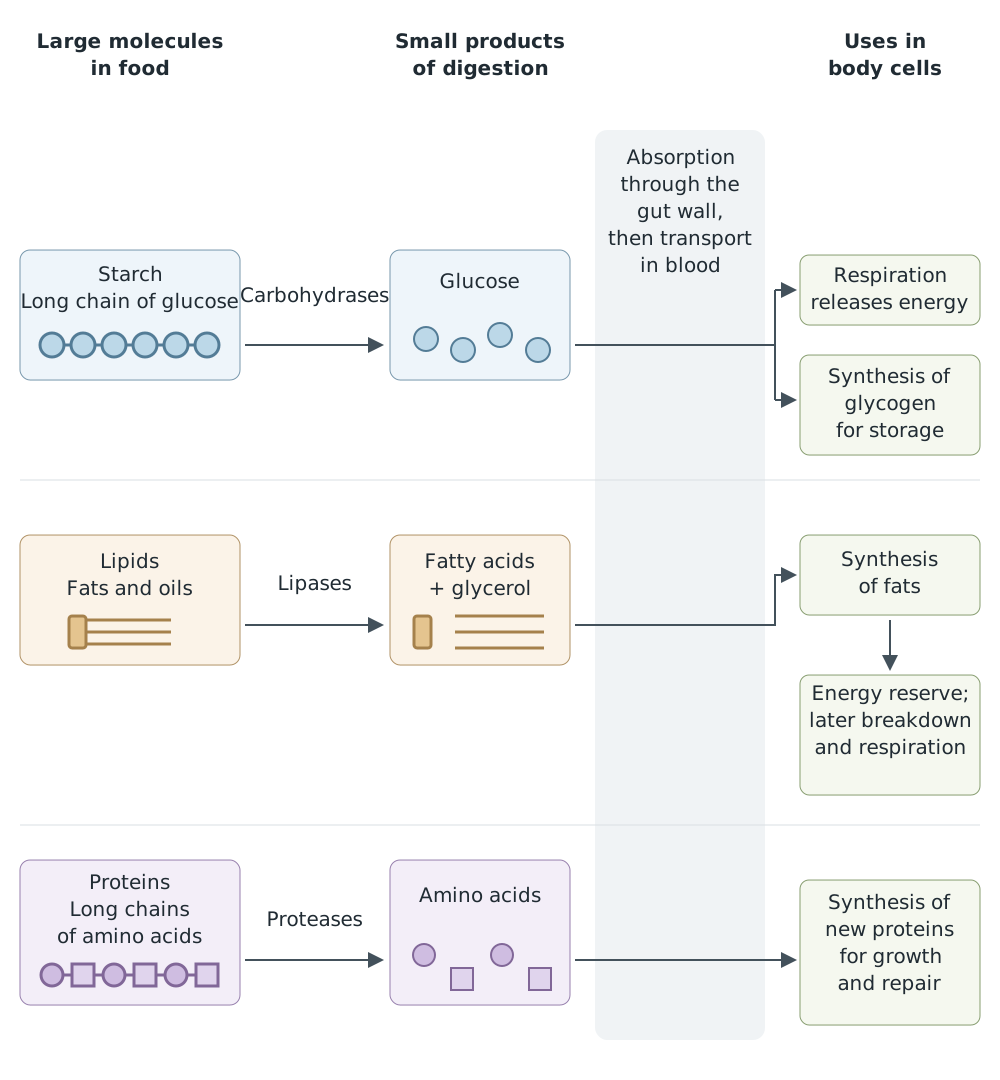
Digestion supplies small building blocks that the blood carries to cells for respiration or synthesis.
Starch is a carbohydrate made from many glucose molecules linked in a long chain. Starch is insoluble, whereas glucose is water-soluble. Digestion by carbohydrase enzymes breaks starch down to glucose, which can be absorbed and transported in the blood.
Cells use glucose in respiration, a series of chemical reactions that releases energy for their activities. This is a chemical process in cells, not another name for breathing.
Sugars can also be used to synthesise larger carbohydrates. For example, human cells can join glucose molecules together to make glycogen, an energy reserve. This links breakdown and synthesis: a carbohydrate in food supplies small sugar molecules that cells can either use immediately or rebuild into a storage carbohydrate.
Lipids are fats and oils. During digestion, lipase enzymes break lipids down into fatty acids and glycerol. These small products can be absorbed and transported to cells.
Cells can join fatty acids and glycerol together again to synthesise fats. Stored fat acts as an energy reserve because cells can later break it down and use it in respiration. Fatty acids and glycerol therefore matter both as products of lipid breakdown and as the building blocks for new lipids.
A protein is a long-chain molecule made from many amino acids linked together. Protease enzymes digest proteins into amino acids, which are absorbed into the blood and carried to cells.
Cells join amino acids together to synthesise the proteins they need. These proteins provide materials for growth and repair, and include molecules such as enzymes. For example, repairing damaged tissue requires cells to make new proteins from amino acids delivered by the blood.
Digestion breaks an existing protein apart; protein synthesis builds a new protein from the resulting small molecules. Keeping these two processes distinct helps explain why amino acids are essential nutrients.
Not all absorbed amino acids are needed to make new proteins. The liver breaks down unwanted amino acids and produces urea. Urea is a waste substance that must be removed from the body.
The urea dissolves in the blood and is carried to the kidneys. The kidneys excrete it in solution as urine. The sequence is therefore: unwanted amino acids → liver produces urea → blood transports urea → kidneys excrete it in urine.
This connects digestion with excretion. Digestion supplies useful small molecules, while excretion removes waste produced when the body processes those molecules.
Large, insoluble food molecules → enzyme digestion → small, soluble molecules → absorption through the gut wall → blood → body cells.
| Enzyme type | Food molecule broken down | Products |
|---|---|---|
| Carbohydrase |
For each digestive enzyme, link the food molecule to its products: carbohydrase → starch → glucose; protease → protein → amino acids; lipase → lipid → fatty acids and glycerol.
Explain why digestion is necessary using both size and solubility: the products are small and soluble, so they can be absorbed through the gut wall into the blood.
Keep the liver and kidneys distinct: the liver produces urea from unwanted amino acids; the kidneys excrete urea in urine.
Say that respiration releases energy, rather than saying it creates energy.
It can see this note and what your specification asks for.
Answers are free with an account.
1 free note left this week
Get more free notesYour answer sets when this note comes back for review, or marks it complete.
Was this note helpful?
Log in to tell us whether it helped, or to report a problem.
Last updated
Digestion
The breakdown of large, insoluble food molecules into small, soluble molecules that can be absorbed into the blood.
Absorption
The movement of small, soluble products of digestion through the gut wall into the blood.
Enzyme
A biological catalyst that speeds up a chemical reaction without being used up.
Synthesis
The building of larger molecules by joining smaller molecules together.
Carbohydrase
An enzyme that breaks down carbohydrates into sugars. Carbohydrases digest starch to glucose.
Protease
An enzyme that breaks down proteins into amino acids.
Lipase
An enzyme that breaks down lipids into fatty acids and glycerol.
Amino acid
A small molecule that can be linked to other amino acids to make a protein.
Urea
A waste substance produced in the liver from the breakdown of unwanted amino acids and excreted by the kidneys in urine.
Excretion
The removal from the body of waste substances produced by its chemical reactions.
Put your knowledge into practice — try past paper questions for Combined Science: Synergy
Digestion
The breakdown of large, insoluble food molecules into small, soluble molecules that can be absorbed into the blood.
Absorption
The movement of small, soluble products of digestion through the gut wall into the blood.
Enzyme
A biological catalyst that speeds up a chemical reaction without being used up.
Synthesis
The building of larger molecules by joining smaller molecules together.
Carbohydrase
An enzyme that breaks down carbohydrates into sugars. Carbohydrases digest starch to glucose.
Protease
An enzyme that breaks down proteins into amino acids.
Lipase
An enzyme that breaks down lipids into fatty acids and glycerol.
Amino acid
A small molecule that can be linked to other amino acids to make a protein.
Urea
A waste substance produced in the liver from the breakdown of unwanted amino acids and excreted by the kidneys in urine.
Excretion
The removal from the body of waste substances produced by its chemical reactions.
| Starch |
| Glucose |
| Lipase | Lipid | Fatty acids and glycerol |
| Protease | Protein | Amino acids |
Breakdown separates large molecules into smaller ones; synthesis joins small molecules to make larger ones.
Unwanted amino acids → liver produces urea → blood carries it → kidneys excrete it in solution as urine.