

Loading…
Loading…
Loading…
AQA GCSE Combined Science: Synergy · 8465
AQA 8465 · 4.8.2.8 Check the specification (PDF) (opens in a new tab)
A product can appear environmentally friendly while it is being used, yet cause substantial impacts before it reaches the customer or after it is thrown away. A life cycle assessment (LCA) considers the environmental impact of a material or product across its whole life. It examines the materials and energy resources needed, as well as wastes and pollutants produced.
For example, a wooden desk may require little energy during use. However, obtaining its wood, making and transporting the desk, and dealing with it at the end of its life still have environmental impacts. Looking only at the use stage would miss these.
Extracting and processing raw materials includes obtaining resources and preparing them for manufacture. Mining can damage habitats, and processing raw materials requires energy. Using a finite resource also reduces the amount available for the future.
Manufacturing and packaging includes making the product and its packaging. Factories use energy and materials and may produce waste and pollutants.
Use and operation during its lifetime includes the resources needed while the product is being used. A car needs fuel and releases pollutants during operation, whereas a desk has much less direct impact during use. How long a product lasts and how often it is reused affect the comparison.
Disposal at the end of its useful life considers what happens to the product and its packaging when they are no longer needed. This may include landfill or recycling, with different requirements for space, materials and energy.
Transport and distribution must be included at every stage. Raw materials travel to factories, finished goods reach customers, and discarded products may travel to waste-treatment facilities. These journeys use energy and may release pollutants.
To carry out an LCA, identify the activities at each stage, collect information about their resource use and outputs, and compare the resulting impacts. Products should be compared on the same basis: for example, carrying the same amount of shopping the same number of times, rather than simply comparing one disposable bag with one reusable bag.
Durability matters because making a reusable product may have a larger initial impact, but that impact is spread over more uses. However, any resources needed between uses must also be included. A comparison based on repeated use is only convincing if the assumed number of uses is realistic.
Suppose two products, A and B, provide the same service over the same lifetime. The following constructed figures represent their energy requirements, with transport included in each stage.
| Stage | Product A: energy / MJ | Product B: energy / MJ |
|---|---|---|
| 1: Raw materials | 2.4 | 3.1 |
| 2: Manufacture and packaging | 3.6 | 4.2 |
| 3: Use and operation | 8.2 | 5.3 |
| 4: Disposal | 1.1 | 1.4 |
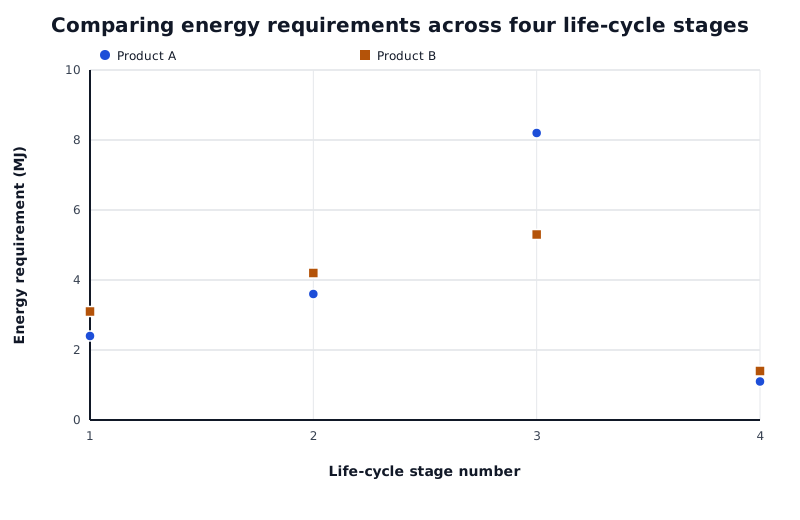
Energy requirements for two products providing the same service. Stage numbers correspond to the table; transport is included in each stage. Compare both individual stages and whole-life totals.
Data for Comparing energy requirements across four life-cycle stages
| Series | Life-cycle stage number | Energy requirement (MJ) |
|---|---|---|
| Product A | 1 | 2.4 |
| Product A | 2 | 3.6 |
| Product A | 3 | 8.2 |
| Product A | 4 | 1.1 |
| Product B | 1 | 3.1 |
| Product B | 2 | 4.2 |
| Product B | 3 | 5.3 |
| Product B | 4 | 1.4 |
The horizontal axis identifies the stages; the vertical axis shows energy in megajoules. To read a point, find its stage, then read its height against the energy scale. Conversely, a table entry can be plotted at its stage number and energy value. For example, Product A’s use-stage entry becomes the point .
Product A requires less energy in raw materials, manufacture and disposal, but more during use. This shows why selecting just one stage can give a misleading impression.
Adding the four entries gives total energy requirements of for A and for B. B therefore requires less energy over the stated lifetime. That supports choosing B on energy use, but it does not establish that B is better for every environmental impact.
Only add quantities that describe the same measure in compatible units. Energy in megajoules cannot be added directly to water use in litres or waste in kilograms to produce a meaningful total.
An estimate gives a rough check on a calculation. Rounding A’s stage values to one significant figure gives . This is close to the calculated total of , so the answer is plausible.
Significant figures begin at the first non-zero digit. For example, has two significant figures: 2 and 3. The zeros before the 2 locate the decimal point but do not count. In , the final zero does count: the number is written to three significant figures.
Follow any rounding instruction in the question. Otherwise, report an answer to a degree of precision appropriate to the original data, rather than copying every calculator digit. To two significant figures, the totals above are and . Retain the unrounded totals when calculating their difference.
Water use, energy requirements, material use and the production of some wastes can be fairly easily quantified. For example, an LCA can compare the volume of water used or the mass of waste produced.
Allocating numerical values to the effects of pollutants is less straightforward. Measuring how much pollutant is released is not the same as deciding how serious its environmental effects are. Deciding how much importance to give different effects requires value judgements. Two assessments can therefore use similar measurements but reach different overall conclusions.
This does not make LCAs useless. It means that a conclusion should explain both the measured evidence and the priorities used to judge it.
An abbreviated LCA considers only part of the full picture. It may answer a narrow question, such as which product needs less manufacturing energy, but it cannot necessarily establish which product has the lowest overall impact.
Selective assessments can be misused to support a pre-determined advertising claim. In the constructed comparison, an advert for A could highlight its lower manufacturing energy while leaving out B’s lower energy requirement during use.
A justified evaluation checks which stages and impacts were included, whether transport was counted, and whether the products were compared over equivalent lifetimes or uses. It then states a conclusion with suitable limits: B uses less energy in this comparison, but information about water, materials, waste and pollutant effects would also matter to an overall environmental judgement.
Include transport and distribution at every stage.
Water, energy, materials and some wastes can be quantified fairly easily. Assigning numerical values to pollutant effects requires value judgements, so an LCA is not purely objective.
Selective or abbreviated LCAs can omit inconvenient stages or impacts to support pre-determined advertising claims.
Estimate by rounding inputs to convenient values, commonly one . Count significant figures from the first non-zero digit. Keep extra digits during calculations; round the final result appropriately.
Include transport and distribution at every stage, not as a replacement for one of the four stages.
Support a comparison with figures and units, then explain what those figures mean.
A lower energy requirement does not automatically mean a lower overall environmental impact.
When evaluating an advertising claim, check whether stages or impacts have been omitted.
Round directly from the original number: 14 489 to two significant figures is 14 000, not 15 000.
Keep extra digits during calculations and round the final answer to the requested or appropriate number of significant figures.
It can see this note and what your specification asks for.
Answers are free with an account.
1 free note left this week
Get more free notesYour answer sets when this note comes back for review, or marks it complete.
Was this note helpful?
Log in to tell us whether it helped, or to report a problem.
Last updated
Life cycle assessment
An assessment of the environmental impacts of a material or product throughout raw material extraction and processing, manufacture and packaging, use, and disposal, including transport and distribution.
Quantify
To express something as a numerical quantity, such as energy used in megajoules or waste produced in kilograms.
Value judgement
A decision based on the importance someone assigns to different effects, rather than measurement alone.
Selective LCA
An assessment that considers only selected stages or impacts of a product’s life.
Estimate
An approximate answer found using simplified or rounded numbers.
Significant figure
A digit counted when expressing a number’s precision. Significant figures are counted from the first non-zero digit.
Put your knowledge into practice — try past paper questions for Combined Science: Synergy
Life cycle assessment
An assessment of the environmental impacts of a material or product throughout raw material extraction and processing, manufacture and packaging, use, and disposal, including transport and distribution.
Quantify
To express something as a numerical quantity, such as energy used in megajoules or waste produced in kilograms.
Value judgement
A decision based on the importance someone assigns to different effects, rather than measurement alone.
Selective LCA
An assessment that considers only selected stages or impacts of a product’s life.
Estimate
An approximate answer found using simplified or rounded numbers.
Significant figure
A digit counted when expressing a number’s precision. Significant figures are counted from the first non-zero digit.