

Loading…
Loading…
Loading…
AQA GCSE Combined Science: Synergy · 8465
AQA 8465 · 4.1.1.4 Heating and Changes of State Check the specification (PDF) (opens in a new tab)
A system is the object or collection of objects being studied, such as a metal block or water in a beaker. Its atoms and molecules store energy. The total energy associated with their motion and their positions relative to one another is called internal energy.
Particles have kinetic energy because they move: particles in a solid vibrate, while particles in liquids and gases also move from place to place. They have potential energy because of their positions relative to other particles and the forces between them.
Heating transfers energy into a system and increases its internal energy. This can raise its temperature or cause a change of state. These are different effects of the same energy transfer.
When heating raises the temperature, the particles gain kinetic energy. They move or vibrate faster on average. Temperature is related to their average kinetic energy; it is not a measure of the total energy stored by all the particles.
During melting or boiling, energy can continue to enter the substance without raising its temperature. Instead, energy increases the particles’ potential energy as their arrangement changes and forces of attraction are overcome. Internal energy therefore increases even though the temperature remains constant during the change of state.
For example, warming solid ice towards its melting point raises its temperature. Melting the ice at its melting point requires further energy but does not raise its temperature. Specific heat capacity describes energy needed for a temperature rise; specific latent heat describes energy needed for a change of state without a temperature change.
The temperature rise depends on the energy supplied, the mass heated and the material.
The specific heat capacity of a substance is the amount of energy required to raise the temperature of one kilogram of the substance by one degree Celsius.
A material with a higher specific heat capacity needs more energy for the same temperature rise. If equal masses receive energy at the same rate, the material with the higher specific heat capacity warms more slowly.
For example, aluminium has a specific heat capacity of about 913 J/kg °C, while copper has a value of about 385 J/kg °C. Raising 1 kg of aluminium by 1 °C therefore requires more than twice as much energy as raising 1 kg of copper by 1 °C.
For a temperature change without a change of state:
Here, is the change in thermal energy in joules (J), is mass in kilograms (kg), is specific heat capacity in J/kg °C, and is temperature change in degrees Celsius (°C).
Calculate the temperature change first:
Then multiply the mass, specific heat capacity and temperature change. The equation can also be rearranged to find an unknown quantity:
The equation applies to cooling too. Cooling decreases the system’s thermal energy. If asked for the amount of energy transferred out, use the size of the temperature fall to give a positive amount; a signed change in thermal energy is negative.
An electrical heater can transfer a known amount of energy to a metal block. Measuring the block’s mass and temperature rise allows its specific heat capacity to be determined.
Use a metal block with holes for an immersion heater and thermometer, a balance, insulation, a stopwatch and a suitable low-voltage power supply. The heater’s power can be provided or determined using an ammeter and voltmeter.
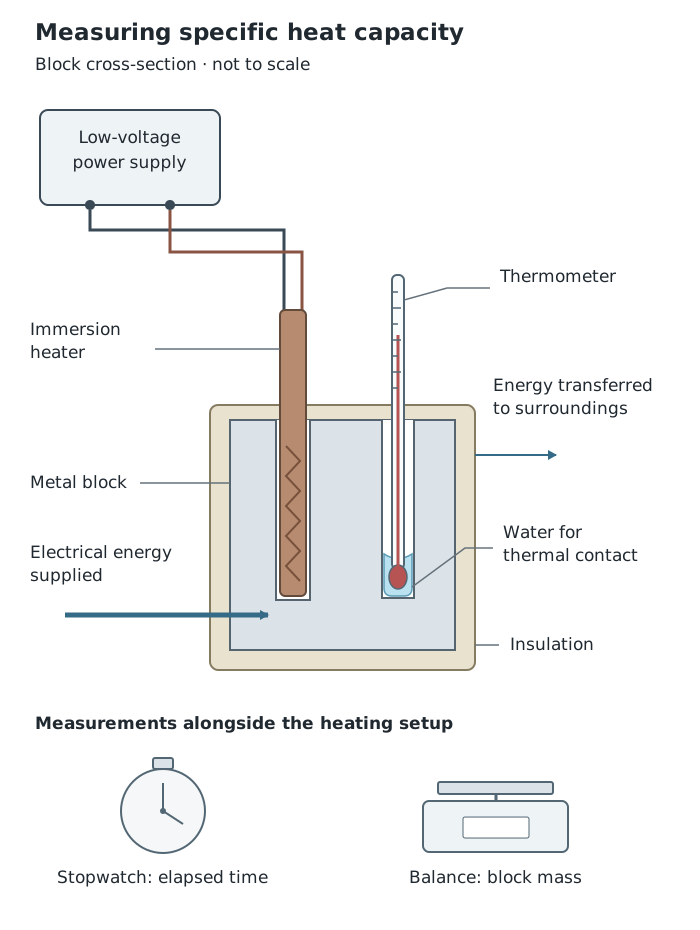
A heater supplies energy to an insulated block; its mass and temperature rise are used to determine specific heat capacity.
The electrical work done by a constant-power heater is:
Power is measured in watts and time in seconds, giving energy in joules. If losses are small, the energy supplied is approximately equal to the increase in the block’s thermal energy:
With a battery supply, the battery’s chemical energy store decreases as electrical work is done. The block’s internal energy increases, producing the measured temperature rise. Some energy also warms the heater and the surroundings, so not all the energy supplied reaches the block.
Use a suitable low-voltage supply and keep water away from electrical connections. The block and heater can become hot enough to burn: do not touch them during heating, switch off before adjusting the apparatus, and allow them to cool before handling.
Insulation reduces energy losses but cannot eliminate them. Better thermal contact helps the thermometer follow the block’s temperature more closely. Repeating the investigation and comparing calculated values helps assess how consistent the results are.
A graph can use energy supplied on the horizontal axis and temperature on the vertical axis. Calculate the energy supplied at each recorded time using . The graph may curve initially because the heater and block take time to warm and the thermometer reading can lag behind.
For the approximately straight section, the gradient is temperature rise divided by energy supplied. Since :
A shallower gradient means a smaller temperature rise per joule. For blocks of equal mass, this indicates a higher specific heat capacity. Using a straight section of the graph also draws on several readings rather than relying on just one temperature measurement.
Energy needed to raise 1 kg of a substance by 1 °C.
Units: in J; in kg; in J/kg °C; in °C.
Use the temperature change, not the final temperature: Δθ = final temperature − initial temperature.
Convert mass to kilograms and energy to joules before substituting into ΔE = mcΔθ.
In a practical answer, explain what insulation does: it reduces energy transfer to the surroundings.
If all the electrical energy supplied is assumed to heat the block, energy losses make the calculated specific heat capacity too high.
The specific heat capacity equation is given on the Physics equations sheet; practise identifying the quantities and rearranging it.
It can see this note and what your specification asks for.
Answers are free with an account.
1 free note left this week
Get more free notesYour answer sets when this note comes back for review, or marks it complete.
Was this note helpful?
Log in to tell us whether it helped, or to report a problem.
Last updated
Internal energy
The total energy stored by the particles in a system because of their motion and their positions relative to one another.
Specific heat capacity
The amount of energy required to raise the temperature of one kilogram of a substance by one degree Celsius, measured in J/kg °C.
Temperature change
The final temperature minus the initial temperature: , measured in °C.
Specific latent heat
The amount of energy required to change the state of one kilogram of a substance without changing its temperature, measured in J/kg.
Thermal insulation
Material placed around an object to reduce energy transfer between it and its surroundings.
Put your knowledge into practice — try past paper questions for Combined Science: Synergy
Internal energy
The total energy stored by the particles in a system because of their motion and their positions relative to one another.
Specific heat capacity
The amount of energy required to raise the temperature of one kilogram of a substance by one degree Celsius, measured in J/kg °C.
Temperature change
The final temperature minus the initial temperature: , measured in °C.
Specific latent heat
The amount of energy required to change the state of one kilogram of a substance without changing its temperature, measured in J/kg.
Thermal insulation
Material placed around an object to reduce energy transfer between it and its surroundings.
For the same energy input, a larger mass or higher specific heat capacity gives a smaller temperature rise. Cooling transfers energy out.
Distinction: specific heat capacity concerns temperature change; specific latent heat concerns state change without temperature change.
Measure the mass of an insulated block. Heat it electrically at constant power and record temperature against time.
Electrical work increases the block’s thermal energy. Insulation reduces losses; good thermometer contact improves temperature measurement. Switch off after collecting readings and let hot apparatus cool before handling.
On a temperature-against-energy graph, use the approximately straight section: gradient .