

Loading…
Loading…
Loading…
AQA GCSE Combined Science: Synergy · 8465
AQA 8465 · 4.1.1.4 Heating and Changes of State Check the specification (PDF) (opens in a new tab)
Ice, liquid water and water vapour contain the same water molecules. What changes is their arrangement and movement. In a solid, particles vibrate about fixed positions; in a liquid, they remain close together but can move past one another; in a gas, they are far apart and move randomly.
Melting changes a solid into a liquid, and freezing reverses this. Evaporation and boiling change a liquid into a gas, while condensation changes a gas into a liquid. Sublimation is a direct change from solid to gas, as happens with solid carbon dioxide.
Boiling takes place throughout a liquid at its boiling point, with bubbles of vapour forming inside it. Evaporation happens only at the surface and can occur below the boiling point: particles with enough energy escape from the surface.
These are physical changes because no new substance forms. If water is frozen and then melted again, it recovers its original properties. A chemical change is different: it forms new substances, rather than simply rearranging the particles of the original substance.
During a change of state, particles are not created or destroyed, and their individual masses do not change. The total mass is therefore conserved during melting, freezing, evaporation, condensation and sublimation.
For example, melting ice in a sealed container leaves the total mass unchanged. Boiling water in an open container can reduce the mass remaining in the container because vapour escapes. The escaped vapour still has mass: including it would give the same total mass as before.
The particles in a substance attract one another. The nature of these particles and the forces between them depend on the substance’s bonding and structure. Particles may be atoms, molecules or ions; ‘intermolecular forces’ refers specifically to forces between molecules.
Energy is needed to overcome forces between particles when a solid melts or a liquid becomes a gas. Stronger forces require more energy to overcome and are associated with higher melting and boiling points.
Internal energy is the energy stored by particles because of their motion and their positions relative to one another. Heating can increase their motion and raise the temperature. During melting or boiling, however, the transferred energy changes their arrangement and increases their potential energy instead. Their average kinetic energy does not increase, so the temperature stays constant while the change of state takes place.
Freezing and condensation reverse this process. Energy is transferred from the substance to its surroundings as the particles become more tightly bound together. The temperature remains constant during these changes of state for a pure substance at constant pressure.
A temperature–time graph shows how temperature changes as energy is transferred. On a heating graph, a rising section means the substance’s temperature is increasing within one state. A horizontal section means two states coexist while the substance changes state.
Suppose a pure substance melts at 20 °C and boils at 60 °C. The following curves show how it could behave during heating and cooling at constant pressure.
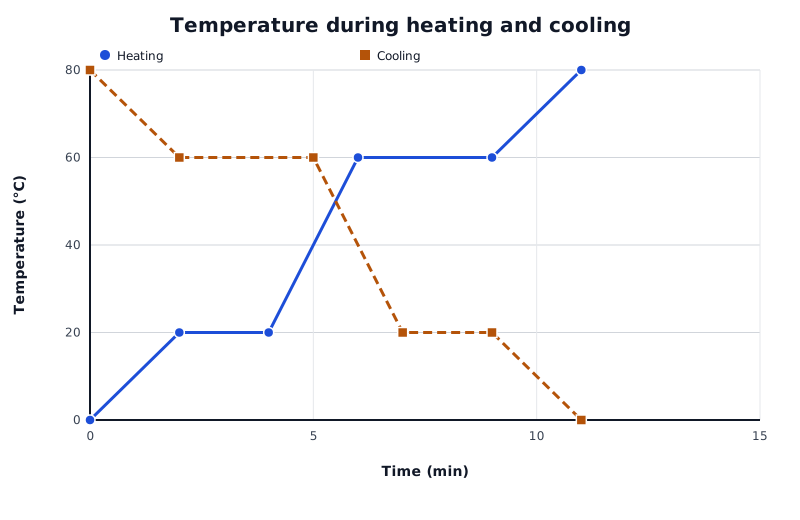
Example curves for a substance melting at 20 °C and boiling at 60 °C. Plateaus represent changes of state while energy continues to be transferred.
Data for Temperature during heating and cooling
| Series | Time (min) | Temperature (°C) |
|---|---|---|
| Heating | 0 | 0 |
| Heating | 2 | 20 |
| Heating | 4 | 20 |
| Heating | 6 | 60 |
| Heating | 9 | 60 |
| Heating | 11 | 80 |
| Cooling | 0 | 80 |
| Cooling | 2 | 60 |
| Cooling | 5 | 60 |
| Cooling | 7 | 20 |
| Cooling | 9 | 20 |
| Cooling | 11 | 0 |
Read the heating curve from left to right. The solid first warms to 20 °C. At the first plateau, solid and liquid coexist as it melts. Once all the solid has melted, the liquid warms to 60 °C. At the second plateau, liquid and gas coexist as it boils. Only after all the liquid has become gas can the gas’s temperature rise further.
On the cooling curve, the sequence is reversed. The gas cools, condenses at 60 °C, then the liquid cools and freezes at 20 °C. Falling sections show decreasing temperature; plateaus show energy being released during a change of state, not a pause in energy transfer.
If a heater transfers energy at a constant rate, a longer plateau means more energy is transferred during that change. Plateau duration alone cannot be used to compare energy transfers if the heating rates differ.
Latent heat is the energy transferred during a change of state without a temperature change. Specific latent heat is the energy required to change the state of one kilogram of a substance without changing its temperature.
The specific latent heat of fusion applies to solid–liquid changes. The specific latent heat of vaporisation applies to liquid–gas changes. Melting and vaporisation absorb energy; freezing and condensation release energy.
The equation is:
Here, is the energy transferred in joules (J), is the mass changing state in kilograms (kg), and is the specific latent heat in joules per kilogram (J/kg).
For example, suppose 200 g of ice is already at its melting point. Using a specific latent heat of fusion of 330 000 J/kg, first convert its mass to 0.200 kg. The energy needed to melt it is . This energy changes the ice into liquid water without raising its temperature. Freezing the same mass releases the same amount of energy.
To find a different unknown, rearrange the equation to or .
Specific latent heat and specific heat capacity describe different changes. Specific heat capacity concerns raising the temperature of one kilogram by 1 °C, with units J/kg °C. Specific latent heat concerns changing its state with no temperature change, with units J/kg.
On a flat section of a heating graph, energy is still being transferred: the temperature is constant because the substance is changing state.
Convert mass from grams to kilograms before using . Divide by 1000.
Choose the correct value of : fusion for melting or freezing, vaporisation for liquid–gas changes.
Explain mass conservation using unchanged particles, not unchanged volume. If vapour escapes from an open container, the mass left in the container decreases.
Use ‘forces between particles’ unless the substance is known to be molecular; not all substances consist of molecules.
It can see this note and what your specification asks for.
Answers are free with an account.
1 free note left this week
Get more free notesYour answer sets when this note comes back for review, or marks it complete.
Was this note helpful?
Log in to tell us whether it helped, or to report a problem.
Last updated
Physical change
A change in which no new substance is formed. A change of state is a physical change: reversing it restores the material’s original properties.
Chemical change
A change in which one or more new substances are formed.
Latent heat
The energy transferred when a substance changes state without changing temperature.
Specific latent heat
The energy required to change the state of one kilogram of a substance without changing its temperature, measured in J/kg.
Specific latent heat of fusion
The energy required to change one kilogram of a substance from solid to liquid without changing its temperature.
Specific latent heat of vaporisation
The energy required to change one kilogram of a substance from liquid to vapour without changing its temperature.
Sublimation
A change directly from solid to gas, without passing through the liquid state.
Put your knowledge into practice — try past paper questions for Combined Science: Synergy
Physical change
A change in which no new substance is formed. A change of state is a physical change: reversing it restores the material’s original properties.
Chemical change
A change in which one or more new substances are formed.
Latent heat
The energy transferred when a substance changes state without changing temperature.
Specific latent heat
The energy required to change the state of one kilogram of a substance without changing its temperature, measured in J/kg.
Specific latent heat of fusion
The energy required to change one kilogram of a substance from solid to liquid without changing its temperature.
Specific latent heat of vaporisation
The energy required to change one kilogram of a substance from liquid to vapour without changing its temperature.
Sublimation
A change directly from solid to gas, without passing through the liquid state.
: J; : kg; : J/kg.