Loading…


Loading…
Loading…
Loading…
AQA GCSE Combined Science Trilogy · 8464
AQA 8464 · 5.6.2.3 Check the specification (PDF) (opens in a new tab)
In a reversible reaction, the products can react to form the original reactants. The forward reaction makes products; the reverse reaction turns those products back into reactants. A reversible arrow, , shows these two directions.
For example, nitrogen and hydrogen react to form ammonia in the Haber process. Ammonia can also decompose to reform nitrogen and hydrogen:
Both reactions can take place in the same mixture. Whether the amount of ammonia increases or decreases depends on which reaction is faster.
A closed system prevents substances from entering or leaving. For a reversible reaction to reach equilibrium, the apparatus must prevent reactants and products from escaping.
Imagine nitrogen, hydrogen and ammonia inside a sealed reaction vessel. Any ammonia formed remains available for the reverse reaction. If it escaped instead, it would no longer be available to turn back into nitrogen and hydrogen. Keeping all the reacting substances together allows the two reactions to establish a balance.
Closed does not mean insulated: energy can still be transferred between the apparatus and its surroundings. The important restriction here is that substances cannot enter or leave.
Suppose the sealed vessel initially contains nitrogen and hydrogen, but no ammonia, and the reaction conditions are kept unchanged. The forward reaction begins, while the reverse reaction initially has no ammonia to use.
As nitrogen and hydrogen are used up, their concentrations fall and the forward reaction slows. Meanwhile, ammonia accumulates. More ammonia is available to decompose, so the reverse reaction speeds up.
Eventually, the forward and reverse reactions occur at exactly the same rate. This is equilibrium.
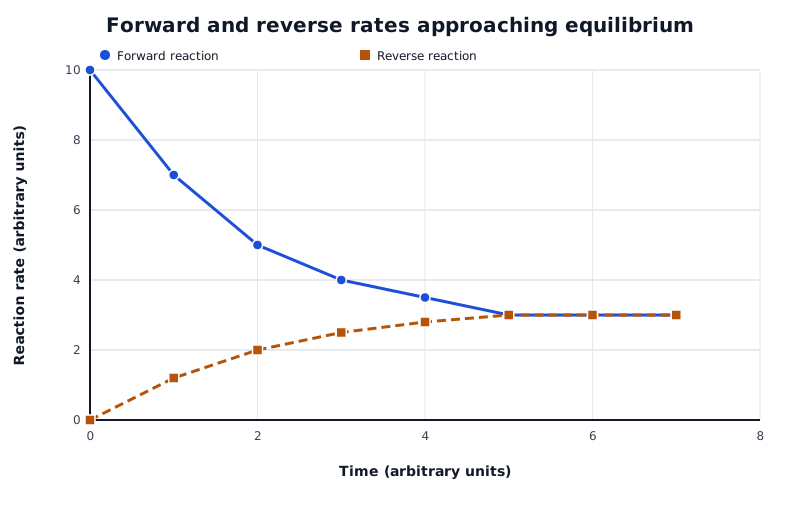
Rates for a reversible reaction starting with reactants only. Equilibrium is reached when the rates become equal and remain equal. Values are constructed, not experimental measurements.
Data for Forward and reverse rates approaching equilibrium
| Series | Time (arbitrary units) | Reaction rate (arbitrary units) |
|---|---|---|
| Forward reaction | 0 | 10 |
| Forward reaction | 1 | 7 |
| Forward reaction | 2 | 5 |
| Forward reaction | 3 | 4 |
| Forward reaction | 4 | 3.5 |
| Forward reaction | 5 | 3 |
| Forward reaction | 6 | 3 |
| Forward reaction | 7 | 3 |
| Reverse reaction | 0 | 0 |
| Reverse reaction | 1 | 1.2 |
| Reverse reaction | 2 | 2 |
| Reverse reaction | 3 | 2.5 |
| Reverse reaction | 4 | 2.8 |
| Reverse reaction | 5 | 3 |
| Reverse reaction | 6 | 3 |
| Reverse reaction | 7 | 3 |
On this graph, the forward rate falls while the reverse rate rises. Equilibrium begins where the two lines meet and then remain together at a non-zero rate. Their shared height shows that both reactions are still occurring.
Equilibrium is dynamic because chemical reactions continue in both directions. It is not a stopped reaction.
At equilibrium, ammonia is formed at the same rate as it is used up. Nitrogen and hydrogen are also reformed at the same rate as they are used up. There is therefore no overall change in the concentrations of reactants or products, provided the conditions remain unchanged.
The concentrations are constant, but they do not have to be equal to one another. A mixture can contain more reactants than products, or more products than reactants, and still be at equilibrium. It is the two reaction rates that must be equal.
Get unlimited access to all revision notes, key terms, and exam tips.
Starting with reactants only: the forward rate decreases and the reverse rate increases. At equilibrium, both rates are equal and non-zero.
Get unlimited access to all revision notes, key terms, and exam tips.
Define equilibrium using equal forward and reverse reaction rates, not equal amounts of reactants and products.
If asked why equilibrium is dynamic, explain that both reactions continue; they have not stopped.
Link the need for closed apparatus to preventing reactants and products from escaping.
Reversible reaction
A reaction in which products can react to form the original reactants, so the reaction can occur in both directions.
Forward reaction
The reaction that converts reactants into products, read from left to right in a chemical equation.
Reverse reaction
The reaction that converts products back into the original reactants, read from right to left in a chemical equation.
Dynamic equilibrium
A state in a closed system in which the forward and reverse reactions continue at exactly the same rate, so reactant and product concentrations remain constant.
Closed system
A system in which substances cannot enter or leave.
Concentration
The amount of a substance in a given volume of a mixture.
Put your knowledge into practice — try past paper questions for Combined Science Trilogy
Reversible reaction
A reaction in which products can react to form the original reactants, so the reaction can occur in both directions.
Forward reaction
The reaction that converts reactants into products, read from left to right in a chemical equation.
Reverse reaction
The reaction that converts products back into the original reactants, read from right to left in a chemical equation.
Dynamic equilibrium
A state in a closed system in which the forward and reverse reactions continue at exactly the same rate, so reactant and product concentrations remain constant.
Closed system
A system in which substances cannot enter or leave.
Concentration
The amount of a substance in a given volume of a mixture.