Loading…


Loading…
Loading…
Loading…
AQA GCSE Combined Science Trilogy · 8464
AQA 8464 · 4.6.2.4 Check the specification (PDF) (opens in a new tab)
An organism's genome is its complete genetic material. Within that DNA are genes: sections that carry instructions for making proteins. Proteins influence how cells work and help produce an organism's characteristics.
Genetic engineering involves modifying an organism's genome by introducing a gene from another organism to give a desired characteristic. The transferred gene supplies instructions that the recipient did not previously have. Genes can be cut out from the chromosomes of humans or other organisms and transferred into other cells, including cells of a different species.
This differs from selective breeding. Selective breeding chooses parents and breeds their offspring over generations; genetic engineering directly introduces a particular gene into the recipient's genetic material.
Crop plants modified in this way are called genetically modified (GM) crops. The purpose is often to improve food production. Plants have been genetically engineered to resist diseases or to produce bigger, better fruits. Other GM crops resist insect attack or particular herbicides.
These changes benefit farmers in different ways:
GM crops generally show increased yields, meaning more useful crop is harvested. This can provide more food and increase farmers' income. However, the benefit depends on the characteristic introduced and the conditions in which the crop is grown: the label ‘GM’ does not itself describe what a crop can do.
A crop grows within an ecosystem, rather than in isolation. Some people are concerned that a GM crop could interbreed with related wild plants, transferring its introduced gene into wild populations. For example, herbicide resistance in wild plants could make weeds more difficult to control.
The way a GM crop is managed can also matter. If herbicide-resistant crops encourage greater use of weedkillers, populations of wild flowers may decrease. Insects that depend on those plants for food or habitat may then be affected. There are also concerns that insect-resistant crops could harm non-target insects, not just the pests the modification was intended to control.
Some people feel that the effects of eating GM crops on human health have not been fully explored. This is a concern about the adequacy of the evidence, not a demonstration that all GM food is harmful. Different modifications need to be assessed on their own evidence.
There are economic and ethical objections too. GM seeds can cost more, making them less affordable for poorer farmers. Some people question whether it is right to modify the genetic material of living organisms. An ethical objection concerns what people judge to be right or wrong; it is different from a scientific question about the likelihood of harm.
A balanced judgement therefore weighs improved food production and reduced pest damage against possible ecological effects, costs and health concerns. It considers who benefits, who could be harmed, and how strong the evidence is.
Genetic engineering also has medical uses. Bacterial cells can be given the human gene that carries the instructions for making insulin. The modified bacteria then produce human insulin, which can be collected for use in treating people with diabetes.
The benefit comes from changing what the bacteria manufacture: they become a source of a useful human substance. The bacteria are not themselves the diabetes treatment, and producing insulin does not mean that a patient's own genome has been changed.
Some inherited disorders result from faulty genes. Modern medical research is exploring whether genetic modification can overcome these disorders. One approach is to introduce a working version of a gene into a patient's cells so that they can make the needed functional protein. This is an example of gene therapy.
The potential benefit is treatment of the underlying genetic problem rather than only its symptoms. It is not a guaranteed cure for every inherited disorder, however. Gene therapy can carry risks: harmful immune reactions and inflammation may occur, and some approaches have carried a risk of cancer. Improved techniques aim to reduce these dangers, but some effects may be difficult to predict.
Medical decisions must therefore weigh the likely improvement in a patient's health against the possibility and seriousness of side effects. This is a different risk assessment from judging the environmental effects of a GM crop.
The main steps of genetic engineering are:
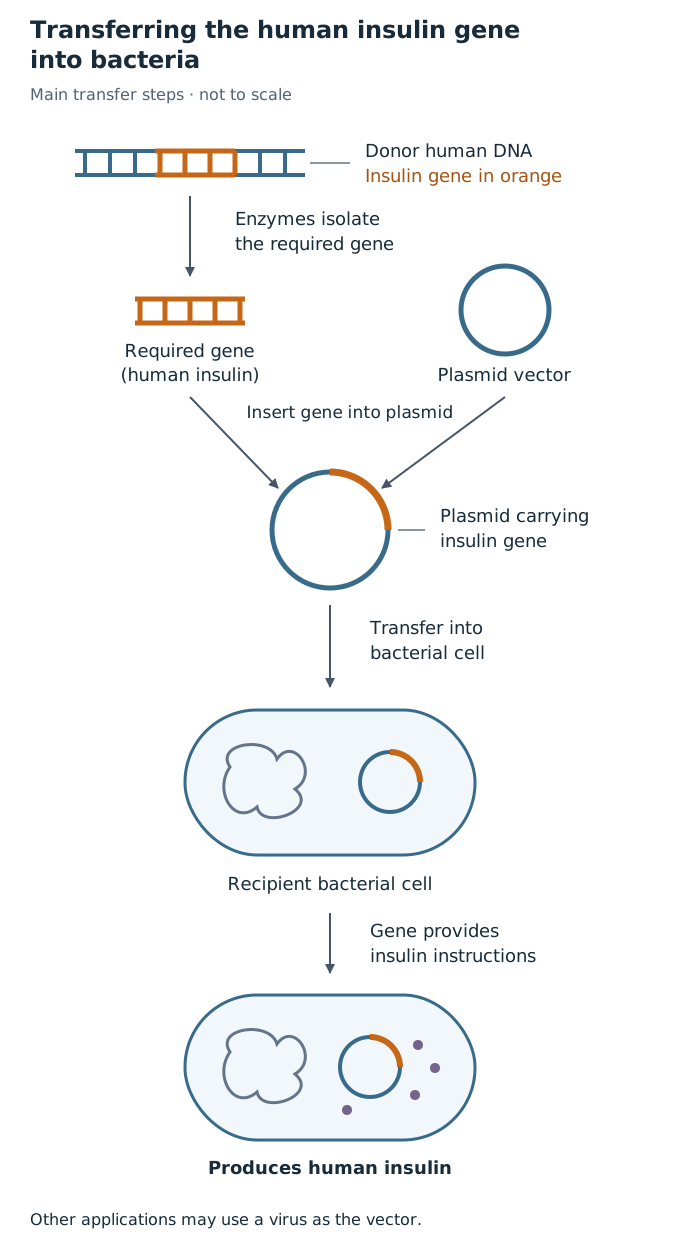
Higher Tier: a plasmid carries the human insulin gene into a bacterial cell, enabling the cell to produce human insulin.
The insulin example shows the connection between these steps and their purpose: the human insulin gene is carried into bacterial cells, allowing those cells to produce human insulin. A virus can be used as a vector in other applications; a plasmid is not the only possible carrier.
The early-development principle applies when producing organisms that develop with a desired characteristic. It does not mean that all medical gene therapy must be carried out in embryos: treatments can instead target particular cells in a patient.
Get unlimited access to all revision notes, key terms, and exam tips.
Genetic engineering: modify an organism's genome by introducing a gene from another organism to produce a desired characteristic.
Agriculture: more food, higher farmer income and potentially less insecticide use. Concerns include gene transfer to wild plants, effects on wild flowers and non-target insects, seed costs, and whether human health effects have been fully explored.
Medicine: useful substances and potential treatment of inherited disorders. Gene therapy can cause harmful immune reactions or other serious side effects, including a risk of cancer in some approaches.
Weigh benefits against risks and ethical objections; uncertainty does not prove harm.
Get unlimited access to all revision notes, key terms, and exam tips.
Define genetic engineering using all three ideas: modifying the genome, introducing a gene from another organism, and producing a desired characteristic.
Distinguish herbicides, which kill unwanted plants, from insecticides, which kill insects. Herbicide resistance does not mean insect resistance.
In evaluation answers, link each benefit or risk to a consequence, then weigh the evidence. A concern about possible harm is not proof that harm occurs.
Keep medical examples distinct: GM bacteria produce insulin to treat diabetes; gene therapy aims to overcome an inherited disorder by modifying a patient's cells.
Higher Tier: include enzymes, a vector such as a plasmid or virus, transfer into the required cells, and transfer at an early developmental stage.
Genome
The complete genetic material of an organism.
Gene
A section of DNA that carries instructions for making a protein.
Genetic engineering
Modification of an organism's genome by introducing a gene from another organism to give a desired characteristic.
Genetically modified (GM) crop
A crop plant whose genome has been modified by introducing a gene from another organism.
Yield
The amount of useful crop harvested, often measured per unit area of farmland.
Vector
A carrier, usually a bacterial plasmid or a virus, used to transfer a gene into a target cell in genetic engineering.
Plasmid
A small circular piece of DNA found in bacterial cells, separate from their main chromosome; it can be used as a vector.
Gene therapy
A medical approach that modifies a patient's genetic material to treat a disorder, for example by introducing a working version of a faulty gene.
Put your knowledge into practice — try past paper questions for Combined Science Trilogy
Genome
The complete genetic material of an organism.
Gene
A section of DNA that carries instructions for making a protein.
Genetic engineering
Modification of an organism's genome by introducing a gene from another organism to give a desired characteristic.
Genetically modified (GM) crop
A crop plant whose genome has been modified by introducing a gene from another organism.
Yield
The amount of useful crop harvested, often measured per unit area of farmland.
Vector
A carrier, usually a bacterial plasmid or a virus, used to transfer a gene into a target cell in genetic engineering.
Plasmid
A small circular piece of DNA found in bacterial cells, separate from their main chromosome; it can be used as a vector.
Gene therapy
A medical approach that modifies a patient's genetic material to treat a disorder, for example by introducing a working version of a faulty gene.