Loading…


Loading…
Loading…
Loading…
AQA GCSE Combined Science Trilogy · 8464
AQA 8464 Check the specification (PDF) (opens in a new tab)
Classification means organising living organisms into groups. It allows biologists to describe the enormous variety of life in an ordered way and compare organisms with shared features.
Carl Linnaeus developed a classification system based on organisms’ structures and characteristics. Traditionally, scientists compared features such as overall shape, wings and legs, as well as internal anatomy revealed by dissection. Organisms with similar combinations of features were placed together.
The Linnaean system is a hierarchy: smaller, more specific groups sit within larger groups. Its seven levels, from broadest to most specific, are:
Kingdom → phylum → class → order → family → genus → species
A kingdom contains many different organisms. Moving down the hierarchy narrows the group, so its members have more characteristics in common. Species is the smallest group in this system, and organisms within a species share the most features.
Humans provide a concrete example:
| Classification level | Human classification |
|---|---|
| Kingdom | Animalia |
| Phylum | Chordata |
| Class | Mammalia |
| Order | Primates |
| Family | Hominidae |
| Genus | Homo |
| Species | Homo sapiens |
These are not seven separate groups that humans must choose between. Humans belong to all seven: the species sits within the genus, which sits within the family, and so on. For example, Mammalia is a narrower group within Animalia.
When using classification information, compare the levels organisms share. Two organisms in the same genus also share the broader groups above it, but they need not belong to the same species.
The binomial naming system gives each species a two-part scientific name. The first word is the genus; the second identifies the species within that genus. Together, the two words identify the species.
For humans, the name is Homo sapiens: Homo is the genus and sapiens is the species-identifying word. The second word alone is not the complete scientific name. This naming system provides a consistent way to identify organisms, rather than relying on common names that may vary between places or languages.
Classification depends on the evidence available. Early scientists could compare visible features and dissected body structures, but later developments allowed much more detailed comparisons.
Improved microscopes revealed internal structures that had previously been difficult or impossible to see. Scientists could therefore identify similarities and differences that were hidden when organisms were compared only by their outward appearance.
A better understanding of biochemical processes—the chemical reactions occurring in organisms—provided further evidence. Chemical analysis allowed scientists to compare organisms at a molecular level, leading to new classification models.
DNA sequence comparisons are another important form of evidence. A DNA base sequence is the order of bases along DNA. In general, greater similarity between comparable DNA sequences indicates a closer evolutionary relationship and a more recent common ancestor. Classification can therefore reflect evolutionary relationships, rather than just visible resemblance.
Chemical evidence led Carl Woese to develop the three-domain system, proposed in 1990. Domains are larger groups than kingdoms. The three domains are:
The important change was recognising Archaea and Bacteria as distinct groups on the basis of chemical evidence. Domains are then subdivided into smaller classification groups, including kingdom, phylum, class, order, family, genus and species.
An evolutionary tree is a branching diagram showing how scientists believe organisms are related. Branching points represent shared ancestors and the separation of evolutionary lineages as new species evolve. The ends of branches identify the organisms being compared.
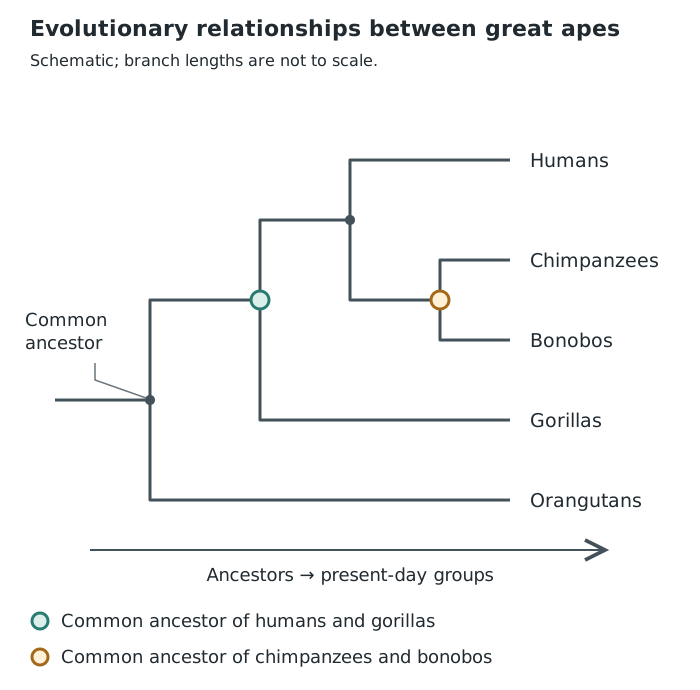
Trace branches backwards to find a shared ancestor. A more recent shared ancestor indicates a closer relationship; this diagram has no numerical time scale.
To compare two species, follow their branches backwards until they meet. This meeting point represents their most recent common ancestor. Species sharing a more recent common ancestor are more closely related.
Chimpanzees and bonobos share a recent common ancestor, so they are more closely related to each other than either is to the other great apes shown. Humans share a more recent common ancestor with gorillas than with orangutans, so humans are more closely related to gorillas than to orangutans. All five groups share an older common ancestor.
Scientists construct evolutionary trees using current classification data for living organisms, including structural similarities and DNA comparisons, alongside fossil data for extinct organisms. Trees represent interpretations of this evidence: new discoveries can change scientists’ understanding of the relationships.
Get unlimited access to all revision notes, key terms, and exam tips.
Based traditionally on shared structures and characteristics:
Kingdom → phylum → class → order → family → genus → species
Moving towards species gives smaller, more specific groups with more shared features.
Binomial name: genus + species-identifying word, for example Homo sapiens.
Carl Woese’s system was based on chemical evidence:
Domain sits above kingdom.
Get unlimited access to all revision notes, key terms, and exam tips.
Learn the hierarchy in order: kingdom, phylum, class, order, family, genus, species. ‘King Philip Came Over For Gran’s Spaghetti’ is one possible mnemonic.
In a binomial name, capitalise the genus but not the second word: Homo sapiens. Write both words in italics when typing, or underline each word separately when handwriting.
When comparing species on an evolutionary tree, trace their branches back to their most recent shared branching point. Do not judge relatedness simply by how close their names are on the page.
Explain changes in classification by linking new evidence to revised groupings: improved microscopes revealed internal structures, while biochemical analysis revealed previously unrecognised differences.
Classification
The organisation of living organisms into groups using shared characteristics.
Linnaean classification
A system developed by Carl Linnaeus that groups organisms into kingdom, phylum, class, order, family, genus and species.
Genus
A classification group containing closely related species; its name forms the first word of an organism’s binomial name.
Species
The smallest group in the Linnaean hierarchy, whose organisms share the most characteristics.
Binomial naming system
A system giving each species a two-part scientific name consisting of its genus name followed by a species-identifying word.
Domain
A broad classification group above kingdom. The three domains are Archaea, Bacteria and Eukaryota.
Evolutionary tree
A branching diagram showing scientists’ understanding of evolutionary relationships between organisms.
Common ancestor
An ancestral organism or population from which two or more groups evolved.
Speciation
The evolution of a new species.
Put your knowledge into practice — try past paper questions for Combined Science Trilogy
Classification
The organisation of living organisms into groups using shared characteristics.
Linnaean classification
A system developed by Carl Linnaeus that groups organisms into kingdom, phylum, class, order, family, genus and species.
Genus
A classification group containing closely related species; its name forms the first word of an organism’s binomial name.
Species
The smallest group in the Linnaean hierarchy, whose organisms share the most characteristics.
Binomial naming system
A system giving each species a two-part scientific name consisting of its genus name followed by a species-identifying word.
Domain
A broad classification group above kingdom. The three domains are Archaea, Bacteria and Eukaryota.
Evolutionary tree
A branching diagram showing scientists’ understanding of evolutionary relationships between organisms.
Common ancestor
An ancestral organism or population from which two or more groups evolved.
Speciation
The evolution of a new species.