Loading…


Loading…
Loading…
Loading…
AQA GCSE Combined Science Trilogy · 8464
AQA 8464 · 6.5.4.1.5 Acceleration Check the specification (PDF) (opens in a new tab)
When an object is released, the Earth's gravitational pull acts downwards on it. This force is called its weight. If gravity is the only force acting, the object is in free fall.
Near the Earth's surface, a freely falling object has a downward acceleration of approximately 9.8 m/s². Acceleration describes how quickly velocity changes: this value means that the object's downward velocity increases by about 9.8 m/s each second. An object released from rest would therefore be travelling downwards at about 9.8 m/s after one second and 19.6 m/s after two seconds, provided air resistance is negligible.
Without air resistance, all objects have this same acceleration, regardless of their mass. A heavier object does not accelerate faster simply because it has a greater weight.
A fluid is a substance that can flow: both liquids and gases are fluids. An object falling through a fluid experiences resistance to its motion, called drag. In air, this is usually called air resistance.
Consider a skydiver beginning to fall. Weight acts downwards, while air resistance acts upwards, opposing the downward motion. The weight remains approximately constant during the fall, but air resistance increases as the skydiver speeds up.
The resultant force is the overall force after the forces have been combined. When weight is greater than air resistance, the resultant force is downwards, so the skydiver accelerates downwards.
The fall can be understood in three stages:
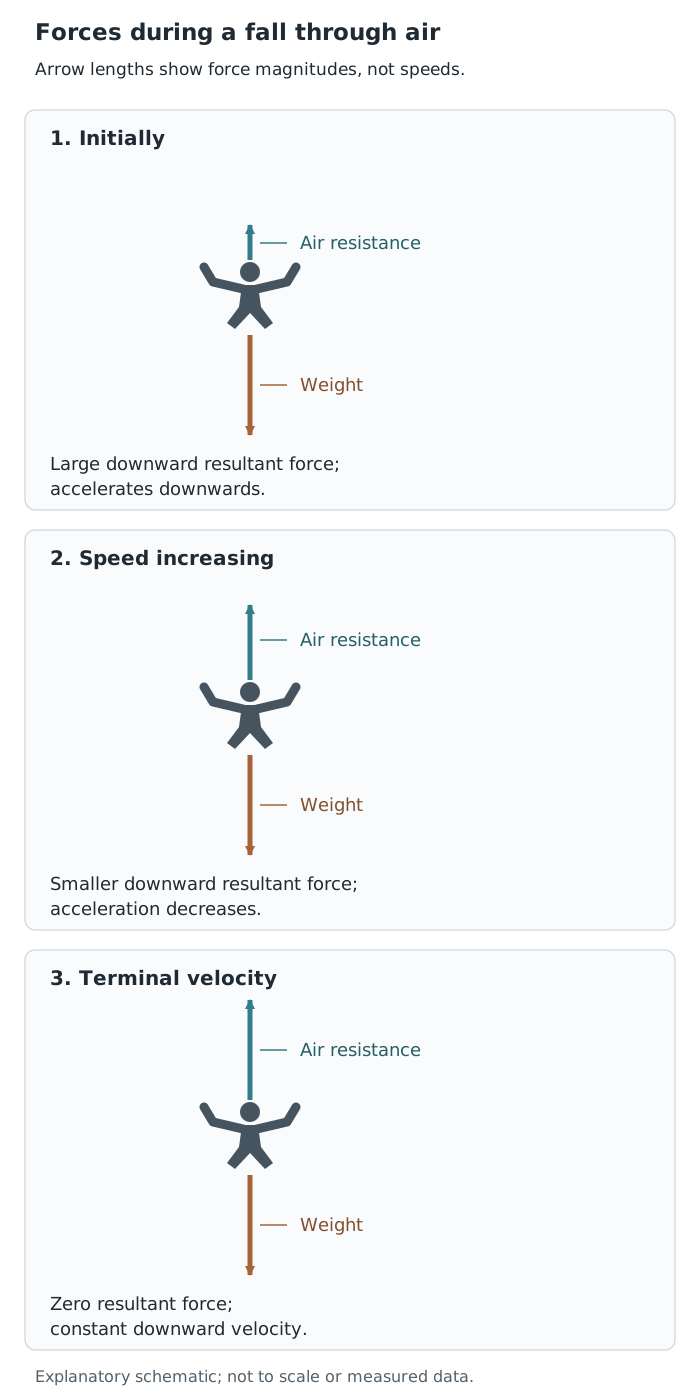
As a falling object speeds up, air resistance increases until it balances weight. The object then falls at terminal velocity.
At terminal velocity, neither force has disappeared: weight still pulls downwards and air resistance still acts upwards. Their effects balance. This explains why the skydiver continues moving rather than stopping.
The same sequence applies to an object falling through a liquid: it initially accelerates, resistance increases as it speeds up, and it eventually reaches terminal velocity when the resultant force becomes zero.
Get unlimited access to all revision notes, key terms, and exam tips.
Weight stays approximately constant; resistance changes with speed.
Get unlimited access to all revision notes, key terms, and exam tips.
Name the downward force as weight and the upward force in air as air resistance, not air pressure.
Explain terminal velocity in a chain: resistance equals weight → zero resultant force → zero acceleration → constant velocity.
Zero resultant force does not mean zero velocity. The object continues falling.
Use 9.8 m/s² for free fall near the Earth's surface, where air resistance is absent or negligible.
Free fall
Motion in which gravity is the only force acting on an object.
Acceleration
The rate of change of velocity, measured in metres per second squared (m/s²).
Weight
The force acting on an object due to gravity.
Fluid
A substance that can flow, such as a liquid or a gas.
Drag
A resistive force that opposes an object's motion through a fluid. Air resistance is drag acting in air.
Resultant force
The single force that has the same effect as all the forces acting on an object combined.
Terminal velocity
The constant velocity reached by a falling object when the forces balance and its acceleration becomes zero.
Put your knowledge into practice — try past paper questions for Combined Science Trilogy
Free fall
Motion in which gravity is the only force acting on an object.
Acceleration
The rate of change of velocity, measured in metres per second squared (m/s²).
Weight
The force acting on an object due to gravity.
Fluid
A substance that can flow, such as a liquid or a gas.
Drag
A resistive force that opposes an object's motion through a fluid. Air resistance is drag acting in air.
Resultant force
The single force that has the same effect as all the forces acting on an object combined.
Terminal velocity
The constant velocity reached by a falling object when the forces balance and its acceleration becomes zero.