

Loading…
Loading…
Loading…
AQA GCSE Citizenship Studies · 8100
AQA 8100 · How We Deal With Those Who Commit Crime Check the specification (PDF) (opens in a new tab)
The youth justice system responds to offending by children. Its operation differs across the UK; the youth courts and organisations described here operate in England and Wales, where children aged 10–17 can be arrested and face criminal proceedings.
Children are still developing and may need help to understand legal proceedings. Some also have complex needs that contribute to their offending. The system therefore aims to prevent offending and reoffending through rehabilitation: helping a child change their behaviour and build a crime-free life. It must also protect the public and deliver justice for victims.
The guiding approach is ‘child first’. This means recognising a child's needs, rights, strengths and potential, rather than defining them only by an offence. It does not mean ignoring the offence or removing responsibility. Support and supervision are intended to help children meet their responsibilities and reduce future harm.
Not every child who comes into contact with the police goes to court. Where appropriate, agencies seek diversion: dealing with behaviour through suitable support or less formal responses instead of taking the child further into the justice system. This can address problems early and reduce the damaging effects of being labelled an offender.
The police and local Youth Offending Team work together on out-of-court responses. These can include a youth caution, rather than a court prosecution, where the relevant conditions are met. A caution is not a sentence handed down by a youth court.
Children detained or questioned by police also need safeguards. An appropriate adult, such as a parent or another suitable adult, helps safeguard their interests during the police process.
Where a case proceeds to court, most children appear in a youth court. A serious offence such as murder starts in the youth court but is passed to the Crown Court.
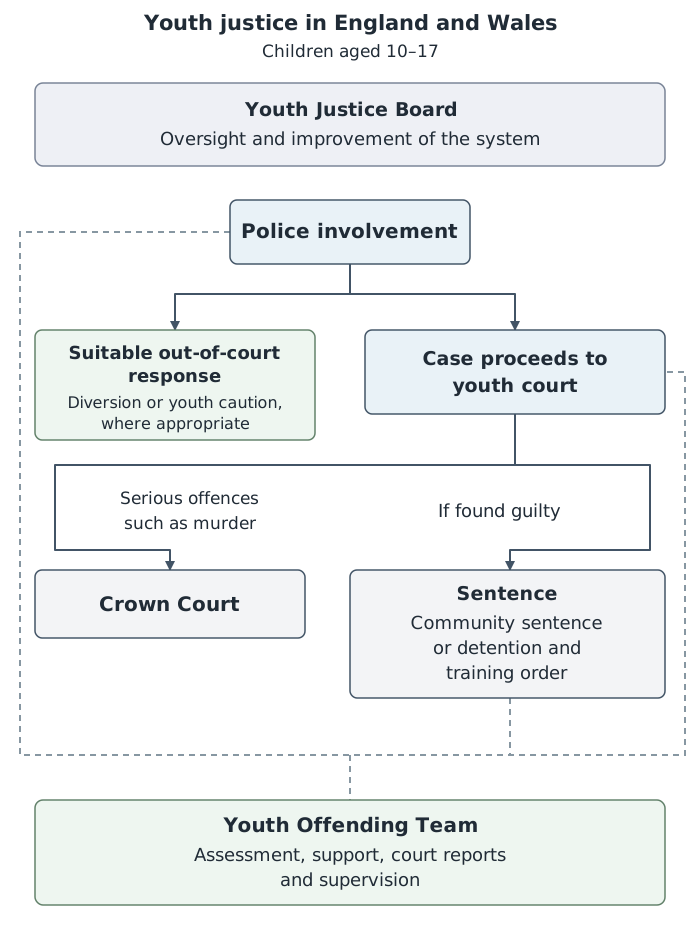
Children can receive an appropriate out-of-court response or face court proceedings. Local support continues across different stages.
A youth court is a special type of magistrates’ court for people aged 10–17. The case is heard by either three magistrates or one district judge, with no jury. It deals with offences such as theft, burglary and drug offences.
Evidence is considered through court procedures, but the hearing is less formal than an adult court. Children are called by their first names and may sit with a parent, carer or another supporting adult. These arrangements help them understand what is happening and participate in their case.
A parent or guardian must attend if the child is under 16. For a 16- or 17-year-old, attendance is compulsory if the court orders it.
Members of the public are not normally allowed into a youth court without permission. Reporting restrictions also usually prevent publication of information identifying the child, such as their name, address or school. These protections reduce public exposure and support the child's chances of rehabilitation, although they are not absolute guarantees of anonymity.
If a child is found guilty, the court can impose a community sentence. The child remains in the community while meeting the requirements of the court order under supervision. Support should address their individual needs and help them stop offending, while also protecting the public.
A court can also impose a detention and training order, involving secure accommodation for young people. The response combines detention with training intended to support rehabilitation. Youth justice is therefore not simply a choice between punishment and help: a sentence can impose consequences while also working towards a crime-free future.
Youth Offending Teams (YOTs) work directly with children who get into trouble with the police, face court proceedings or receive sentences. They assess each child's needs and risks, involve the child and their parents or carers in planning support, and prepare reports to help courts make informed decisions. They also explain court outcomes and supervise community orders.
For example, a court report can identify barriers to a child's progress and recommend suitable support and supervision. This connects the court's decision to a practical plan for preventing further offending rather than treating sentencing as the end of the process.
The Youth Justice Board (YJB) oversees the system rather than deciding individual court cases. It monitors standards, supports improvements in local services and influences policy and practice. Fair treatment is part of this work, including addressing racial disparities and ensuring that children's different needs are recognised.
Explain differences from adult justice and why they matter: less formal hearings and adult support help children understand and participate.
Distinguish a police caution, dealt with outside court, from a sentence imposed by a court.
Do not confuse local Youth Offending Teams, which work directly with children, with the Youth Justice Board, which oversees the system.
Qualify your claims: identity is usually protected, and serious offences such as murder are dealt with in the Crown Court.
It can see this note and what your specification asks for.
Answers are free with an account.
1 free note left this week
Get more free notesYour answer sets when this note comes back for review, or marks it complete.
Was this note helpful?
Log in to tell us whether it helped, or to report a problem.
Last updated
Youth justice system
The arrangements for responding to offending by children, including prevention, support, court proceedings and supervision of sentences.
Rehabilitation
Support and interventions that help someone stop offending and build a crime-free life.
Diversion
Responding to a child's behaviour through suitable support or less formal measures rather than taking them further into the criminal justice system.
Youth court
A special type of magistrates’ court in England and Wales dealing with people aged 10–17.
Youth Offending Team
A local team that assesses and supports children involved with the law, advises courts and supervises young people serving sentences.
Youth Justice Board
The public body responsible for overseeing the youth justice system in England and Wales and supporting improvements in its services.
Detention and training order
A court sentence involving detention in secure accommodation for young people and training intended to help prevent further offending.
Put your knowledge into practice — try past paper questions for Citizenship Studies
Youth justice system
The arrangements for responding to offending by children, including prevention, support, court proceedings and supervision of sentences.
Rehabilitation
Support and interventions that help someone stop offending and build a crime-free life.
Diversion
Responding to a child's behaviour through suitable support or less formal measures rather than taking them further into the criminal justice system.
Youth court
A special type of magistrates’ court in England and Wales dealing with people aged 10–17.
Youth Offending Team
A local team that assesses and supports children involved with the law, advises courts and supervises young people serving sentences.
Youth Justice Board
The public body responsible for overseeing the youth justice system in England and Wales and supporting improvements in its services.
Detention and training order
A court sentence involving detention in secure accommodation for young people and training intended to help prevent further offending.