

Loading…
Loading…
Loading…
OCR GCSE Psychology · J203
OCR J203 · Freudian Theory of Dreaming Check the specification (PDF) (opens in a new tab)
Sigmund Freud, the Austrian founder of psychoanalysis, proposed that dreams express wishes we cannot openly acknowledge when awake. Psychoanalysis seeks to understand the influence of unconscious thoughts and conflicts. For Freud, a dream was therefore more than a strange story: analysing it could offer insight into a person’s hidden desires.
Freud compared the mind to an iceberg. The conscious mind is like the visible tip: it contains thoughts and feelings we are currently aware of. The preconscious mind contains information we are not thinking about now but can easily bring to awareness, such as a familiar person’s name. The unconscious mind lies beneath awareness and is normally inaccessible. Freud believed it contains unacceptable wishes, disturbing memories and feelings that nevertheless influence us.
This is a psychological model of the mind, not a description of three physical compartments in the brain.
Freud proposed three interacting parts of personality. The id produces primitive urges and seeks satisfaction. The superego represents moral standards and tries to control unacceptable urges. The ego deals with reality, managing these competing demands.
An urge can create conflict if satisfying it would be socially unacceptable or distressing. According to Freud, the ego uses repression to keep such thoughts and desires out of conscious awareness. Repression is unconscious: the person does not deliberately decide to hide the thought.
Repression does not make the desire disappear. Freud argued that it remains active in the unconscious. For example, unacceptable anger towards someone close to us could remain influential even though we are not consciously aware of it.
Freud believed that the ego weakens during sleep, allowing unconscious wishes to seek expression. Dreams provide an outlet through wish fulfilment: an unconscious desire is satisfied within the dream rather than acted on in waking life.
However, directly experiencing a disturbing wish could cause anxiety and wake the sleeper. Freud proposed that the ego carries out dream work, disguising the wish through symbols. The dream can then express the desire in a less disturbing form. In this explanation, dreaming both satisfies unconscious wishes and helps protect sleep.
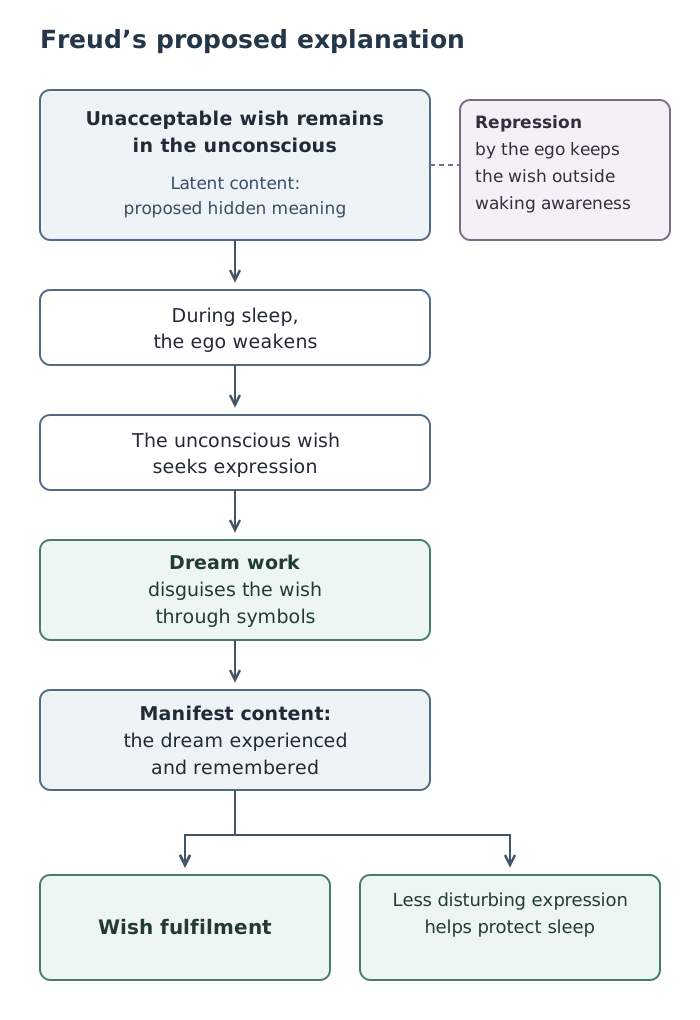
Freud proposed that dream work disguises an unconscious wish, allowing wish fulfilment without its full disturbing meaning becoming apparent.
The important connection is that repression keeps a wish outside waking awareness, while dream work disguises its expression during sleep. These are related processes, but they do different jobs.
Freud distinguished two levels of dream content:
Suppose someone who feels unable to express anger towards a relative dreams of arguing with them. The remembered argument is the manifest content. A psychoanalytic interpretation might identify a wish to express otherwise unacceptable anger as the latent content. In a more disguised dream, the people or events could symbolically represent that conflict rather than show it directly.
This distinction explains the purpose of dream analysis. Freud tried to work backwards from the remembered dream to its underlying meaning. Identifying what happened in a dream is not the same as establishing why the person dreamed it.
Freud used his dream analysis of the Wolfman (1918) as support for his theory. He interpreted the patient’s dream as expressing disturbing unconscious material linked to repressed childhood experiences. The case connected his ideas about repression with the distinction between manifest and latent content.
However, the interpretation itself is a central weakness. Dream analysis is subjective: it depends on the analyst’s judgement. Two analysts could assign different hidden meanings to the same dream, and there is no reliable independent way to establish which interpretation is correct. This makes Freud’s explanation difficult to test scientifically.
There is also a risk of interpreting dreams to fit an existing theory. If an analyst already expects a dream to express a repressed wish, they may select a meaning that confirms that expectation. Freud’s own interpretations therefore cannot, by themselves, provide strong independent confirmation of his theory.
Finally, a dream need not have a hidden symbolic meaning. It could reflect ordinary concerns or recent experiences without disguising an unacceptable desire. Freud offered a connected explanation of why dreams might occur and what they might mean, but an interpretation that sounds plausible is not necessarily evidence that the proposed unconscious wish exists.
Judgement: the theory connects repression, wishes and dreaming, but subjective interpretation limits the strength of its evidence.
Distinguish repression from deliberately trying not to think about something: Freud proposed an unconscious defence mechanism.
Keep manifest and latent content separate: manifest is the remembered dream; latent is its proposed hidden meaning.
Explain why subjectivity is a weakness: different interpretations of the same dream make it difficult to establish which, if any, is correct.
Describe unconscious wishes and dream symbolism as Freud’s proposals, not as established facts about every dream.
It can see this note and what your specification asks for.
Answers are free with an account.
1 free note left this week
Get more free notesYour answer sets when this note comes back for review, or marks it complete.
Was this note helpful?
Log in to tell us whether it helped, or to report a problem.
Last updated
Conscious mind
The part of the mind containing thoughts and feelings a person is currently aware of.
Preconscious mind
The part of the mind containing information outside current awareness that can readily be brought into consciousness.
Unconscious mind
In Freud’s theory, the part of the mind containing thoughts, memories and desires that are normally inaccessible to conscious awareness but can influence behaviour.
Repression
An unconscious defence mechanism that keeps threatening or unacceptable thoughts, feelings and desires out of conscious awareness.
Wish fulfilment
In Freud’s theory of dreaming, the satisfaction of an unconscious desire through a dream.
Dream work
In Freud’s theory, the process that disguises the hidden meaning of a dream through symbols, making its content less disturbing.
Manifest content
The images, events and storyline of a dream that the dreamer experiences and remembers.
Latent content
The hidden meaning of a dream, which Freud believed expressed unconscious wishes.
Subjectivity
The influence of personal opinions and interpretations on a judgement, rather than a conclusion established independently of the person making it.
Put your knowledge into practice — try past paper questions for Psychology
Conscious mind
The part of the mind containing thoughts and feelings a person is currently aware of.
Preconscious mind
The part of the mind containing information outside current awareness that can readily be brought into consciousness.
Unconscious mind
In Freud’s theory, the part of the mind containing thoughts, memories and desires that are normally inaccessible to conscious awareness but can influence behaviour.
Repression
An unconscious defence mechanism that keeps threatening or unacceptable thoughts, feelings and desires out of conscious awareness.
Wish fulfilment
In Freud’s theory of dreaming, the satisfaction of an unconscious desire through a dream.
Dream work
In Freud’s theory, the process that disguises the hidden meaning of a dream through symbols, making its content less disturbing.
Manifest content
The images, events and storyline of a dream that the dreamer experiences and remembers.
Latent content
The hidden meaning of a dream, which Freud believed expressed unconscious wishes.
Subjectivity
The influence of personal opinions and interpretations on a judgement, rather than a conclusion established independently of the person making it.