

Loading…
Loading…
Loading…
OCR GCSE Psychology · J203
OCR J203 · Activation Synthesis Theory of Dreaming Check the specification (PDF) (opens in a new tab)
Hobson and McCarley proposed the Activation Synthesis Theory of Dreaming in 1977. It offers a biological explanation: dreams begin with activity inside the sleeping brain, rather than with a hidden wish that needs to be disguised, as Freud proposed.
The name describes two connected processes. Activation produces random neural signals. Synthesis occurs when the brain interprets those signals and puts them together into a dream. The starting signals are random, but the brain still tries to turn them into an experience that makes sense.
REM sleep means rapid eye movement sleep. During this stage, the eyes move rapidly and the brain is highly active. REM sleep is associated with brain restoration, while most voluntary muscles are temporarily paralysed. A sleeper can therefore experience movement in a dream without normally carrying out those movements.
The theory focuses on the brain activity occurring during REM sleep. Information from the outside world does not reach the areas that normally interpret sensory information in the usual way. However, those areas still receive internally generated signals. This helps explain why a dream can feel like a real experience even though the person is asleep and is not seeing the dream's events in the outside world.
A neuron is a nerve cell that communicates information. According to the theory, neuronal activity increases during REM sleep in the pons, an area of the brainstem. This generates random electrical signals that travel to higher areas of the brain.
These signals activate different brain regions, including areas involved in images, memories and emotions. They are not a deliberately organised message. This gives the brain a mixture of stimulation to interpret, rather than a coherent sequence of events arriving through the senses.
The cerebral cortex is the outer layer of the cerebrum. It normally helps interpret information received through the senses. During dreaming, it treats internally generated stimulation as though it were real sensory information.
The cortex draws on stored memories to organise and interpret the signals. This process is synthesis: making an experience out of the random activation. Because the starting signals activate different areas without an orderly pattern, the resulting dream may contain strange combinations, sudden changes or events that would be impossible when awake.
For example, suppose someone dreams of being in their classroom, but the classroom suddenly becomes a beach. In this explanation, the cortex is combining activated memories into an experience, rather than reporting an actual change in the environment.
The limbic system is a group of brain structures involved in emotion. Its activation during REM sleep helps explain why dreams can be frightening, exciting or otherwise emotionally intense.
The brain regions therefore have different roles. The pons generates random signals; the cerebral cortex interprets them; activation of the limbic system contributes emotional content. A dream can consequently be both bizarre in its events and convincing in the feelings it produces.
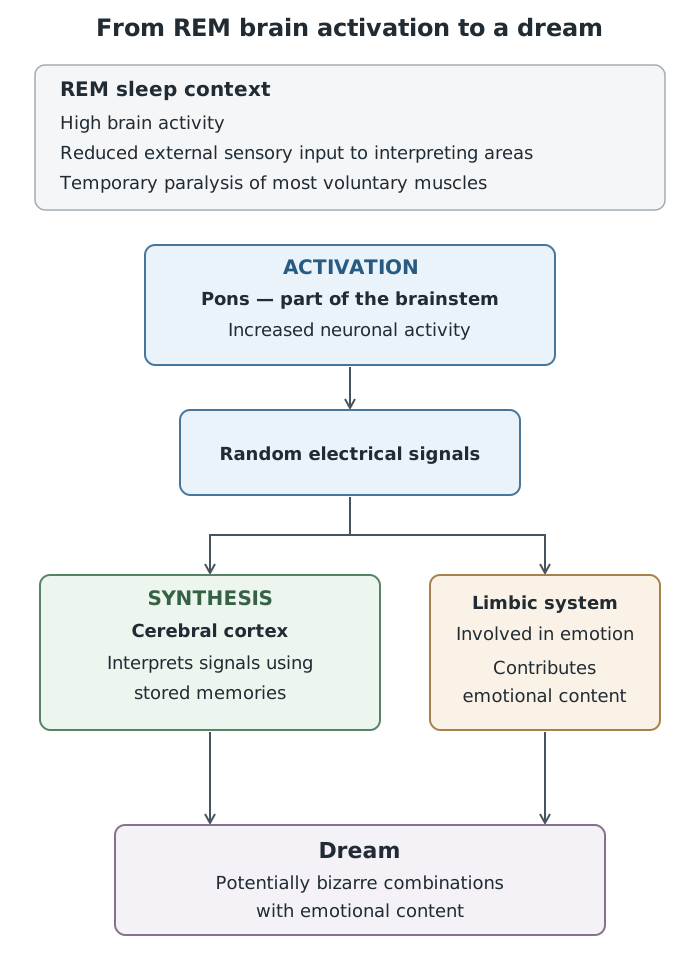
Activation generates random signals; synthesis organises them into a dream. Limbic-system activation contributes emotion.
A strength is that the theory connects dreaming to identifiable brain processes. It explains why dreams can contain unusual combinations of experiences and strong emotions without assuming that every detail has a hidden symbolic meaning. Williams et al. (1992) found that REM dreams contained more bizarreness and other dream-like features than waking fantasies. This is consistent with the theory, although bizarreness alone does not prove that random activation causes dreams.
A central criticism is reductionism. Reductionism explains complex behaviour through simpler constituent parts. Activation Synthesis Theory reduces dreaming largely to neural signals and the cortex's interpretation of them. This is useful for explaining a mechanism, but it may be too limited to explain the whole experience of dreaming.
Dreams can seem meaningful to the dreamer and relate to their experiences, worries or memories. Critics argue that treating dreams mainly as the outcome of random activation gives insufficient attention to this personal significance. The theory also explains where dreams come from more clearly than it explains whether dreams serve a purpose. Explaining how something is produced is not the same as explaining what it is for.
A holistic explanation would consider the whole person, including their emotions, experiences and current circumstances, alongside brain activity. It could therefore give a fuller account of why a particular dream matters to an individual. However, the biological explanation does already include stored memories and emotions: it does not claim that these play no role.
A justified conclusion is that Activation Synthesis Theory provides a useful explanation of the processes producing dreams, especially their bizarre and emotional qualities, but may not provide a complete explanation of their meaning or purpose.
Hobson and McCarley, 1977: dreams arise from the brain making sense of random neural activity, rather than disguising hidden wishes.
Distinguish activation in the pons from synthesis by the cerebral cortex: random signals are generated, then interpreted.
Link the limbic system to the emotional content of dreams, not to the process of synthesis.
Develop the reductionism criticism: explain what the theory reduces dreaming to, what it overlooks and why this limits the explanation.
Describe the theory as an explanation of how dreams arise; this is different from explaining what purpose dreams serve.
It can see this note and what your specification asks for.
Answers are free with an account.
1 free note left this week
Get more free notesYour answer sets when this note comes back for review, or marks it complete.
Was this note helpful?
Log in to tell us whether it helped, or to report a problem.
Last updated
Activation Synthesis Theory
A biological explanation proposed by Hobson and McCarley in which dreams arise when the cerebral cortex tries to make sense of random neural activity during sleep.
REM sleep
Rapid eye movement sleep: a stage of sleep involving rapid eye movements, high brain activity and temporary paralysis of most voluntary muscles.
Neuron
A nerve cell that communicates information through electrical and chemical signals.
Pons
An area of the brainstem where increased neuronal activity generates random signals during REM sleep, according to Activation Synthesis Theory.
Cerebral cortex
The outer layer of the cerebrum, which interprets information and, in Activation Synthesis Theory, organises internally generated signals into a dream.
Limbic system
A group of interconnected brain structures involved in emotion; its activation helps explain the emotional content of dreams.
Activation
The increased neural activity that generates random signals during sleep in Activation Synthesis Theory.
Synthesis
The cerebral cortex's process of interpreting and organising random neural signals, using stored memories to form a dream.
Reductionism
Explaining a complex behaviour by breaking it down into simpler constituent parts, such as neural activity.
Holism
Explaining behaviour by considering the whole person and the wider context rather than only separate constituent parts.
Put your knowledge into practice — try past paper questions for Psychology
Activation Synthesis Theory
A biological explanation proposed by Hobson and McCarley in which dreams arise when the cerebral cortex tries to make sense of random neural activity during sleep.
REM sleep
Rapid eye movement sleep: a stage of sleep involving rapid eye movements, high brain activity and temporary paralysis of most voluntary muscles.
Neuron
A nerve cell that communicates information through electrical and chemical signals.
Pons
An area of the brainstem where increased neuronal activity generates random signals during REM sleep, according to Activation Synthesis Theory.
Cerebral cortex
The outer layer of the cerebrum, which interprets information and, in Activation Synthesis Theory, organises internally generated signals into a dream.
Limbic system
A group of interconnected brain structures involved in emotion; its activation helps explain the emotional content of dreams.
Activation
The increased neural activity that generates random signals during sleep in Activation Synthesis Theory.
Synthesis
The cerebral cortex's process of interpreting and organising random neural signals, using stored memories to form a dream.
Reductionism
Explaining a complex behaviour by breaking it down into simpler constituent parts, such as neural activity.
Holism
Explaining behaviour by considering the whole person and the wider context rather than only separate constituent parts.
Random activation → cortical synthesis → a dream that may be bizarre and emotional.
Judgement: useful biological mechanism, but potentially an incomplete account of dreaming.