

Loading…
Loading…
Loading…
OCR GCSE Psychology · J203
OCR J203 · Psychological Explanations of Schizophrenia Check the specification (PDF) (opens in a new tab)
Social drift theory proposes that schizophrenia comes first and is followed by a downward movement in social class. Social class refers to a person's position in society, associated with factors such as occupation and income. A person may lose employment, income or secure housing after developing the illness, leaving them in more disadvantaged circumstances.
This is a psychological explanation because it considers interactions between the individual and society. It emphasises two connected processes: rejection by society and disengagement by the individual. These may contribute both to declining social status and to worsening mental health.
A diagnosis gives a name to a person's condition, but other people may react negatively to that label. Stigma means negative beliefs and judgements attached to a characteristic, such as having a mental illness. Stigma can lead to discrimination, which is unfair treatment based on that characteristic.
According to social drift theory, misunderstanding or prejudice may lead employers or friends to reject someone diagnosed with schizophrenia. An employer might be unwilling to hire them, while friends might withdraw support. Reduced opportunities and a lack of appropriate support can make it harder to remain employed or maintain secure housing. Losing a job, and possibly a home, can therefore contribute to a downward shift in social class.
These are possible consequences, not inevitable outcomes of a diagnosis.
Disengagement means withdrawing from social relationships and participation in society. A person who fears discrimination or has experienced poor treatment may withdraw to avoid further rejection.
For example, someone who has been rejected by friends after a diagnosis may avoid further social contact because they expect similar treatment. This can leave them with less support and greater isolation. The theory proposes that this isolation can worsen mental health, making participation in society harder still.
Rejection and disengagement can therefore reinforce one another: rejection encourages withdrawal, and withdrawal reduces access to relationships, support and opportunities.
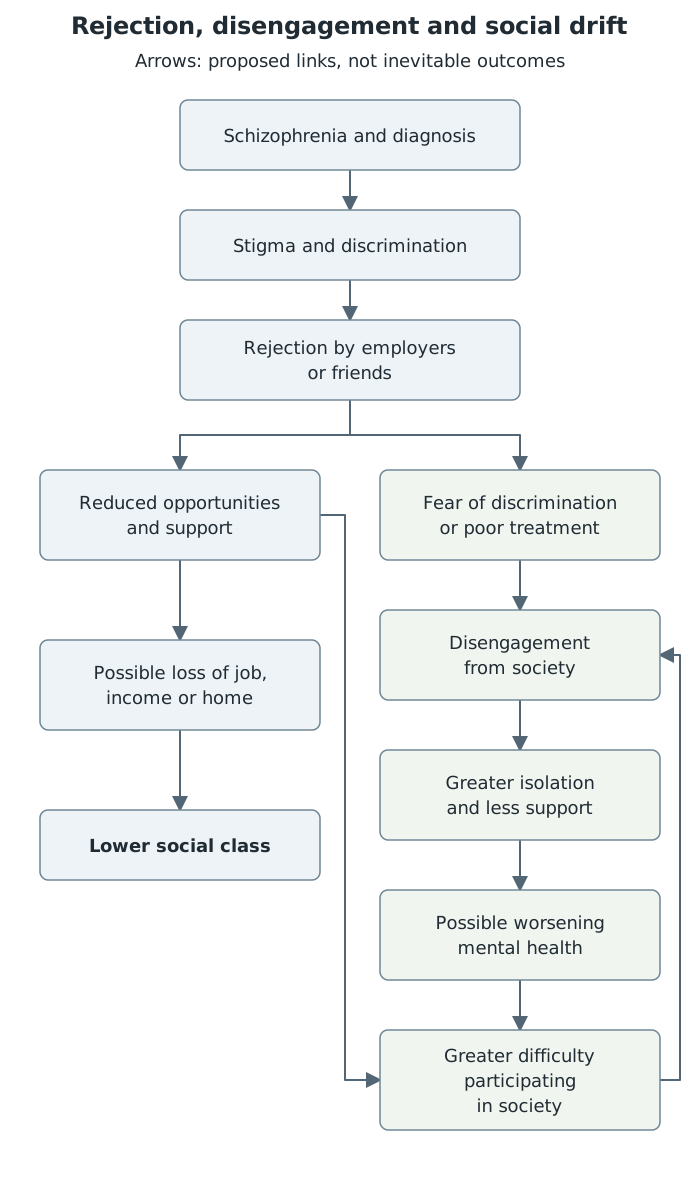
The proposed social drift process: rejection and disengagement can reinforce isolation, worsening mental health and declining social status.
The central criticism is the difficulty of establishing cause and effect. Finding a relationship between schizophrenia and lower social class does not show which came first or caused the other.
Social drift theory proposes that schizophrenia leads to a downward shift in social class. Social causation theory proposes the reverse direction: disadvantaged circumstances may contribute to the development of mental illness. Poor living environments and low or no income may therefore be contributing causes, rather than only consequences, of schizophrenia.
This also connects to the nature–nurture debate. Nature refers to biological influences; nurture refers to environmental influences. An explanation that treats an existing illness as the starting cause of downward drift can underplay how adverse environments contribute to the illness's development. Although social drift recognises social reactions after diagnosis, this does not mean it fully explains environmental influences before the illness begins.
Social drift theory draws attention to how stigma, discrimination and lost support may make life harder after diagnosis. Its value is in connecting social treatment with isolation, worsening mental health and declining social status.
However, it mainly explains what may happen after schizophrenia develops, rather than why the illness originally develops. Its proposed sequence also cannot be established simply from an association between schizophrenia and social class.
A justified conclusion is that social drift offers a useful account of possible consequences and deterioration, but is not a complete explanation of schizophrenia. Disadvantage may be both a consequence of illness and a contributing factor in its development.
Schizophrenia first → downward movement in social class.
Judgement: useful for understanding possible decline after diagnosis, but incomplete as an explanation of schizophrenia.
Distinguish rejection by society from disengagement by the individual: explain what other people do and how the person may respond.
For a cause-and-effect criticism, give both possible directions: schizophrenia may lead to lower social class, or disadvantaged circumstances may contribute to schizophrenia.
Develop a weakness rather than just naming it. Explain the problem and link it specifically to schizophrenia and downward social mobility.
Do not claim that everyone diagnosed with schizophrenia loses their job or home: these are possible outcomes proposed by the theory.
It can see this note and what your specification asks for.
Answers are free with an account.
1 free note left this week
Get more free notesYour answer sets when this note comes back for review, or marks it complete.
Was this note helpful?
Log in to tell us whether it helped, or to report a problem.
Last updated
Social drift theory
An explanation proposing that schizophrenia comes before a downward movement in social class, with societal rejection and individual withdrawal contributing to declining social status and worsening mental health.
Social class
A person's position within society, associated with factors such as occupation and income.
Stigma
Negative beliefs and judgements attached to a characteristic or label, such as a mental health diagnosis.
Discrimination
Unfair treatment of someone because of a characteristic or label, such as a mental health diagnosis.
Disengagement
Withdrawal from social relationships, activities or wider participation in society.
Social causation theory
An explanation proposing that disadvantaged social circumstances contribute to the development of mental illness, rather than simply resulting from it.
Put your knowledge into practice — try past paper questions for Psychology
Social drift theory
An explanation proposing that schizophrenia comes before a downward movement in social class, with societal rejection and individual withdrawal contributing to declining social status and worsening mental health.
Social class
A person's position within society, associated with factors such as occupation and income.
Stigma
Negative beliefs and judgements attached to a characteristic or label, such as a mental health diagnosis.
Discrimination
Unfair treatment of someone because of a characteristic or label, such as a mental health diagnosis.
Disengagement
Withdrawal from social relationships, activities or wider participation in society.
Social causation theory
An explanation proposing that disadvantaged social circumstances contribute to the development of mental illness, rather than simply resulting from it.